The Capital City - MALE'
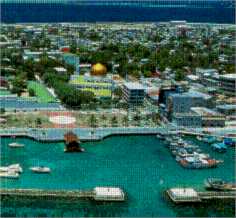
Although tiny, Male', the capital of Maldives, has been the political, economic and cultural
hub of this far-flung archipelago for centuries. Since the arrival of Islam in the twelfth
century, it has been known as the "Island of the Sultans". Set in the middle of the Male' Atoll,
Male' covers just 1.8 square kilometers (more than half a square mile). Fifty years ago it was
a sleepy village lost in the limbo of the Indian Ocean. Today Male', the capital of a nation
caught up in a race to join the rest of the world, contains the greatest wealth in the country
and is the administrative and religious centre of the islands.
Earlier this century, with its clean rectangular streets of coral sand and its one storey coral
buildings behind neat palisades, visitors were struck by its peace and charm. English woman
Lawson Robins visited the capital in 1920 one of the few white women to do so and noted that there was no Telegraph, no Ox Carts, no Motor Cars and no Carriages. It was "a land of quietness and peace". Some of the best houses have walls of whitewashed coral stones; but most are in a tiny compound surrounded by a fence of cadjan. Trees and shrubs flourish, we saw firs, oleanders, bamboos, palms and other plants. And "each street was carpeted with white coral sand soft and clean".
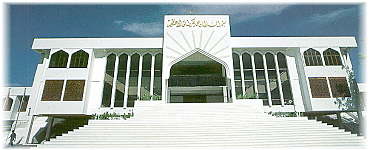
When the English traveler T. W. Hockly visited Male in 1934 he, too, recorded: "The roads are
all of white coral sand and I have never seen any place kept cleaner". There were several small
shops and a few houses where plantain, papaya and mango trees, and many shrubs were flourishing
luxuriously."The poorer inhabitants have their houses walled with mats or cadjans made from
palm leaves, about six to seven feet in height. Every little dwelling stands in its own
compound. They are roofed with cadjans or corrugated iron sheets."
When H.C.P. Bell stayed on Male' in 1921, he remarked that "with its teeming population of over
5,200 souls, it is far too overcrowded already". Yet the capital now boasts 70,000 inhabitants
nearly a third of the population and a floating population of several thousand people who come
to sell their wares and buy goods.
Return to Main Page