
Tanya's | Travels
Home > Africa
>>
Egypt page 2
|
Tanya's | Travels
|
|
Home > Africa
>>
Egypt page 2
|
Europe | Asia | Australasia
Egypt continuedCopyright © Tanya Piejus, 1998 Tuesday 10th November Opposite the Windsor is a 'funky Arab cafe' where men sit at rickety wooden tables out on the pavement and smoke hookahs, play furious backgammon and drink large quantities of mint tea to the accompaniment of tacky Egyptian pop music. It's great to have a room that looks out on such a vibrant local scene but it ceases to be quaint and interesting at 3 am when you've had a hard day at the pyramids. Street life gets going at about 5 am. Well, it never really ceases, and we were both awake by 6 am. We still managed to loll in bed until 8.15, though, and had a leisurely breakfast of tea, toast and jam. The tea and coffee is served with hot milk which makes it taste a bit odd but not entirely unpleasant. We also had scrambled egg which came in a neatly-shaped mound on a piece of miniature toast. We had to book out train tickets to Luxor so went down to reception to talk to the man about it. While we were there, he told us that he could arrange a Nile cruise, hotels and tours from here for our next few days is Aswan and Luxor. We took his proposed plan away with us, hummed and hah-ed for a while, then decided that it sounded like a good deal. It seems like a cop-out to get someone else to do all the work for us but we both fancy a Nile cruise for a couple of days and, after our stress-out yesterday beating off the grasping camel touts and hawkers, we felt that a few days with some of the pressure taken off wouldn't be a bad thing. We'll have time to do our own thing for three days at the end and won't have to worry about finding hotels or booking train tickets either. We took ourselves off to the Islamic Quarter after changing up some money for our tour. I actually got given E£1000 in a taped-up bundle. I've never had a wad of cash like that before! It was a long, hot walk along cracked pavements, across broken drains and round randomly-parked and broken down vehicles to the Islamic part of Cairo. A short way down the long road that leads down to the Citadel, Sharia Qa'laa, we were joined by a young man who said, 'Hello' and 'Welcome to Egypt' in the familiar fashion. It didn't take long to realise that he wasn't, like most of his predecessors, trying to sell us something. His name was the ubiquitous Mohammed and he's studying computing at Cairo University and working part-time in his father's bakery. we chatted away with him the length of the street and he showed me on our map where his bakery is and invited us there if we'd like to go for tea and pastries after our trampings around the mosques and museums. It was refreshing to talk to someone who just wanted to chat and practise their English, rather than drag us into their shop to do business involving large amounts of our holiday money or to simply demand baksheesh. The Islamic area is much more the 'real' Cairo. Our hotel is in the posh end of town and the area around the Citadel is typical of the average Cairene's way of life as far as we have been able to gather. Fruit and veg stalls, and others selling a whole range of bits and pieces from bath taps to rope to floor brushes, spilled all over the streets, kids meandered to and from school, and the adults bustled about their daily business of ordinary life. They took little notice of us as we weaved our way through the organised chaos looking for our chosen mosque. The street that I wanted to walk up has just been filled in as far as I can tell because it definitely isn't there anymore, despite what the map says. We were assisted by a couple of young men who pointed back the way we'd come and said to turn left at the end of the road, which was the long way round on the map. We plodded off again and eventually found Ibn Tulun mosque. Along the way, we were accosted by three young boys, one of whom asked 'What is your name? How old are you?' then said it again for good measure as it's probably the only bit of English he remembered from school. They are obviously training for a future in the tourist industry because the eldest, a ten-year-old by his own admission, then demanded 'Pen! Give me pen.' Our assorted biros, brought for precisely this purpose, then came into play. The cheeky blighters then came back claiming that the ones we'd given them didn't work and could they have more. We gave them a polite-but-firm brush-off and two elderly men shooed them away and they ran off up the street laughing ecstatically. Ibn Tulun mosque is basically an 800-year-old open square with a minaret attached. We had to put on overshoes at the gate and shuffled, penguin-like, around in them unaccompanied. It's a simple, peaceful haven from the pressing Cairenian way of life outside and the small sanctuary in the middle is a graffiti-covered oasis of calm. We were virtually alone and it was a sudden relief to be free in an open space after the constantly burgeoning crush of humanity of the last three days. We climbed up the spiral external staircase, apparently inspired by a twist of paper, of the minaret and looked out over the heaving, never-ending city. The mosque of the Citadel looked suitably noble atop the escarpment and we could even see the Great Pyramid peeping feebly through the skyscrapers and smog. I felt a far greater reverence for the power of places of worship to provide a moment's relief from the endless grind and stress of daily life in that minaret above the cluttered mess of Cairo than I've ever felt in a Christian church, even in London. Next stop was the Gayer Anderson Museum which consists of two houses directly adjoining the mosque. They were owned during the war by a British major who filled them with a collection of objets d'art gathered in the Middle East, Europe and the Orient. The dusty, beautiful Persian rooms were straight out of a romantic novel and, in fact, parts of 'The Spy Who Loved Me' were filmed there. The harem room, men-only 'celebration room', roof terrace and assorted rambling chambers were filled with delicate Chinese watercolours, gaudy Italian chandeliers, colourful Persian rugs and alabaster Nefertitis from the local mines making it the pleasingly eccentric and personal space of a gloriously individual character. After our first long walk to get there, we had no desire to walk any further, so decided to get a taxi back into town. We stood around by the main road for a bit then two male students came to help us when the taxi driver we were trying to speak to didn't grasp where we wanted to go. The men hailed us another taxi and told the driver where we wanted to go once we'd shown them on a map. It became obvious that the taxi driver actually had no idea where he was going when we started to head towards Giza over the Nile. We showed him the Rough Guide map and, after quizzing other taxi drivers while careering at 40 mph over the Tahrir Bridge, he eventually worked out where we wanted to go. He had the cheek to overcharge us when we finally got out an hour after getting in. One dose of tea and cake and a bout of 'mummy's tummy' later, we were back in the sanctity of the Windsor for a shower and a set of fresh clothes. Dinner this evening was round the corner in the El-Haty where we were on one of only four occupied tables in a large restaurant. The lack of tourists here generally is greater than we'd expected considering the time of year and that it's over a year since the last terrorism against tourists. Where is everyone? I had a very flat grilled pigeon and Scott really pushed the boat out and had chicken from a menu that included 'crilld shops' and the mysterious 'main course nank'. Salad and tahina and the usual naan-type bread accompanied. There ain't much meat on a pigeon which is just as well considering the current state of my intestines. Now having mint tea in the Windsor bar to settle my stomach and quell King Tut's gastric curse. Wednesday 11th November-Thursday 12th November Mummy's Tummy struck with a vengeance this morning. Maybe Tutankhamun doesn't like being photographed in profile. Two Imodium and some scrambled eggs later, we set off for our first experience of the Cairo Metro. We had a fast, clean, efficient ride down to Mar Girgis station, right next to which is the Coptic Museum. No-one talked to us in the tube which seemed unusual - in fact, it was a very similar experience to travelling on the underground at home except with less litter, winos and general argey-bargey. I stood next to a Muslim woman shrouded head to toe in black. She even had thick gloves on and a veil that came right over her face. I could just make out her eyes when I got a glimpse under the brow of the veil, but that was literally the only piece of flesh showing. Next to her was a young student dressed in jeans and blouse with loose hair and make-up who could have been in any city in the world. The Coptic Museum was fascinating, although we had to fend off the advances of several wannabe guides who didn't speak enough English to make it worth engaging them to take us around. The collection was housed in a beautiful, high-ceilinged, whitewashed building and the labelling of bits of church interiors, brass objects and assorted knick-knacks was, for a change, very good. We were virtually the only people in there and were able to potter from cabinet to cabinet in a way that would be impossible in the average London museum. The Coptic style is very different from that of the Islamic and Pharaonic things we've been seeing but incorporates many of their stylistic features. All three seem to have blended together at various times to form a sometimes incongruous, and at other times very harmonic, effect. The museum staff are all Coptic Christians themselves and, according to them and the staff in the Islamic Arts Museum where we went next, the Christians and Muslims mix and match happily and are very tolerant, and even supportive, of each other's beliefs. All we usually hear of Islamic devotees implies quite the opposite but, as I would have expected, are greatly in the minority. The Metro took us back to Sadat station in downtown and from there we walked to the Islamic Arts Museum. Half way there, as we were looking for a tea shop, another young man approached us and started chatting. He was meeting a lawyer friend, on his middle-of-the-day break, and they took us round the corner to a tea shop for a glass of strong black char. We talked to them about a number of things including Islamic, Christian and Bedouin weddings. Tariq, the young man, invited us to his cousin's wedding on Friday. Apparently, foreigners are often invited to weddings as they are felt to bring good luck to the couple. We'd have loved to go but are scheduled to be in Aswan on Friday. Friday's celebrations are to be the zenith of a week of serious partying and will be held in Bedouin style in Abu Sir. Shame we have to miss it. The Islamic Arts Museum is suitably impressive, containing a well-labelled range of rugs, bits of mosque, brass ewers and the like, some gorgeous ceramic tiles and a couple of enormous chandelier arrangements with condom-shaped oil holders. It mostly came from the Middle Ages and included a fair selection of objects from outside Egypt. The guides were quite entertaining both in the way they explained things, which involved a lot of prosaic miming, and in that their main job was to turn the lights on and off in the display cabinets and lamps. The guides seem to have an obsession with showing me the harem screens in their collections. Three times today I have been shown the little wooden windows behind which the 'sexy madames' hid to sing and ply their trade to the men, and made to wave to Scott on the other side. There seems to be a city-wide job creation scheme in Cairo. Why have one person to do a job when you could have six? We've noticed this blatant over-employment wherever we've been. We went to an off licence where, apart from sniggering at the appalling rip-offs of Western spirits, we were highly amused by the fact that it took four people to sell us two bottles of water - one to take the order and write it on a piece of paper, another to go out the back and get the water out of the fridge, a third to ring up the amount from the slip of paper onto the cash register and take our money, and finally a fourth to wrap and bag-up the bottles. Everyone apparently without jobs seems to sit in roadside cafes smoking, drinking tea and playing board games all day, or just watching the world go by in mellow fashion. Lacking a sensible amount of loose change to stop a taxi driver grossly overcharging us, which they seem to do at the drop of a hat, we decided to walk back to the environs of the Windsor. We've missed lunch most days through not being hungry or not being near a place to get a quick snack and have fallen into the habit of finding a pastry and a drink at about 4 p.m. This we did just along Sharia Alfi Bey where there is an excellent patisserie. We also got what is basically an exotic Slush Puppy and sat in Midan Orabi on the walls around the little garden where locals congregate to eat various take-aways and pass the time of day. We loafed around the Windsor for a couple of hours swilling mint tea and reading up about Aswan and Luxor, and looking at a book on Egypt that I bought at the Islamic Arts Museum. I was feeling the side effects of the Imodium that I felt in East Africa - headache, nausea and slight fever - so didn't' feel up to much. When we felt a bit more like going out, we went down the road for our second visit to Restaurant Alfi Bey. We had intended to go back to Felfela and try out their sit-down restaurant but didn't fancy the long hoof down there. The Head Waiter at Alfi Bey showed us the paintings on the wall and brought us a huge bowl of rice mixed with bread and meat each. We couldn't do it justice, neither of us being particularly hungry, but we did have a good chat with the Head Waiter. He comes from Nubia and was busily slagging off Cairenes and Lower Egyptians in general for being grasping and insincere. According to him, Nubians are much more easy-going than other Egyptians and less uptight from a religious and moral standpoint, and aren't always after your money. It won't be long before we get to put his opinion to the test. At 9 o'clock, the Windsor called us a taxi after booking us a room for next Friday night and their bellboy came with us to help with the baggage and to see us to the train. The man on reception had made out that we'd get leapt upon by ticket touts, tour touts and assorted general low-lifes at Ramses station but it was actually fine. What did make me smile, though, was that when we got out of the taxi and opened the boot for our luggage, the bellboy took Scott's bag, picked up mine and said 'You carry this', then strode off leaving Scott to carry his own little rucksack and me to carry everything else! There's definitely a social pecking order here that starts with grown men, then goes on to young men and, finally, women. We found our seats in first class and were impressed by the accommodation. We'd really had no idea what to expect first class to actually mean, but it was almost like business class on a plane - gusty air-conditioning, big, squishy seats with tray tables, foot rests and plenty of leg-room, video screens and a pink-blazered waiter officiously taking orders for tea and coffee throughout the night. All was fine and dandy until the video started. It was a truly atrocious romance-in-the-midst-of-adversity epic in Arabic with blurry English subtitles and boy was it LOUD. The headphone sockets in the armrests are obviously there solely to give a false sense of security. It's now 9.30 on Thursday morning and, if I had a mobile phone, I'd be saying 'I'm on the traaaaain' and, in fact, have been for nearly 12 hours with a couple more to go and I've just had possibly the worst nights' sleep in my life thus far. The Arabic tale of scandal, love and death ground to a flickering, blaring halt just after midnight. I tried to settle down for some sleep but idiotic Australians in the corridor, people nattering and smoking and tramping up and down to the loo, banging doors along the way, made sleep well nigh impossible, even with ear plugs and an eye mask. At one station stop at 4 a.m., people came on the train selling papers, soft drinks and tissues, then the armed guards stalked the corridors brandishing their Uzis and the train guard, bizarrely, decided that it was time to check everyone's ticket whether they were sleeping or not. After this, they finally turned off one row of lights and most people settled down to sleep. I got about two hours kip, woke up and removed my eye mask (thank you, Swiss Air!) to bright sunshine and palm trees streaming past the window. We're now rumbling between Luxor and Aswan through barren desert, Bedouins on camels and donkeys, square stucco houses and gardens of date palms, bananas and sugar cane. Occasionally we brush the banks of the Nile languidly rolling towards Lake Nasser to our right. It's as different from Cairo here as the Scottish Highlands are from London. All the clichés about time having stopped in this part of the country actually appear to be true, but I suppose that's why they're clichés. At first glance, life out there seems as timeless as the desert itself. Later on Thursday
The train got into Aswan at 11.15, not far off schedule as far as we could tell. This journey seems to take an indeterminate amount of time somewhere between 14 and 18 hours, so we were on the lucky side. Our man, Esmat, from Amigo Tours was there at the station, as promised, and a small group of others who were in our carriage joined us for the hotel drop-offs. We had one night booked in a clean, municipal-looking hotel with faux hieroglyphs carved into the plaster called the Ramses. Our post-Revolution room has noisy air-con, fridge, view of the Tombs of the Nobles across the Nile and comfy, chunky beds. Despite having just stepped off the train, we had to go on a tour at 1.30, so we just had time for a much-needed shower and change of clothes before meeting the rest of our little group to go to Philae. The temple is really lovely and quite well preserved. It was rescued from a nearby island which was inundated when the High Dam was built. Its new island location is probably better than its original one, being in the main body of the Nile and commanding an impressive view as it does. The temple is dedicated to Isis and Osiris and our guide told us their fantastical story of filial jealousy, love and magic before giving us 20 minutes of free time to wander and take photos. Our question about where all the tourists are has been answered - they're here! After Philae, we were driven up to the High Dam and paid our E£5 to stand on the top and admire Nasser's contribution to Egyptian history and global kudos. It's big, but not as big as I'd expected. Like the Sphinx, its reputation is better than its actuality. Still, the view up Lake Nasser was handsome in the fading light and the ancient temple at Kalabsha skulked just above the waters of mighty progress that might have drowned it. Twenty other temples weren't so lucky. In the evening, we strolled along the Corniche with the intention of having a pre-dinner drinkie at the Old Cataract Hotel where Agatha Christie wrote some of 'Death on the Nile'. We got there without too much fending off of caleche and taxi drivers only to find that the hotel was only open to residents unless you forked out E£25 up front to sit on the terrace. Being somewhat disgusted by the outrageous, and unusual, snobbery, we declined and headed back into town. We found the Aswan Panorama which claimed to serve 'the best food money can buy'. This sounded like an offer we couldn't refuse and I effectively had fish and chips, but the fish was fresh out of the Nile and fried in a lovely, herby Aswanese coating. For a change, the restaurant was actually understaffed and the service was pretty slow. We'd specifically gone there for rice pudding, it being an Egyptian speciality, but the rice pudding was off and we were thwarted in our search for comfort food. Instead, we both had a herbal tea. As we had diametrically opposed bowel problems, I ordered anti-diarrhoeal tea and Scott laxative tea which caused a raised eyebrow. The herbs seemed to have worked for me at least as my mummy's tummy attack has finally been quashed. On the way back to the hotel we stopped to buy some bottled water and got talking to a young spice-trader called Ahmed. He had us sniffing samples from his various bowls and guessing what they were. He was selling hibiscus tea amongst his wares and, on finding out that we'd never tried it, took us to the nearby cafe and bought us each a glass. It was very tasty, more like hot fruit juice than tea, and we decided to buy a bag each. I also bought some Nubian saffron for Mum and Graham as it's a snip here compared with buying it at home. The spice stalls are extremely attractive as they pile everything into little conical mountains and it all has such beautiful colours and smells. They also have indigo which they use as a bluing agent in washing and it makes a startling contrast to the russets, browns, greens and ochres of the spices. Friday 13th November A potentially worrisome day for the superstitious, particularly in a land of Pharaonic curses, but a very pleasant and stress-free one for us. We had our best night's sleep so far and woke up refreshed and raring to go on a felucca trip to Elephantine and Kitchener's Islands. Our wooden felucca, 'Zimzam', was captained by a wizened Nubian in blue robes and white turban-type arrangement, apparently called 'Captian Blackfox', who plied the Nile with the assurance that probably comes from honing his skills since boyhood. It's a wonderfully relaxing way to travel with a gentle breeze pushing you along just on top of the water to the soft creaking of the boom and quiet slap of rope against mast and wave against prow. We'd set off a bit late so were only able to spend ten minutes on Elephantine Island in the Aswan Museum. It was only small but we still had to rush round. They had a particularly gruesome, shrunken and mummified head on show amongst the scarabs, pots and other dug-up artefacts. Another gentle float took us on to Lord Kitchener's island, otherwise known to the locals as the Island of Plants, where he set up an impressive botanical garden. It's a bit like the Palm House at Kew without the house. Again, we only had a short time there but that was no bad thing in some ways as it was full of traders selling necklaces, hats and other tack, as well as families enjoying their Friday sabbath. I'd like to have had a better look at some of the luscious plants on show, though. Another little scam the youngsters have developed is taking your photo then saying they'll send it to you for an outrageous amount of money. They all have compact cameras, probably without film in them, and roam around the public areas in their best clothes apparently taking photos of each other and keeping one eye open for tourists. We nearly got sucked into this one after a child of no more than three grabbed my hand and wailed 'Baksheesh' at me. He was then deftly hauled aloft by one of a group of well-dressed young lads, the others of whom swarmed around us and made to take our photo. They certainly start 'em young! After landing back at base, we were taken to collect our luggage then onto the boat. It's one of the many moored-up at Aswan. It's pretty plush and really is five star. Our cabin is number 123 and is just above the waterline. Debra and Isaac, mother and son from Ohio who we've been chatting to, are in the cabin opposite ours. We had a Western-style lunch, pottered around the boat and sat in the sun, unmolested, for most of the afternoon. We had dinner on the boat too, after walking the Corniche and drinking a big bottle of Egyptian 'Stella' beer, then crashed out for a good night's rest at about 10. Saturday 14th November We woke up at 5 am when the boat's engines started grinding and it chugged out of Aswan to start its way up the Nile to Kom Ombo. We were due to dock there at 8 so were called, literally, to breakfast at 7. Having woken up before the sun came up, we dressed in warm clothes and went up to the top deck to wait for the sun to creep above the horizon. As we waited, one of the crew joined us and, although he spoke only a few words of English and us even less Arabic, we still managed to have a fairly intelligible conversation with him involving a lot of miming. He was 25 and not married but wanted to get a house and car of his own before he could afford to take a wife. When the sun finally popped up, fat and yellow, over the east bank, he insisted on taking photos of us against the sunrise - me with him against the sunrise, Scott with him against the sunrise, me and Scott against the sunrise... He also invited us to have tea with the captain at 10; at least we were pretty sure that's what all the gesturing and random Arabic words translated as. Our Amigo guide from Aswan, Methad, had accompanied us on the boat and was ready to meet us at 8 to go to the temple at Kom Ombo. The temple is right by the water and has some very well preserved paintings. It's a grand Graeco-Roman construction in the same vein as Philae and has some excellent carvings. It also has some natty mummified crocodiles in the little temple dedicated to Sobek, the crocodile god. We pottered around on our own for a while after Methad had done his stuff, then got back on the boat for a 9.30 sailing to Edfu. In between our temple visits, we had lunch and lazed around on the sundeck and dangled our feet in the pool, but it was so windy that towels, clothes, books and cups of tea kept threatening to fly away into the Nile. We stuck it out as it's the only sun we're likely to be able to really enjoy for a few months at least after we get home. Debra and Isaac gave in to the wind and took shelter below. Edfu was quite an alarming experience in more ways than one. On arriving, the caleche drivers fought over us. We got on and off one carriage before being ushered into another and finally taken by the fastest caleche driver in Egypt to the temple. We got there before people who had left before us and taken the short cut! Once out of the caleches, we were instantly surrounded by vulture-like traders shouting 'Everything five pound! Five pound only. You want djellabah? Only five pound.' As if! It was like Dante's version of Poundland in Croydon. I'm sure Ramses II was hiding round the corner, sniggering into his loin-cloth. We made it through without succumbing to the pressures of crass commercialiam. The temple was fronted by a dustbowl of a courtyard where fetid rubbish and other domestic detritus mingled with the swirling, aching dust. At one point, a blasting gust of wind suddenly blew a storm of sand into our faces and we entered, watery-eyed, into the temple, coughing and desperate for water. The temple itself was uncovered in the mid-1880s by an archaeologist who cleared out all the sand, demystified the tombs and claimed himself a substantial chunk of someone else's history. Soon after, the local Muslims said, 'Damn the past', trashed the temple by obliterating the faces of the carvings, blackening the five thousand-year-old ceiling paintings with their cooking fires, and driving bolts into the walls to support their shelters. It creates and oddly desolate feel. The encroaching mud and brick houses that have already engulfed part of the temple precinct are only a whisper away from crowding out this ancient relic and the enshrouding sands seem no longer to be able alone to protect it from the insidious thrust of modern Egypt. While I was wandering about taking photos, I heard Isaac shouting my name and it transpired that he'd found a hole full of rats in an off-limits passage leading from one of the side chambers. This I had to see! We paid a pound in baksheesh to one of the 'guides', whose particular little scheme this was, and climbed into the hole after waiting for a tour party with a long-winded guide to leave. But, although we could hear what sounded like squealing babies, the rats had hidden and wouldn't oblige us, so I still have yet to see a wild rat; a live one, anyway. At least now I've heard one which is a step closer, I suppose. On the way back out, we were besieged more than ever. One of the men even grabbed us by the arms and literally tried to drag us into his shop, which is a first. They must be especially desperate for trade. I suppose the tour parties go there less often than to the better-known sites like the Valley of the Kings so any tourists they do get are even more precious in terms of their spending potential. It was a big relief to get back into the quiet kindergarten atmosphere of the boat. We chugged off again for the final stage to Luxor at 3.30, although some twits missed the boat and we wasted 45 minutes going back for them. We killed the few hours till dinner drinking beer on the sundeck, chatting to Debra and Isaac and playing demonic backgammon with the guides in the bar. We had a 'farewell dinner' in the restaurant at 8 with our little group of Amigos - our new American chums Debra and Isaac; Fred and Dorothy, a retired couple from Illinois spending their twilight years seeing the world; and Guy, a sardonic Frenchman who is, of course, very rude about the English and dunks absolutely everything in his morning coffee. Dinner caused a sense of deja vu as it bore a strange resemblance to the meal we had last night, but the bland European concoction was palatable enough. Pudding consisted of a lurid cake but, before we were able to eat it, they brought it out to the accompaniment of singing, banging drums and tambourines. Everyone was dragged away from the tables and made to conga around the restaurant. Everyone that was except the seven of us who resolutely refused to budge from our seats and be made a fool of, while the tour party lemmings cavorted around us bellowing a vague approximation of the words to Nubian songs that they didn't have a hope of understanding. We saw a crowd of them again later dressed up in mock-Arab harem gear, grinding away under the spinning party lights of the disco, swilling beer and falling over. We took to the roof with Isaac to have a look at the night sky instead. Jupiter and Venus were twinkling cheerily over the Nile and we picked out Orion and Cassiopaeia bright against the clear black that you never see in London. The Plough, though, we couldn't find and came to the conclusion that it must be below the horizon in this part of the world. A shooting star to the south-west (yes, really!) completed the sort of cheesily romantic picture that I'd wanted to take home of Egypt. Sunday 15th NovemberWe docked in Luxor about 11.30 last night so had a peaceful night without the droning of engines. Our wake-up call came at 6.35 once we'd lingered in bed for an extra five minutes after the alarm went off. I'm sure they're watching us from behind the mirror. We were packed and ready to leave the boat at 7.30 but, after a bit of group faffing, didn't get going till 8. We were supposed to go to our new hotel first but the delay meant that we headed straight for the West Bank for our tour of the Valley of the Kings and its environs. On the way, we saw a sign for 'King Dude Pub and Tomb' which caused some hilarity. Our first stop was Ramses III's tomb in the Valley of the Kings which had some beautifully preserved and conserved tomb paintings in its little chambers and burial room. The tombs are completely adorned with scenes of gods, the person's life and hieroglyphs, with stars on the ceiling and vultures over the doors. Some of them look like they were painted yesterday. I don't know how much conservation has gone into the pictures but the overall effect is pretty impressive. Our next stop was Tuthmosis's tomb which we had to climb up a steep metal staircase to reach as it was tucked away deep into a cleft in the rock to keep away the tomb-robbers. There was also a steep drop bridged by a walkway, presumably also to act as a deterrent to gold-hungry bounty-hunters. This also has some impressive paintings but they were much simpler, in fact naive, in their style with stick-like representations of people, animals and gods. They guide didn't actually explain why this king had such basic tomb paintings - perhaps no-one knows? Last stop in the Valley of the Kings was Ramses VI's tomb, the biggest and best in the Valley. It was difficult getting in and around the tomb because we were squeezed by huge French, Italian and Japanese tour parties who insisted on choking up the walkways. All the tomb paintings were really well preserved and the burial chamber itself, with its gargantuan granite sarcophagus, was really a sight to behold. Every surface was festooned with scenes from The Book of the Dead, the king's life and journey into the afterlife, all in glowing yellows, reds, blues and blacks. Gold stars covered the ceiling and two giant pictures of noble Ramses stood guardian over the entrance. It was well worth the jostling to see it. On the way to our next location, we were told that we'd visit an alabaster factory for a demonstration of carving and refining the material, and cheap sodas. None of our party of seven was desperately taken with this idea which was obviously a cheap way to get us to part with our cash in a you-scratch-my-back, I'll-scratch-yours type arrangement, so we vetoed the visit and said we wanted to go on to the Valley of the Queens straight away. The guide accepted our choice and we went into the tomb of a son of Ramses III's who died in infancy. A glass case houses his tiny, foetal skeleton. The sarcophagus rests in a prettily-decorated sanctuary with pictures that glorify his father. Presumably the boy's life was too short to be able to show anything about himself. On the way down from the Valley of the Queens, we stopped at the alabaster factory anyway. I think we were all too hot and tired by then to put up much of a fight and mooched in to have a look at the stuff. I took a fancy to an Anubis in white alabaster and beat the man down from E£65 to E£35. He upset Isaac by haranguing Debra to buy a bowl at an outrageous price and both ended up getting pretty frazzled. It seems like we all lose the will to be polite anymore and go beyond the point of cracking. The culture here is so different and the constant in-your-face tactics get extremely wearisome when they just refuse to leave you alone until you've handed over some money. No-one was very impressed by this manoeuvre on behalf of Amigo who, up till then, had taken good care of us and largely shielded us from too much hassle. At Deir El-Bahari we had a tour round Queen Hatshepsut's temple. There were more well preserved painted reliefs and some large statues of the Queen dressed as a man, and the gods. It's the only temple that's terraced and it stands at the end of a long path giving it a brooding, overwhelming presence in the rocky limestone landscape. Scott and I bought two knitted cotton Nubian caps for E£22 outside the temple and the smarmy bloke who sold them to us lured us into his shop, kissed my hand and made insincere platitudes to keep his price up. We'd agreed not to pay more than E£15 for two hats if we could but caved in at E£22 because we had to get back to the bus. That was the end of the tour but there's still plenty more in the Theban Necropolis to come back and see. Amigo took us to our hotel, the Windsor. We thought we'd keep the Windsor theme going and its pool was a big incentive as we're going to have plenty of time to chill out, being here for four days. While we were checking in, the Amigo man, Ahmed, told us that they had a tour going to Karnak Sound and Light Show that evening. We, along with Debra and Isaac, decided to go, as had Nick and Lorraine from our tour group this morning. As a group of six we would get the show and transport for E£55 instead of the usual £E66 which wouldn't normally include transport. It sounded like a good deal. We asked about our train tickets back to Cairo which Amigo were supposed to be booking for us. They said that first class was full and we could only have second class tickets with a E£10 refund. We thought this bizarre as first class had been half full at best of tourists on the way down and we knew damn well that the difference in fares was E£20 not 10, but didn't let on at this time that we knew. We laboured the point and they said they'd check up on first class again. Ahmed was also flogging hand-made cartouches at a good price but I didn't order anything as I want to get the train tickets sorted before I commit any more money to him. As it was Debra's birthday, she and Isaac invited us to dine with them. We decided to meet at 3 and go for an early dinner / late lunch at the King's Head Pub. This was billed as a real English pub selling proper beer and even roast beef and Yorkshire pud. We were intrigued by this concept and were actually pleasantly surprised when it turned out to be pretty authentic, down even to the Guinness towels and photos of Bob Marley all over the walls. It was a damn sight nicer than most pubs in London, in fact. We had a good meal of slightly Egyptianised pub grub and I couldn't resist taking a photo of the titular king himself who was a bizarre cross between Henry VIII and Tutankhamun. We decided to walk back, having taken a taxi there driven by a chatty local called Birbiri (pronounced Burberry), and on the way stopped in various shops and bazaars. There's a fixed price shop selling just about everything in the souvenir line and also lots of books, including 'Death on the Nile' and the 'Ramses' series. I bought a particularly attractive snow globe with a camel scene and glitter sand instead of snow, and Scott got a wooden box decorated with Mother of Pearl. We also stopped at the shop owned by possibly the campest man in Egypt who was far more interested in luring Isaac into his lair than Debra. It was a wonderfully funny and relaxing walk back to the hotel and we just had time to freshen up and put some warmer clothes on before going to the Sound and Light Show. The show started with a walk through the temple to the accompaniment of eerie music and voice-overs about the various kings and gods, and changing coloured lights. We went through in several stages and were told in clear English about its history. The same theme continued when we sat in the stadium behind the Sacred Lake and looked down on the temple complex. It had a long history of building and wrecking by several rulers, each trying to outdo and defame the others. Queen Hot Chicken Soup's obelisks were a particularly striking feature and the hypostyle hall contains an unsurpassed 136 columns, all fully inscribed. It's certainly the most impressive of the temples we've seen so far. It has a stately, well-cared-for grandeur that has to make it one of Egypt's crown jewels. |
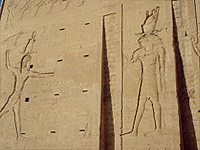
The temple at Edfu Amazon.co.uk picks:
|
