
Tanya's | Travels
Home > Africa
>> Mozambique >>> page 2
|
Tanya's | Travels
|
|
Home > Africa
>> Mozambique >>> page 2
|
Europe | Asia | Australasia
Mozambique continuedCopyright © Tanya Piejus, 2003 Tuesday 22nd October I’m now sitting cross-legged on the centre box of the Bluefin making our way on a low swell to Ilha Quirimbas. Alongside us is the Orion which, for various logistical reasons, has now become the dive boat. Hanging off its handrails are the wetsuits seeming like Professor Van Hagens’ plastinated skins at Bodyworlds. Jo and sophie are on board tying coloured rope and attaching cable ties to the Bluefin’s anchor rope. This will become our 100m transect rope, although it is a little short, as we’ve now decided that the tape measures are more hassle than they’re worth. Six of us went out on the Orion yesterday to do the first 12m transect. Jo and Julie descended first to lay the tape measure and supposedly do the fish survey but the tape-laying proved to be such a mission that they had to give up on the fish survey. Tooni is insisting that we use surface marker buoys at all times which makes the poor bugger towing it have a much harder time, especially when there’s a current running. I dived second with Shawn who had a complete nightmare with our SMB. The reel got stuck at about 6m then when we replaced it with another one, he let go of it before it inflated. To add to our problems, my first borrowed mask was leaking and I had to replace it. So on our fourth attempt we finally got down to look for fish, although we had been prepared to look for invertebrates. We saw very few of our indicator species. The reef off Quisiva seems quite young probably as a result of cyclone damage a couple of years ago. After lunch and a surface interval, Jo and Julie went down again to do the invertebrates, closely followed by Mary and Nadine to record the substrate every 50cm. Shawn and I were left on the Orion as dive supervisors. The rest of the group had the morning off to explore the island and went to the ruined Portuguese fort. They found the local fish businessman who had examples of just about every reef species in his warehouse of 200 dried specimens for sale. He takes them to Pemba to sell. (Morne just yelled ‘Dolphins!’ but they don’t seem to want to come and play.) They also found a turtle graveyard with seven huge loggerhead shells in it. It’s all interesting additional information for our survey and was added to the Quisiva spreadsheet on Tooni’s laptop. One thing that depressed all of us on the dive boat was the Orion crew’s indifferent attitude to the marine environment. Julie has explained to the four Mozambiquans what we’re trying to achieve but when it came to retrieving the carefully-laid survey rope, they just dragged it and its attached anchor the whole 100m across the delicate reef we’d just surveyed, despite Julie begging them not to. Yesterday was one of teething troubles and hopefully that’s all they’ll be. The kayakers were out looking for dugongs and turtle nesting sites but didn’t find any of either. They seem to have enjoyed their day though. They brought back crayfish which they’d got from the village which ended up in a curry and the chief was true to his word by sending a man down with fresh coconuts for us. He hacked them open with the camp panga [machete] and the milk was like nectar. Tooni and I rang the SES in England but there’s still no news of my backpack. I’m getting a bit down about it now as I would so love to have my own kit, especially for the two weeks after the expedition. (The dolphins just reappeared but still don’t want to bow-ride.) The usual crowd of watchful locals was there from first light to observe us striking camp. I’m feeling a little like a spare part at the moment as I’m supposed to be swapping into a kayak later, although we’re having to take a different route in the big boats to avoid sandbanks and mud flats that threaten to trap us between Quirimbas and the mainland. I seem to be spending a lot of time sitting on my arse on boats but I expect my time will come. Friday 25th October My time did come, and in spades. We can’t seem to get through a day here without it turning into a mission. On Tuesday, Julie and I walked across the mudflats off Quirimbas Island to the home of the Gessners. They own Orion and it was their plane that passed by us so low on Saturday. They were expecting us at Quirimbas that day. Somehow the message didn’t get through that we were stopping off at Quisiva - no surprise there. When we rocked up at the Gessners’ holiday lodge, they were there with four huge dogs - two German shepherd/Rottweiler crosses and two ‘Boer bulls’ which are bulldog/mastiff crosses. All were big and brutal-looking. The Gessners are classic old-school colonials. Jochan was sent to boarding school in Germany by a father who set up the farm there in the 20s. He took over the farm in 1960. His wife is Mozambique-born, though a German national. Both are inherently racist, white settler types with German satellite TV, a bevy of black workers and an extremely small-minded attitude. It took them an hour to even offer us cold drinks. They were quite hospitable after that though and I spent a couple of hours in their self-built bungalow making polite conversation while Julie liaised with the Bluefin and Orion crews. Eventually, they all came over and we decided to set up camp in their front garden area where we had access to showers and toilets in the guest lodge. We loafed around in the garden until the kayakers arrived looking extremely hot and knackered having twice been stranded by the tides. During the night, Laurie got up to go to the loo but rapidly reappeared in the tent with one of the black dogs on her tail. The following night, one of them bit Mary on the back of the thigh. She has puncture marks and a huge bruise to show for it. Fortunately, all the Gessners’ dogs have had jabs for rabies and other nasties. Despite the showers and the possibility of cold beer, we were all pretty keen to get out of there as soon as we could. We were hampered somewhat by the tides and had to stay three nights in order to resupply the boats and do our dive surveys. [Insert: my expedition diary entry for Wednesday 23rd October. We each took it in turns to record the day’s events and the task fell to me this time. Nicky had written up the previous day and suggested in her entry that we address the diary to our missing doctor, John, so here’s what I wrote...] Dear John, Well, just look what you are missing. You’ll have got the idea by now that Mozambique is pretty special and today ‘s experiences were no exception. The just-past-full Moon has risen behind the palm trees that fringe a warm ocean. Nadine, Sandra and the boys are whipping up what I’m sure will be another fine meal with the aid of a large proportion of the team. Shawn, Ali and Mary and bent over the plasma glow of the SES laptop inputting the day’s data into spreadsheets. I’ve parked my bum on the roots of an Indian almond, stopping the pages blowing up in the cooling sea breeze... Blah, blah, blah. Enough of the superlatives - down to the day’s business. We again split into two teams for the day. I was part of the dive team who set off at 6.30 this morning, wading our way towards Orion in a rapidly receding tide. We chugged towards the private island retreat where the kayakers were refused Cokes yesterday. Morne and Tooni hopped out to talk to a man there who knew where the good reefs are. The plan was to arrive for slack water to avoid the pumping currents that screwed up our transects last time. Sophie and Jo spent the boat journey yesterday attaching various coloured bits of string and cable ties to the Orion’s rope so that we could dispanse with the bothersome tape measures. Morne laid the transect by suspending it above the reef from buoys to avoid damaging the delicate corals. All was well for Ali and Mary’s fish ID but the returning tidewaters started to shift things about by the time Shawn and Nadine had completed their invertebrate survey. Julie and I went down to do the substrate work and were pushed along perpendicular to the rope which was catching on the corals again. On my way up to the surface, my filled-in slate broke off its attaching cord and my data ran away with the tide. It seems the popular phrase ‘teething problems’ is still very much in fashion. It’s all Tooni’s fault for saying that she had a gut feeling that everything today would be as sweet as a nut! The second transect went a little better after we’d parked up nearer the island, waiting for high water. Morne laid the line on the surface and we jumped in in quick succession to do our surveys. The returning buddy pairs were treated to the bizarre sight of Julie and me riding along in tandem, me above her holding on to her tank valve to guide her along the line while she used a 50cm bit of wire to guestimate the substrate markers. So not all was rosy on the work front but the day had its compensations. We spotted a pod of nine bottlenose dolphins on the way out to the first survey site. One came close to the boat and I hoped it would join us for a spot of bow-riding but it didn’t want to play. Soon after, a cry of ‘Whale!’ went up as we spotted the fins, spout and disappearing tails of two humpbacks, probably mother and calf. That was definitely one to make the rest of the team jealous, but even more galling for them was our return visit by the pod of bottlenoses we had seen in the morning. They came past of a feeding mission, corralling a school of fish which leapt in a frenzy from the water. Banging on the side of the boat attracted their attention and the whole pod was soon within swimming distance of the boat, although they apparently do not like white people! More, Mary, Ali and Shawn jumped in kitted up in masks, snorkel and fins while the rest of us gesticulated excitedly from Orion, yelling ‘They’re over there !’ Ali was treated to the best experience of his trip by having a mother and calf swimming past him 3m away. It doesn’t get much better than that! As we trundled homewards, the setting sun flushed the clouds in bleached purple and wispy red. Silhouetted against the horizon were the triangular shapes of the fishing dhows. We moored outside the lodge but still had a way to go to the shore. Eight of us, plus Gizmo and tonight’s dinner, piled into the tender and made our way gingerly to the shore. As we slowly poled back, lightning flashed in the distant sky and the velvet black sky began to twinkle with myriads of brilliant stars. We waded in when the overloaded tender ran aground on the sand. The kayakers told us about their day. They’d toured the Gessners’ coconut grove and learned all bout the processing from the plantation foreman, then took a trip to the village to search for a Mr Bakari. Instead they found the fetchingly-named 79 to guide us to Ibo tomorrow. Ah, tomorrow… maybe I’ll have some clean pants by then (Mr Gessner has been to Pemba airport to check on my still-errant backpack), maybe we will find the mysterious dugongs, maybe we’ll discover more local colour and dried fish remains on Ibo, maybe Tooni will stop having gut feelings. Well, John - wherever you are - I hope you’re enjoyed our experiences so far. It’s hard to believe we’ve been here less than a week. The journey north promises so much more. Like said, this is a special place. Lots of love, Yesterday turned into the biggest mission so far for seven of us. I was looking forward to my first real kayaking trip here and was part of the group paddling to Ibo Island which we were interested in from a cultural perspective. It was largely abandoned after the slave trade on which it thrived died out. Pemba took over as the main trading centre and the grandiose Portuguese townships went to ruin. We ambled about through the remains of administrative buildings and forts which are now home to silver workers and schools. We picked up a group of child followers who played peekaboo with us and called ‘Bom dia!’ in high voices. A local man sold us six fresh papaya and a clay-faced lady offered Sophie her chubby three-month-old baby to hold. It seemed like good manners for her to make a fuss of it for a while. Ibo is a beguiling place - a monument to grander schemes that’s now gone native. There are pavements but no roads, the only traffic being the occasional motorbike or bicycle. There are remnants of street lights, curly-balconied administrators’ houses and oddly well-maintained gardens with a long-redundant flagpole. It’s a fascinating slice of history. When we’d explored, lunched and the rest of the gang had returned from an attempt at snorkelling (there was no water), we climbed back into the kayaks and headed for the mangroves again. A man with the fetching name of 79 was recruited yesterday from the village to guide us through the mangrove maze to Ibo which he successfully did. Going back to Quirimbas was a different story. We tried the middle of three channels which we were pretty sure wasn’t right but 79 insisted it was. He soon changed his mind and we backtracked. We tried the third channel, which is the one we all thought it was. Again, he changed his mind when we were half a kilometre or so in. Julie was translating his stream of Portuguese and it became increasingly obvious that he didn’t have a clue how to get home. Rather than risk a third wasted attempt at finding a channel we took the decision to forego the shortcut and take the long route home by going round the edge of the dense mangrove patch. Light was starting to become a concern. We’d wasted an hour faffing about in the mangrove channels and only had around an hour of daylight left. It’d taken two hours to get to Ibo and the long route would more than double the distance we’d need to paddle. We set off at speed, plunging our blades in against the waves and wind. When we rounded the point the water was calmer and we laughed and joked for a while as the waves carried us forward and storks wheeled over our heads. We cruised along the mangrove edge until we reached one corner, then another. The sun set and we started to get a bit worried. We seemed no closer to Quirimbas. Eventually the dark set in and 79 had no clue where we were. We consulted the chart, put torches on our boats and planned to stay close together. Not only had we lost the sun with the moon not due up for another hour, but the tide was turning and we’d be beached if we didn’t find our way soon. We were on the verge of deciding to head for Quilaluia and finding a beach to make a fire on when we spotted a pair of lights on the horizon. We’d heard a sound that seemed like a boat or generator but it was coming from the wrong direction according to where we thought we were, so we were obviously well lost. However, Morne was sure that the distant glow was Quirimbas harbour so we put the steam on and pelted towards it. We all found the strength to motor several kilometres to the point of Quirmibas and gave whoops of delight when we spotted the Orion - one of the lights had been hers. We ditched 79 at the village before Morne got to the point of drowning him. He’d stopped at one point when speed was crucial to say he wanted a pee. Morne was livid and made him suffer. We were all pleased to see the back of him. We considered climbing out at the harbour and walking back but Morne was convinced that we could still make camp before we ran out of water. Again we stomped o the accelerator and pulled out whatever hidden reserves of strength the human body digs into when it comes to the crunch. After a false alarm, we finally picked out the two sets of lights on the Gessners’ property and a bright bluish-white spot light behind which was Ed. Ali and I headed for shore but scraped to a halt about half a kilometre out from the beach. As we started to drag in the kayak, moving lights appeared on the beach and soon Edward came out of the darkness, dazzling us with the spotlight. He’d been sitting on the beach with it for nearly two hours. Other points of light made their way to the other boats and reassuring voices called out. I asked Nadine when they’d started to worry about us. She said at six, an hour after we were due in and half an hour after night fell. We got in at 7.45. We’d had a radio but the battery wasn’t charged. Although we had a chart, we had no compass and none of us could read the insanely beautiful but baffling skyful of stars. It was lucky that we had five torches between us so at least we could stay in visual touch. 79 had been engaged to guide kayakers to Ibo today but his services were no longer required. Instead we rose again at 3.30 a.m. to pack and load Orion. I rode out on the tender with s swaying pile of baggage and fought with the swell to to pass it onto the boat. The kayaks were loaded onto the roof ready to drop those who wanted to paddle from Ibo. I was more than happy to prostrate myself on the roof of Orion with Mary and an ailing Laurie for the ride to Matemo. The kayakers included Julie, Ali and Nicky - three of the team that did last night’s marathon. I thought they were crazy, especially as they set of into waves, a counter current and a head wind. I snoozed for part of the way to the Bounty bar island of Matemo. We unloaded the boat onto a lush white sand beach lapped by turquoise water and set up camp under casuarinas and coconut palms. The paradise illusion was somewhat shattered by fire coral which stung my shin when I went for a swim, but this is the kind of stunning tropical island that I’d heard we’d be finding up here. Shame it’s being turned into an exclusive honeymoon hideaway by a bunch of South Africans working for an Arab sheikh. I joined the dive group for an afternoon recce on the reefs. The problem was that there ain’t a reef here no more. We drifted across sand, sand and more sand. It was peppered with spiny black sea urchins, enormous starfish, the occasional hermit crab and the biggest nudibranch any of us had seen. There was also an outrageously striped zebra shrimp and a hermit crab carrying an anemone in its pincers - most odd. It was an interesting dive in a featureless sort of way, but didn’t yield anything we can survey tomorrow. Back at camp, the kayakers had spent the afternoon relaxing and flying Jo’s kite on the beach. I don’t know how long we’re here but we were planning mutiny on the Orion it’s so idyllic. Saturday 26th October After the various dramas of the last few days, today was restful and uneventful except in a good way. Laurie, Nicky and I stayed in camp while the rest of the team went out on Orion to find some reef to survey. We whiled away the morning and early afternoon reading, chatting and generally having a weekend. Pierre got Bluefin ready for 3.30 and we went onto the beach where Ed and Joe had already taken the kayaks. We dollied out to Bluefin and put the boats on board. It was a short, pleasant ride over to the neighbouring island, Rolas, where we head heard reports of dugongs only a week ago. We dropped the kayaks in the water and poodled around the island near the shore, scanning the water for Sirens. Sadly, the cute-but-uglies weren’t there. There weren’t any beaches either apart from one that was regularly used by fisherman so we had no need to stop to look for turtle nests. We did see an African fish eagle perching royally on a wind-thrashed tree. The edges of the island had been bitten into by the waves and gnawed into weird curves and caves. It only took about half and hour to circumnavigate it and it was too late to paddle back to Matemo before sunset. On the way back, Pierre set a fishing line with lure off the back of the boat and within a couple of minutes he’d caught a lively barracuda which thrashed and snapped as Ed and Pierre hauled it onto the boat. We had barracuda for dinner last night, but that one came out of the fridge. Nicky named our catch Bert. My thumb that I strained playing softball has swollen up and the muscle that goes up into my forearm has been quite badly strained by the huge night kayak. It feels squishy and full og fluid. Even though this evening’s was a short kayak, it’s swollen up again. I hope it doesn’t become a problem as kayaking seems to be more strength than diving. I feel rather inadequate next to the others who have a lot more confidence and experience than I do. Still, the more practice I have, the better I’ll get. |
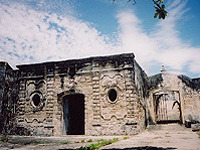
Old Portuguese fort on Ibo Island Amazon.co.uk picks:
|
