Driving to Tholing
May 23, 1998
Today we are driving to the ancient capitol of the Guge empire, which flourished in the 10th and 11th centuries. While we are having breakfast at camp, we see the two cyclists whom we had passed enroute to Darchen several days earlier (May 17th). They have a difficult time fording the rushing stream, and are obliged to wade through the icy water barefoot. Once across, we are happy to provide them with some hot coffee while they thaw out their feet. We learn an interesting story:
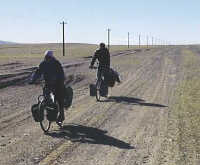
The two are a young couple who have been cycling across Asia for over a year. Starting in New Zealand, they had traversed most of Southeast Asia including Burma (Myanmar), and then China. They had cycled through Lhasa, and thus had covered most of the Tibetan plateau. Their plan was to continue on through Pakistan, Iran, Turkey, and thence to Europe.
Their names are Daniel Aufdermaur (Swiss) and Victoria Spurgeon (English). I took their names and addresses of next-of-kin in order to report on their progress. Subsequently I was able to email Daniel's brother and telephone Victoria's mother. Neither had had contact for several months. In any case, both cyclists have been mailing their journals home at periodic intervals, and perhaps we will be able to read an interesting history on the web in the future.
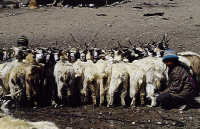 The drive to Tholing is long, dusty, and jolting, but it had some interesting sights. Mid-morning, we stop by a nomad encampment where a herd of goats is being milked. This is obviously a family enterprise, with numerous children aiding the adults. The female goats are tethered together at the neck, with each animal facing in the opposite direction to her neighbors. This arrangement presents the animals conveniently for milking, with two women working each side of the lineup. We pay for the photo opportunity with a few cigarettes, and are then on our way.
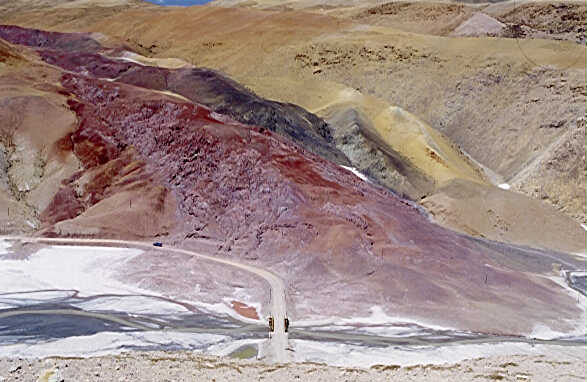
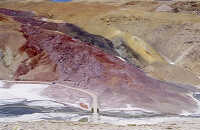 The route mounts via multiple switchbacks to the high "Eagle Pass", then descends in the same manner. In crossing several river valleys, the road descends windingly to the base of each valley, crosses a bridge, and then mounts again the opposing valley wall. The bridges are built of steel I-beams bolted together, and were evidently prefabricated.
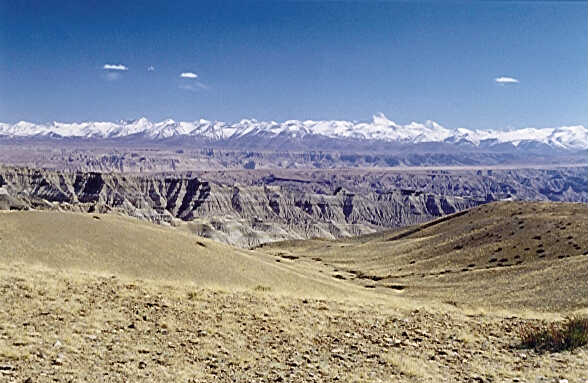
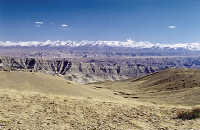 In late afternoon we enter an area of fantastically eroded soft rock formations. The stone is apparently a type of crumbly mudstone which is easily worked by wind and water, forming a sort of mini-grand canyon effect. Although entranced by the beauty of the natural sculpture, we are hot, dusty and tired. Thus, we are happy to arrive at the banks of the Sutlej river, which we follow to the town of Tholing, arriving at 8:00pm.
We lodge here at the Guge Hotel, which is a nominal step above that in Darchen. It consists of a couple of two-story buildings containing dormitory-like rooms with three beds each. Apparently there was once electricity provided because the rooms contain electric lights and a television, none of which work.
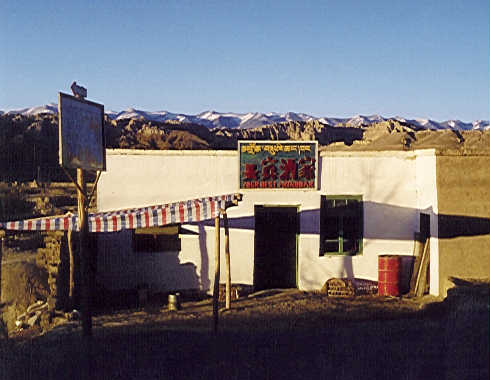
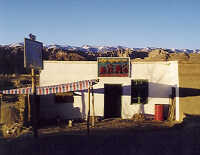 Across from the hotel we discover the "Best Frind Bar" (sic), a small restaurant run by a couple of Chinese who have immigrated from Szechuan. I am happy to have a change of diet, and dine on boiled rice noodles with egg washed down with Chinese "Yellow River" beer. The fact that we can see the meal being cooked over a roaring fire gives confidence that we won't catch any local microbes.
May 24, 1998 - Tholing and Tsaparang
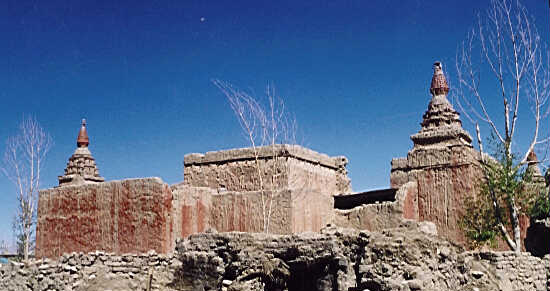
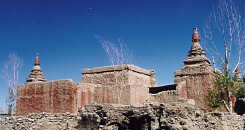 In the morning I skip the camp breakfast for momos and tea at the BestFrindBar. Then we tour the town inspecting the exterior of the gompas. Many are under repair. As can be seen from the photo at the left, the architecture of these temples is nevertheless impressive. We need a permit to visit the inside of the "White" temple, but some bureaucratic foul-up means that the permit is not ready. After another noodle lunch at the bar, we load up for a drive to Tsaparang at 2:30 in the afternoon. The drive is about an hour following the Sutlej valley.
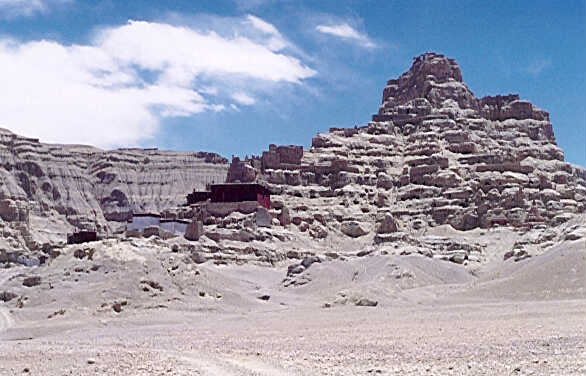
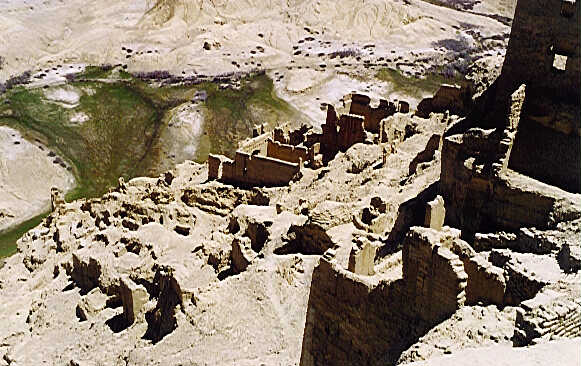
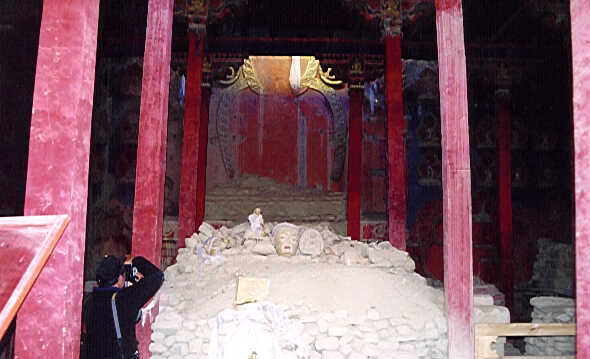
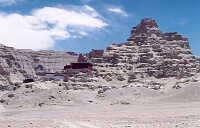 Tsaparang is a deserted city carved high into a mudstone cliff, with several wood-framed temples grafted into the ensemble. The city was first built around the 10th century, and it declined after the 17th. The temples and the murals thay contained remained were deserted and relatively intact until the Cultural Revolution of 1966, when the Red Guards defaced the statues inside the temples.
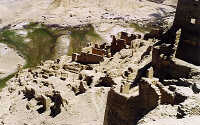 There is a single guardian living in a hut at the base of the city, who has the keys to all of the temples. Because of the remoteness of the site, there are few groups who visit. This is fortunate in one respect, since the visit is accomplished via steps carved into the soft rock of the cliffs. It would seem that hordes of visitors would quickly degrade the passages. Our guides strike a deal with the guardian which allows us to photograph the interior of the temples.
The visit starts with a climb to the top of the city (about 300 feet above the base). We are surprised when the guardian offers to sell us cans of Coca Cola at the top, proving that Coke is indeed a world-wide commodity. 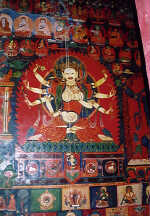 Then we descend visiting each of the temples in turn. The interiors are dark, and photography is difficult since I have only a speedlight flash and no tripod.
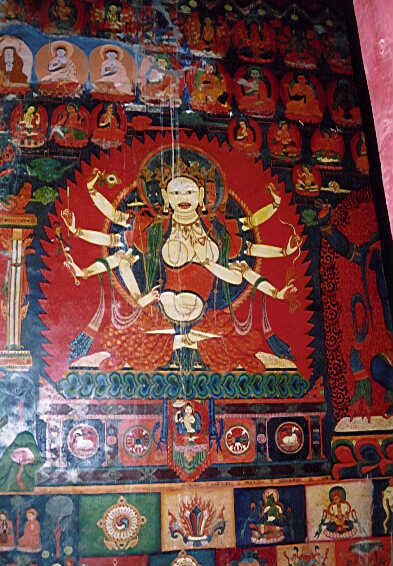
 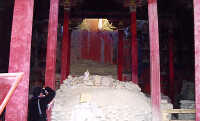 The tantric mural painting are in generally good conditions, although the statues and altars are smashed and defaced, their parts lying on the ground or heaped into piles.
At the end of the tour, we enter the guardian's dwelling where he serves us tea. We contribute our photography fee and a small tip before leaving for the return trip to Tholing.
On arriving back in town, we visit the White Chapel gompa to arrange our visit. After almost an hour of waiting, we are admitted into the interior. The main attraction of here are the mural paintings which cover the entire interior walls. Unfortunately is is now almost sunset, and impossible to photograph anything. We look at small sections of the paintings exposed by our flashlight beams; these paintings are truly magnificent, and it was a major disappointment that we were not able to see them in daylight hours.
Another noodle dinner at our friendly corner bar brings the visit to close.
Page 10
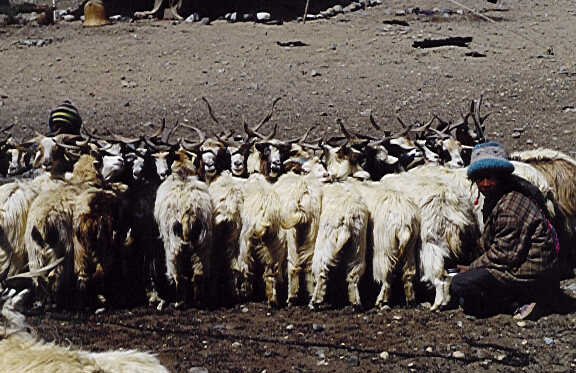 The drive to Tholing is long, dusty, and jolting, but it had some interesting sights. Mid-morning, we stop by a nomad encampment where a herd of goats is being milked. This is obviously a family enterprise, with numerous children aiding the adults. The female goats are tethered together at the neck, with each animal facing in the opposite direction to her neighbors. This arrangement presents the animals conveniently for milking, with two women working each side of the lineup. We pay for the photo opportunity with a few cigarettes, and are then on our way.