 |
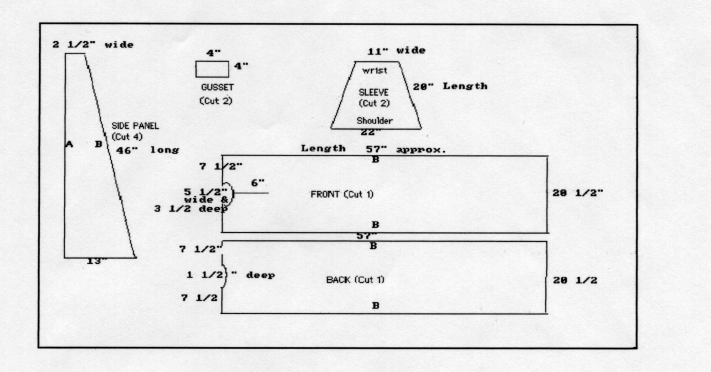
| The Djellaba is a full length loose Arabic garment with long sleeves and sometimes a hood. This is a folk costume, minus the hood, makes a very good ceremonial garment. The method of its construction is based on the simple geometric principles that arose form the standard width of cloth as it came from the loom. For our purpose the width will be the width of the wearers shoulders since all garments hang from the shoulders. Measure the length of the garment from the curve of the shouldar to the ankle and add 3 1/2" for the shoulder seam and hem. These two measurments will give you the length and width of the front piece and the back piece. I will give the standard measurments for someone of medium build who is 5'6" in height and any adjestments can be made by siply modifying the front and back piece length and width since the garment hangs from these. From the measurments given you will be able to develop the side seam piramid-shaped inserts, gussets and the sleeves. The side pannels are sewn with the vertical edges together. The neck will be a 5 1/2" curve that is 3 1/' deep in fornt and 1 1/2" deep in the back. In the front, vertically, there is a 6" slit and this will be faced with 2" of hemmed fabric all round. The facing mirror image of the neck and front slit areas. It is important, once this is seamed on to cut on the wrong side all of the curves and points nearly up to the stitching when this is turned around and the hand stitch close to the seam fold all round before hemming to the garment on the wrong side. This must be done slowly and carefuly as it must be strong. The garment hangs from the shoulder and neck areas. Using newspaper or brown wrapping paper measure out a piece equivalent to the front piece. Do the same for the 4" by 4" gusset, side pannels and sleeve. If you are brave and measure carefully you can measure out the garment directly on the fabric. The measurments are: Font and back pieces= 20 1/2" wide and 57" long (Cut one of each) Sleeves (Cut two)= Top 22", Wrist end 11", Side 20" Side pannals (cut four)= Top 2 1/2", bottom 13", side 46' Gussets (cut 2)= 4"x4" When the side pannels are cut they will be sewn together to form a narrow pyramid which will be sewn lengthwise to lower portion of the front and back pannels. Leave a 3 1/2" unsewn portion between the sewn together side pannels. Leave unsewn (at the shoulder end of the sleeve) another unsewn 3 1/2" portion. The points of the gussets will be fitted into these openings in the side pannels and under the sleeve. The opening will be spread to contain the gussets on either side. You may wish to hand sew the gussets area before doing it up on a machine, if you have one. The side panelling and the gussets allow for fullness at he chest and the movement for a wide variety of arm sizes. The sleeve itself is bugle-shaped, starting full but narrowing down to a narrow wrist opening. this bugle shape allows for changes in size of the wearer over time. The wrist may be reinforced with a band material sewn onto it, then turned over to form an external facing. The Djellba is an all-purpose robe which can be used in any rituals or prayers |
|
|
| The Djellaba as a ceremonial robe |
 |
| Click on the butterfly to go home |
 |