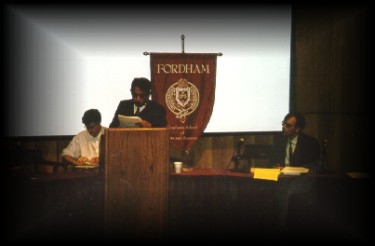
The Voice of Pramoedya Ananta Toer New York, April 24, 1999. Joesoef Isak is pak Pram's editor and publisher (Hasta Mitra.)
I am pleased to join you all in this symposium celebrating Pramoedya's
tremendous literary achievements. As the literary issues relating to his
works are being discussed by other speakers, it has been left to me to
tell the story of the journey of Pramoedya's manuscripts from the prison
island of Buru and into the hands of the reader. Though his works of
fiction and non-fiction easily stand on their own, we must acknowledge
that Pramoedya has achieved worldwide fame largely due to the political
injustices he has suffered, from imprisonment to censorship.
My comments here today are therefore necessarily political in nature.
Pramoedya himself suggested that I use this opportunity to state clearly
to an American audience how we conceived of the foundation of the Hasta
Mitra publishing company and the publication of Pramoedya's works as a
form of resistance against the New Order regime. Though we faced
censorship and intimidation time and time again, we continued our struggle
to publish the works of Pramoedya, because we were fully aware that the
freedom to write and publish these books was a right that we had to fight
to maintain, not something we could expect the government to hand to us as
a gift.
There is no doubt that the problems that were faced by Pramoedya's
manuscripts and books make a long and interesting story. Perhaps they
could even fill more volumes than the literary study of his works. The
foreign and domestic press coverage of the bannings, interrogations and
other intimidation experienced by the author and the publishers became
excellent advertisements for us at the time. As publishers we were never
able to take out advertisements because we didn't have the money for the
very high costs. The reports of bannings and the suppression of the author
have indeed operated as very effective free publicity which has helped
greatly the sale and distribution of Pramoedya's books.
But the greatness of Pramoedya does not, as you all know, depend on this
great free publicity but flows from the literary quality of his works. His
works stand equal with the great literature of the world that has enriched
the spiritual life of humankind as well as the sense of humanity itself on
this earth of mankind.
I want to begin my story with the tetralogy that was born on Buru Island.
There was a time on Buru Island when the prisoners' morale was at rock
bottom, when hopelessness and demoralization gripped the 10,000 political
prisoners that inhabited the island. This Earth of Mankind was born - or
more accurately was consciously conceived and given birth to - during this
time with the aim of awakening again the morale and optimism of the
prisoners. These dark times were caused by actions of the military guards
who did not hesitate to kill prisoners who tried to escape or who were
accused of rebellion. Prisoners were kept under even tighter guard and
isolation and new restrictive regulations were introduced. It was in these
circumstances that Pramoedya began to tell the story of Nyai Ontosoroh,
Minke, Pangemanann, the heroes and the villain in this series of four
novels that now are in the hands of readers around the world.
This Earth of Mankind and the other three volumes were born as manuscripts
while Pramoedya was still a prisoner. But in fact Pramoedya had finished
gathering the material for this tetralogy before 1965. He and his students
had gathered this material about the Indonesian national awakening while
he was a lecturer in Indonesian history and literature at Res Publica
University. By 1965 Pramoedya reached the stage where he had to decide
whether to present this material in the form of a scholarly historical
work or through an historical novel. It seems he chose to remain
consistent with his nature as a novelist. He decided that he could present
this material to a much wider readership through a novel. All these plans
came to nothing at the time because of the events of 1965. Pramoedya
himself ended up in Salemba Prison and then on to Buru Island prison camp
via Nusakambangan Island prison. It was on Buru Island where finally he
was able to produce this four-part magnum opus, whose outline was inside
his head even before he was imprisoned.
Though Pramoedya later had the opportunity to write Sang Pemula (The
Pioneer), a biography of Indonesia's first nationalist newspaperman
Tirthoadhisoerjo, the fictional life story of Minke would prove to be
Pramoedya's lasting legacy for the world, cherished in countless
translations. The Buru Quartet is all the more precious because many of
the original materials that would serve as the basis for the true story of
Tirthoadhisoerjo and the fictional story of Minke have been permanently
lost. When Pramoedya's library was burnt down in the riots of 1965, many
priceless documents were tragically destroyed, including some of the only
remaining original copies of Tirthoadhisoerjo's trailblazing nationalist
newspaper, Medan Prijaji. Without this important documentation, the
fictional account told in the Buru Quartet is ironically one of the most
important records we have of the earliest chapter in the Indonesian
struggle for nationhood.
There were three factors that enabled Pram's stories to spread throughout
Buru and beyond despite the restrictions on him as a prisoner. Firstly,
the majority of the prisoners on Buru Island were Javanese who have a
natural talent for storytelling, the skill of the dalang, the puppet
master. Pramoedya himself was only able to tell this story each day to ten
or fifteen fellow prisoners but the storytelling skills of the prisoners
meant that his story could be told and re-told finally getting to all of
the units and their 10,000 prisoners. Pramoedya was only able to put his
words on paper after 1972 when Pramoedya was allowed paper and typewriter.
Secondly, there were the Catholic and Protestant priests who helped
smuggle out carbon copies out of Buru.
Thirdly was the role of the photocopier. Once the manuscripts were
smuggled out of Buru, photocopies were made in Jakarta and quickly sent
out of Indonesia. Storing them in Indonesia would have been a danger to
both the manuscripts as well as the people hiding them.
I had been released from prison myself in 1977 after ten years inside
Salemba prison. After I got out I was one of the people able to read
Pramoedya's manuscripts even while he was still in prison. I think
Professor Wertheim in Holland and perhaps people at Cornell University
also had photocopies of the manuscripts that had been smuggled from Buru
to Jakarta. The political situation meant that it was impossible to
publish the books at this time. Even the reading of the manuscripts was
done very secretly to safeguard the smuggling network that was getting the
manuscripts out of Buru. But at the same time, I became committed to
publishing these books when the time was ripe. Pramoedya had also resolved
that his books must be published, even though at that time he did not know
when he was likely to be released. None of the political prisoners had any
idea how long they were to be imprisoned because none were ever put on
trial or sentenced. But despite this, Pramoedya had already decided on the
name of the publishing company that would be set up to publish his books:
HASTA MITRA or "hands of friendship". Optimism about a better future never
left the political prisoners.
Then, maybe just by chance, maybe it was God in Heaven that arranged it,
Hasyim Rahman and Pramoedya came to my home to invite me to join with them
in setting up a publishing house for which he had already chosen the name
Hasta Mitra. Hasyim was a fellow political prisoner on Buru who had been
editor of the newspaper Bintang Timur, which published Pramoedya's
literary supplement Lentera. Hasyim and Pramoedya had only been free from
Buru Island for one month and had not seen me for 14 years. Our first
priority was to publish Pramoedya's novels from Buru Island. To cut a long
story short, some months after this meeting, This Earth of Mankind, was
published. This was a sensational event in Indonesian society and in the
Indonesian publishing world.
Over night Pramoedya became a popular sensation. His books were sought
after by all sections of society: ordinary people, students, journalists,
housewives and even officials, although the latter often searched for his
books secretly. Except for the late Vice President Adam Malik who invited
Pramoedya, Hasyim Rahman and myself into his office and declared that the
book should be compulsory reading for all students. How incredible! After
all Pramoedya was classified as a dangerous political prisoner, just out
of Buru. He was supposed to be a dangerous communist, imprisoned for his
own safety because society did not want him in their midst. Now his books
were selling like hot cakes - as I think you say here in the US - in that
very same society.
Pramoedya became the idol of many young people - in fact, many people
think that you can trace the rise of the spirit of rebellion among young
people that led to the overthrow of Suharto back to the publication of
This Earth of Mankind in 1981. Bookshops that did not sell This Earth of
Mankind knew they would be disappointing their customers. Book
distributors and the country's big bookshops fought among themselves to
get their share of Pramoedya's This Earth of Mankind.
Then suddenly, during the sixth printing of This Earth of Mankind and the
first printing of Child of All Nations, the Attorney General issued a ban
on both these two books. I think you can all picture just how this ban
created a huge black market for the books. The reasons given for the ban
on these two books were that they spread the teachings of Marxism-Leninism
and that they caused unease in society. The same reasons were given when
the later books were also banned.
I am often asked why was the Suharto government so afraid of Pramoedya
that they felt they had to ban all his books. Is it true that the books
caused such social unease? Was it true that there was Marxist propaganda
hidden between the lines in Pramoedya's works? There is no certain answer
to these questions. Because there are no answers that a rational person
could accept. These bans were very clearly the result of a combination of
authoritarian arbitrariness and idiocy, a combination of fear of a ghost
that they created themselves and the race between officials to prove to
their superiors that they are more anti-Communist than anybody else. And
then there were the efforts of writers and journalists sick with revenge
against Pramoedya who did their best to get the books banned.
They didn't dare directly harass Pramoedya but Hasyim Rahman as company
director and myself as editor were interrogated repeatedly for a whole
month by the Attorney General. The printers were also interrogated, but
this stopped after he started to answer the questions with money. I once
suggested to the interrogator that we organize a scholarly symposium to
discuss objectively whether or not there really was Marxist propaganda in
Pramoedya's books. I told them that Hasta Mitra would meet all the costs
and that the Attorney General could invite whomever he liked as
participants as long as they were scholars in the fields of sociology,
political science, anthropology or cultural workers. They rejected my
proposal. The interrogator understood better than anybody else and was
convinced that This Earth of Mankind and Child of All Nations were Marxist
literature, so there was no need for a symposium.
But the idiocy! They said they knew that the books were Marxist literature
but in the interrogations they asked me to point out the lines of the
books that contained the theory of historical materialism and dialectical
Marxism. I said to them that as the accusers they should be able to
produce the evidence themselves: "We can't identify the lines where the
Marxist teachings are, but we can feel that it is there!"
There is a saying attributed to General Nasution in 1965 that "Slander is
more cruel than terror or killing." But after these repeated
interrogations I have my own saying: "The terrorism of idiocy is more
cruel than either slander or killing." I am not exaggerating; this was
certainly the experience I had again and again. I will tell you one story
that captures the goings on around the bannings of books at that time.
After a month of tense interrogations, full of debates and arguments, the
end came and I had to sign the transcript of all the interrogations. As
soon as I signed, the face of the interrogator lit up with a smile. He put
his hand under the table, so I had to glance underneath the table. What
did I see: the thumbs up sign! He whispered, afraid of other prosecutors
hearing him: "Pram's books are fantastic! Do you have another copy? My
wife hasn't read it yet. Can you send a copy to my house? Everybody should
read that book!" Of course, I couldn't believe this but he just said: "You
have to understand, Pak Yusuf, this is all on orders from those above." We
were on the fourth floor then. There were still a fifth and sixth floor
above us where the interrogators' bosses sat at their desks. I am sure
that these people too would blame others above them or maybe they would
point sideways. Their bosses have their desks in other buildings. I was
tortured by the idiocy of the interrogators, but they in turn were
tortured by their bosses who were even more stupid.
Another story of this terroristic idiocy. The publisher Goenawan Mohammed
once suggested to the Minister for Culture and Director-General of
Cultural Affairs that the ban on Pramoedya's books be lifted. This Ph.D.
with the title of Professor answered: "The situation doesn't allow it.
Society could not tolerate the Marxism in Pramoedya's TRILOGY from Buru."
Later the Attorney General said the same thing about The Pioneer and OTHER
FICTIONAL WORKS of Pramoedya such as Girl from the Coast.
Pramoedya did not write a TRILOGY on Buru Island and The Pioneer is not a
fictional work but a non-fictional historical work. Did these high
officials of the state ever even look at these books let alone read them?
I can only shake my head.
These are some of the reasons that it is impossible to give a clear and
firm answer to the question as to why the books were banned. There are
other things too. The first book took seven months to be banned. As time
went on the banning orders came out more and more quickly: after 4 months,
3 months and finally even less than one month. The seven months the regime
took to ban the first book indicated that there was a pro and contra
struggle taking place inside the regime. The regime took quite a while to
ban these books. But as time went on, the bannings became routine, there
was no need to give any real consideration to the issue or to even check
what was in the book. One book that was banned was not written by
Pramoedya at all. It was The Tale of Siti Mariah, a penny romance novel
written at the beginning of the century. Pramoedya wrote an introduction
to this work because he believed that the popular novels written at the
turn of the century paved the way for the writing of the modern Indonesian
novel.
Then there is the strange story of Pramoedya's novel The Tide Turns (Arus
Balik), a great historical work no less in literary stature than This
Earth of Mankind and also written in Buru. We published this book four or
five years ago and it still hasn't been banned. Strange. Why? We will
never know the answer. If I were to use the Attorney General's approach I
could just as easily analyze that The Tide Turns was cleverly packed full
of Marxist propaganda. It is dangerous communist propaganda.
My guess is that there were two reasons why this book was not banned.
Firstly, as a 700-page novel it was just too long for them to read.
Secondly, they had become bored with banning Pramoedya's books. They
banned one, another one appeared a little while later. And so it went on.
What could they say? After all, writing is what Pramoedya does. There is
little point looking for some rational reason behind the policy of banning
Pramoedya's works. In a repressive system, you don't need rational
justifications of policy.
Pramoedya had to be silenced, that was all.
Perhaps though there is another reason, another factor that perhaps we
underestimate. It is very possible that the New Order Suharto government
wanted to make very sure that Pramoedya and Hasta Mitra did not develop
into a large and powerful publishing company. There were all the signs
that such a thing was possible. At that time Hasta Mitra was based in my
house and garage. With Pramoedya's books becoming best sellers, I myself
was already imagining us moving to bigger offices equaling that of the
other big Indonesian publishing companies. At the time Pramoedya was able
to buy a car with his royalties, something that no other author had ever
been able to do. This was not just us fantasizing, there was a real
prospect of Pramoedya's best-sellers accumulating the capital we would
need.
Suharto and his repressive bureaucratic apparatus never really were able
to defeat us politically. But they were able to do Hasta Mitra a lot of
economic damage. What publishers can survive if all their books are
banned? As a business we were badly hit, but we still survived. Those who
write about the censorship of Pramoedya's works often overlook the fact
that when the government robbed him of his freedom of expression, they
also robbed him of his economic livelihood.
I'd like to tell you a little now about the relationship between author
and editor, between Pramoedya and I.
I became the full editor of Pramoedya's books at the time of the second
printing of This Earth of Mankind. Even though the first printing passed
through my hands, I was not yet really his editor. It was more like I was
a corrector.
When Hasta Mitra was founded, there was a division of labor between the
three of us. Pramoedya was, of course, the writer, although we also
intended to publish other writers that other publishers would be afraid to
publish. Hasyim Rahman was business manager as he had skills in raising
money. I would be editor for all the manuscripts. I became editor proper
for Pramoedya after the first printing because there were many corrections
that were needed. All the translations around the world today are based on
the second printing.
From the time that Pramoedya appointed me editor for all his books,
starting with the second printing of This Earth of Mankind, I began to
learn more about him both as a writer and a friend. At one time, he said:
"It's up to you, Bung Yusuf. If you think something needs to be changed,
then just change it!" He said this the first time 20 years ago, and I have
consistently heard those words spoken again every time I have suggested
something about his manuscripts. It is a great honor to receive such trust
from a writer such as Pramoedya. I cannot answer why Pramoedya trusts me
as an editor. I have no literary background. I am a journalist through and
through.
Pramoedya has never controlled or even asked me what changes I have made
to his manuscripts. Pramoedya has an extraordinary custom: he never
rereads any manuscript that he has typed, let alone one that has already
been published as a book. There has only ever been one exception to this
and that is with the English version of the book launched by Hyperion, The
Mute's Soliloquy. It was Willem Samuel as translator, and I think Will
Schwalbe also, that caused Pramoedya to change this custom. The Mute's
Soliloquy is the only work that Pramoedya has completely reread. I should
tell some of the story of the journey of this work.
One day in 1987, Pramoedya came to my house with a sheaf of thin, worn
paper densely covered with single spaced typing from an old typewriter. I
immediately knew this was another manuscript as this was how Pramoedya
wrote: an old typewriter using every square centimeter on the page. He
said: "When I was going through my things at home I came across these
papers. Read them. If you think they are worth publishing, then please
edit them." He found these papers seven years after he had returned from
Buru.
Only his closest friends knew about these writings, and he never expected
that they would be published. He wrote them secretly and had them smuggled
from Buru so that his children would know his story in case he should die
in prison. After I had read these papers, I quickly came to two
conclusions. This collection was an important social document. But it
could not be published without us going back into jail. The Mute's
Soliloquy is the only Buru work that was not fiction. Historical works
about the early decades of the century that had no direct relation with
contemporary conditions were banned let alone The Mute's Soliloquy that
told the real story of political imprisonment from Jakarta's Salemba
prison to Buru Island.
I decided quite firmly that these important and beautiful writings must be
published one day. But the immediate priority was to distill an integrated
story out of the assorted documents that made up this collection. With
Pramoedya's agreement and guidance I divided the materials into three
sections based on three major themes. These were:
1. letters to Pramoedya's children that he had written on Buru but which
he had never been able to send;
2. reflections on his life experiences, including the time in the New
Order's prisons; and
3. his essays.
After the materials were edited and formed into an integrated collection,
I sent them off to a Dutch publisher. Perhaps this was the first time that
a major work was published in translation before being published in its
own language in the country of origin. While the book Het Lied van een
Stomme was being prepared for publication in the Netherlands, Pramoedya
turned up at my house again with another collection of papers. This time
he had discovered a bigger collection than the first time. That's why
Nyanyi Sunyi Seorang Bisu was published in two volumes. It was not the
result of a plan but because I received the materials in two lots.
Then in 1995, two weeks before his 70th birthday, he said to me: Publish
Nyanyi Sunyi Seorang Bisu (The Mute's Soliloquy). We knew the risk would
be great. As Hasta Mitra director, Hasyim Rahman thought the risk was too
great. He thought that not only the books would be banned but the company
disbanded as well. So The Mute was not published by Hasta Mitra by
Pramoedya himself. He spontaneously decided on LENTERA as the name of the
publishers for The Mute. LENTERA was the name of the cultural section of
the newspaper Bintang Timur which was a mass circulation newspaper before
1965. Pramoedya was editor of this cultural magazine inside Bintang Timur
until it was banned in 1965. Hurriedly I printed off the manuscript that I
had edited seven years earlier and that now rested on the hard disk of my
computer.
Five days before Pramoedya's birthday, the printers returned the
manuscript to me. They were too afraid to print it. Perhaps they had read
some of it. Perhaps they had seen the list of political prisoners that had
died on Buru Island, died of hunger, of disease, of accidents when
carrying out forced labor or killed by guards. The printer said that he
could be imprisoned and his printing business closed down. I think this is
the only documentation of those who died on Buru Island. I don't think
that even the government has such a list.
In these difficult circumstances, I received help from the young
journalists in the "Alliance of Independent Journalists". They promised to
have the book published by his birthday. And they succeeded. It was
delivered just as the numerous guests at Pramoedya's house were waiting
for the official launch. The printing quality was not so good. The paper
was the cheapest newsprint quality. There were many pages printed out of
order. But everybody was very pleased to see it published, despite the
blemishes. Many people knew that it had been published in Dutch but this
was the first time that there was a chance to read it in Indonesian. I
need not tell you that the book was quickly banned by the Attorney
General.
Back to The Mute's Soliloquy translated by Willem Samuel and published by
Hyperion. This book is published in one volume, not two. There are some
sections that were adapted especially for the American edition. These
adaptations were all made with Pramoedya's consent. Willem Samuel and Will
Schwalbe asked Pramoedya to read the whole English volume and to give his
agreement. Pramoedya told me that this was the first time he had reread
one of his books. He told me that he cried after he finished reading it.
You can imagine why Pramoedya was so moved when he reread what he had
written about Buru Island.
Just one more thing. I am often asked, including by foreign and Indonesian
journalists, if Hasta Mitra has any plans to publish more of Pramoedya's
books or to republish the Buru tetralogy or other of his banned books. Of
course, this question is also often asked by those who don't yet have
their own copies.
Almost all of Pramoedya's books were published by Hasta Mitra when Suharto
was in power, including during the period when he was at the peak of his
power. This shows how we viewed the question of freedom and of human
rights. We did not wait for the regime to give us our rights and we
certainly never went begging for them. We were always very conscious that
we had to fight for our rights, to seize them and realize them in our
activities. Now Habibie is in power but do not think that the Habibie
government has instituted the freedom to write and publish. None of the
Suharto regime's bans on Pramoedya's books have been revoked. Freedom for
individual rights and democracy have not been instituted in Indonesia
today. If there are those that think that there are some freedoms today,
such as freedom of the press, they should realize that those freedoms have
been won through the struggle of our youth and students. They certainly
were not because the Habibie government that replaced Suharto is showing
goodwill or that it understands democracy.
And if Pramoedya is here today it is also because he has seized his rights
to freely travel wherever he wants and not because the official
restrictions on him travelling overseas or even leaving Jakarta have been
revoked.
Since Suharto was forced to resign we have not published any more of
Pramoedya's books or republished any earlier works. This is not because we
are afraid that the government will ban them. The reason is simple: we
have no money to publish them. As I said earlier, the economic damage that
the New Order did to us was quite serious. The economic crisis has made
things even harder for us, as it has done for all the Indonesian people,
with the prices of basic goods as well as printing paper increasing
several times over.
I hope I have made clear to you that the damage we have suffered has not
simply been political but has been financial as well, especially in these
long days of economic depression in Indonesia. Nevertheless, I want to
assure you that we will continue our struggle to publish Pramoedya's works
in Indonesia regardless of the financial difficulties we may face. On our
return from this trip, we will publish two books written by Pramoedya on
Buru that have not yet seen the light of day. The first is a historical
novel entitled Arok and Dedes, and the second is a play entitled Mangir.
Not only that, we will reprint all four volumes of the Buru tetralogy,
which the people of Indonesia have been clamoring for ever since they were
banned.
I leave you with a quote from This Earth of Mankind which sums up our
struggle. At the end of the novel, Minke feels defeated, but Nyai
Ontosoroh tells him, "We fought back, child, as well and honorably as
possible!" Not only have Pramoedya and Hasta Mitra fought back, we will
continue to fight, and we will never accept defeat. To protect our
freedom, our livelihood, our very existence, there is no other way.
Thank you.
|