Burnham Beeches
The ancient woodlands at Burnham Beeches in Buckinghamshire were used to represent the region around the Silchester gladiator school in 'A Rift in Time'. The 540 acres of pollarded Beech woods have been owned by the Corporation of London since they bought it from the Lord of the Manor of East Burnham in 1880, and a number of events are planned this year (2005) to celebrate its 125 aniversary in Corporation ownership.The area is open to the public as a recreational area, with the gates locked between dusk and 8am daily. The extensive pedestrianised area includes several walks, streams and two scheduled ancient monuments (an Iron Age Hill Fort that might reasonably have been in occupation around 1AD and Hartley Court Moat).
Clacton-on-Sea
See special page on Clacton-on-Sea.
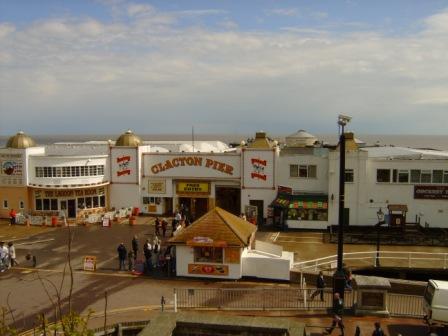 |
A seaside resort in Essex, England, mentioned and used for filming in 'The Vanishing Earth'. The Haunted House in the seaside funfair was used by the Spidron and Sandor (aka Joy) as a tool to identify individuals who would not be missed and abduct them to use as workers, removing magnamite from the Earth's crust. Clacton has recently reappeared in the TP universe with a cameo in the Big Finish CD 'A Living Hell'.
(Left) The Pier at Clacton-on-Sea (in May 2005) |
|
Clacton is about 70 miles from central London and boasts sandy beaches and clifftop gardens in addition to the pier and fairground seen in the episode. However, the 'sea' in question is the North Sea so expect the waters to be rather chilly! By those sufficiently determined, it can be reached by trains out of London Liverpool Street Station via Colchester (the journey taking about 90 minutes).
The roller coaster at Clacton, the Steel Stella, burnt down in 1973. The Pier has been extensively renovated since the 1970s with a roof covering some of the funfair, including the current Haunted Mansion attraction. |
 (Above) The current Haunted House at Clacton Pier in May 2005 |
The Great Pyramid
Not actually used for filming in the series, the great pyramid of Cheops (more properly known as Khufu, on the Giza plateau, near Cairo, Egypt) was visited by John, Elizabeth and Timus in 'Worlds Away' and also appeared in stock footage used to set the scene at the beggining of 'Revenge of Jedikiah'. The same location also features extensively in the New Series story 'The Rameses Connection' which had several scenes set in Cairo and Giza.The great pyramid topped the list of seven wonders of the ancient world first mentioned by Herodotus in the fifth century BC. The pyramid itself is believed to have been constructed around 2560BC by Khufu, a monarch of the fourth dynasty. The overt purpose of the pyramids was to entomb the deceased pharoahs. Whether the pyramids had additional purposes - most likely as part of a ceremonial landscape encompassing the lower Nile valley - remains a matter of speculation and debate. The pyramid was more than 145m tall when constructed and remained the tallest building on Earth until the 19th century.
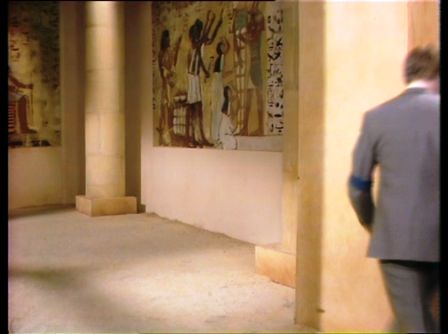 The decorated walls of the pyramid visited in 'Worlds Away' - Giza or Saqqara? Screenshot © Freemantle Media
|
Although the scenes in the Tomorrow People story 'Worlds Away' showed scenes of ornately decorated chambers, the interiors of tombs in this period were barren of markings, with funery wall decorations only becoming common in later dynasties. The first pyramid texts appeared on the walls of the 5th dynasty pyramid of Unas at Saqqara suggesting that although stock footage of the Great Pyramid at Giza was shown in both 'Worlds Away' and 'Revenge of Jedikiah', these scenes should be more correctly set ten miles south east of that in Saqqara.
|
Loch Ness
|
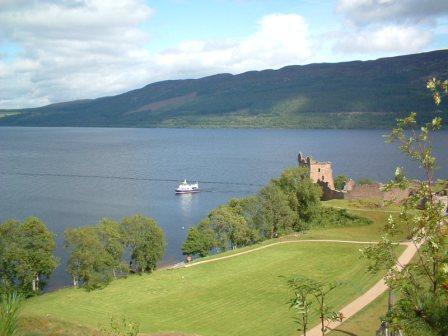
Never actually used for filming in the series, Loch Ness nonetheless featured prominantly in 'Castle of Fear'. Andrew and his father owned a hotel on the shores of the Loch, and one of Andrew's first uses of his abilities was to create the illusion of the Loch Ness Monster (or Kelpie as the locals call it). Loch Ness is a long thin lake, more than twenty miles long, running along the valley of the River Ness, just south of Aberdeen, in the Higland region of Scotland. Is is approximately 600 miles north of every other location on this page (except the Great Pyramid and White House) - which may explain why the producers of the Tomorrow People chose economy over geographical accuracy when filming! (Right) Loch Ness, Scotland (Photo credit: Len Stanway, July 2004) |
 |
Silchester
|
Never actually appearing in an episode, Silchester was the supposed location of Gaius' gladiator school in which first Peter and then Stephen became trapped in 'A Rift in Time'. Silchester is now mostly occupied by a walled farm. The wall, however, represents the boundary of the roman and native British city of Calleva Atrebatum that occupied this site. The town is unusual in not being overbuilt in more recent times, and hence the entire street plan remains preserved beneath the surface and is the subject of occasional archaeological excavations, mostly by the University of Reading. It is owned by Hampshire County Council and English Heritage and can be visited year round, although little remains visible above ground
|
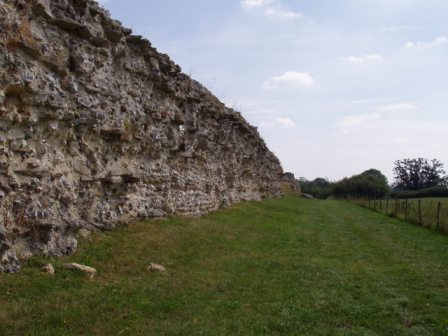 The walls of Roman Silchester (photograph by Jackie Clark, 2004) |
Skylab and the Watchdog Sattelite
A recurring location in the series was the Tomorrow People's Watchdog sattelite, which was described as being adapted from the abandoned American Skylab. The craft featured heavily in 'The Blue and the Green' and 'Achilles Heel' amongst other stories.
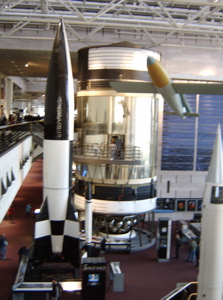 (Above) The duplicate Skylab orbital workshop at the National Air and Space Museum in Washington DC. Note the people at ground level and the access door half way up the structure (January 2006).
|
Skylab was humanity's first long-term residence above the Earth's atmosphere. It was launched on 14th May 1973 (not long after the debut of the series), with the intention of proving the viability of living in space, and of advancing astronomy. These aims were accomplished despite initial mechanical failures and malfunctions, caused by vibrations during take off. The micrometeorite shield deployed during the launch stages, badly damaging the solar power array. After repairs in orbit, the space station was inhabited by three consecutive three man crews for a total of 117 days. The longest individual mission lasted 84 days, performing about 300 medical and scientific experiments, including unplanned observations of a bright comet. The station was finally abandoned in February 1974. After its last use, the space craft was placed in a high orbit, intended to remain stable for the next decade, but by 1977 this had been destablised by higher than predicted solar activity. The craft descended through the Earth's atmosphere, burning up and with scattering debris over the Indian Ocean and Western Australia, on 11th July 1979.
|
|
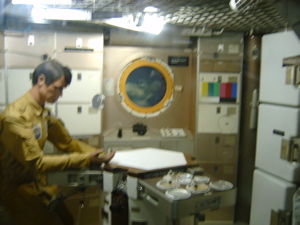
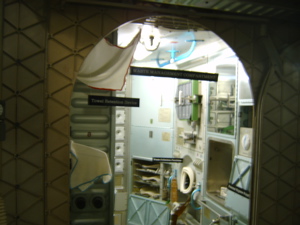
Skylab was launched (unmanned) using the massive Saturn V launch vehicle, and was crewed and serviced by manned Apollo capsules. The structure was 36 metres tall, and 6.7 metres in diameter. It weighed 96 tonnes. A good grasp of the scale of the station can be gathered from the backup Skylab orbital workshop module at the Smithsonian Air and Space Museum in Washington DC. This was a duplicate of the main habitation capsule, never flown because of project cancellation, and not including the airlock module, vast solar panels and sun shielding umbrella that formed part of the final station configuration.
| |
|
|
|
(Above) The interior of the duplicate Skylab orbital workshop at the National Air and Space museum, complete with imitation astronaut. Note the cramped conditions in which a team of three astronauts lived. (January 2006)
| |
Washington, DC and the White House
Washington DC, USA, was not used for filming, but the city, and in particular the White House, was the location for scenes in 'War of the Empires'. Stock footage was used in the serial.
|
The White House has been the symbol of government in the United States of America since construction was begun by George Washington in 1792, and is both the residential home and the administrtive office of the president. The house itself has been the residence of the president since 1800, although the Oval office, from which the President addresses the nation, has only been in use since 1909. It was damaged by fire in 1814 (as part of the 1812 war between the US and Canada) and a second fire damaged the west wing in 1929.
|
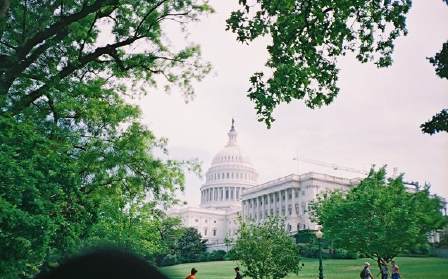 (Above) The US Capitol building, one of the complex of US Government buildings in Washington DC (May 2004)
|
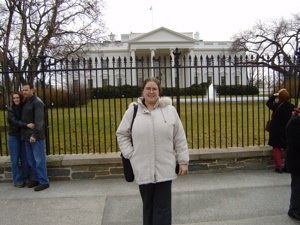 (Above) Me, in front of 1600 Pennsylvania Avenue - the White House - in Washington DC (January 2006)
|
Contrary to popular belief, the painting of the White House (a process which requires 570 gallons of paint) began long before these fires, and may have started with a whitewash applied to seal and protect the stonework when it was constructed. The nickname appeared in correspondance as early as 1812, but 'The White House' was officially named by President Roosevelt in 1901.
|
| An act of Congress in December 1790 declared that the federal government would occupy an area 'not exceeding ten miles square' in central Washington, and the District of Columbia was created to ensure that this would not reside in any one state. As a result, the White House itself is just one building in the complex of government buildings on the banks of the Potomac river. This complex of buildings includes the US Capitol, Library of Congress, National memorials and a large number of national museums (including the Smithsonian museums). | 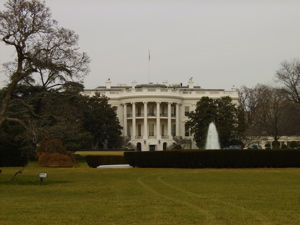 (Above) The White House rear facade and lawns (where the Sorsons landed!) in Washington DC (January 2006)
|
Wycombe Air Field
'The Lost Gods' includes several scenes shot at an air field near High Wycombe in Buckinghamshire, where Mike was learning to glide and where he first made telepathic contact with Hsu Tai.The location of this air field is not completely clear, but the only gliding club currently listed in the directory of the British Gliding Association for this region is the Booker Gliding Centre, based at Wycombe Air Field. This former RAF aerodrome has been in continuous use as an airfield since 1939 and is located in the Chiltern hills. It is now a very busy field, home to two flying schools, several vintage aircraft and a museum which houses film aircraft.