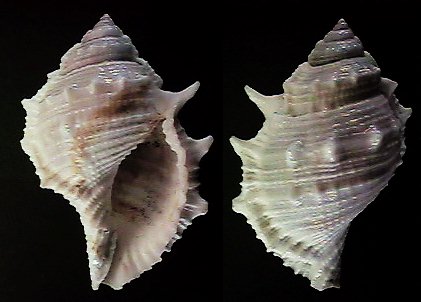
BURSIDAE
Common name: 'frog shells'
Characteristics:
External
1. posterior exhalant siphon at the top of the outer lip
2. coarsely sculptured shell, often with varices, ribs or warty lumps
Internal
1. jaws absent (or minute)
2. presence of a third accessory salivary gland
Habitat: intertidal or subtidal epifaunal carnivores, common on sand and coral rubble.
Feeding:
Information pertaining to bursid feeding is sparse. However, works done by Houbrick & Fretter (1969) shed some light on diets of several species of bursids. The bursids under investigation fed on several species of sipunculids ('peanut worms') as well as polychaetes (marine 'worms'). Taylor (1977) found polychaete setae, holothuroid spicules and ophiuroid remains from the gut and faecal samples of Bufonaria rana. Ophiuroids, echinoids and crinoids were also the diet of some bursids found elsewhere in the tropics (Taylor 1978). Such variety of prey items found in the gut and faecal remains suggest that bursids are generalist feeders, unlike the cassids and tonnids which are specialist feeders on echinoids and holothuroids respectively.
Bursids generally employ the method of releasing anaesthetizing fluid on its prey before consuming. This is to aid in capturing especially errant polychaetes. Furthermore, acid secretions released on its prey functions in partial digestion before ingesting. This is necessary particularly for polychaetous prey in which its setae are numerous.