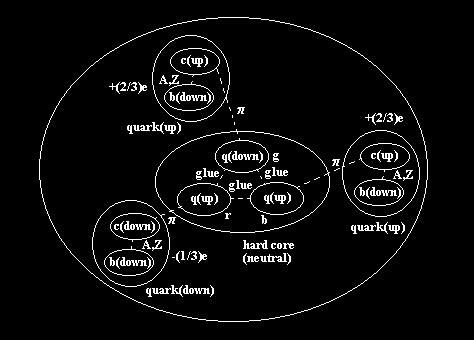
Fig.A Structure of Proton
Before discussing the structure of hadron, we review the ordinary Lagrangian density for quarks. The Lagrangian density for quarks is described as;

where m means the generation. In this paper the problem of generation isn't dealt with. Precisely qml is expressed as;

As I indicated above, there is no mass term in this Lagrangian density such as;

We know the fermion which doesn't have mass is described with Wyle equation. Therefore it is suggested from the above supposition that the new Lagrangian density will induce Wyle equations for mhons instead of Dirac equations.
I wrote that quark is composed of c-on and b-on and the hard core is composed of q-ons. Precisely the c-on in up quark has the flavor "up", the c-on in down quark has the flavor "down", and the b-on has the flavor "down" in both of up and down quarks. The up and down q-ons have the flavor "up" and "down" respectively. The up-c-on has the electric charge +(1/2)e, down-c-on has -(1/2)e and down-b-on have the electric charge +(1/6)e. The up-q-on has the electric charge -(1/3)e (not +(2/3)e!) and down-q-on has +(2/3)e where -e is the charge of electron. There is not up-b-on in nature. Namely,
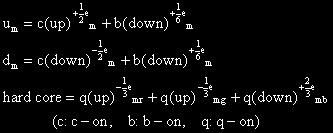
As indicated above, the hard core is neutral electrically. Therefore the scattering sectional area with relatively slow or low-dissolutional electron is almost zero. The covariant differentials of c-on, b-on and q-on are defined as,
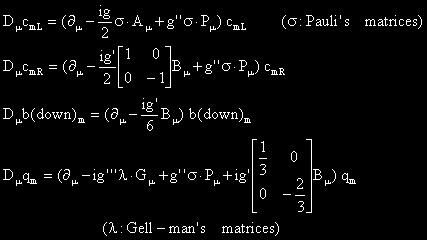
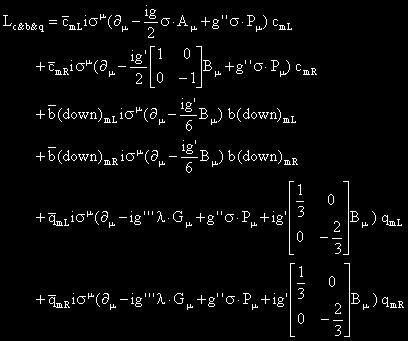
where the coefficients g and g' are equal to these of Weinberg-Salam model. g'' and g''' are the coupling constants of pion interaction and color interaction respectively. P corresponds to the pion field and G corrsponds to gluon. Since the spin of pion is 0, that is, the interaction term must be transformed as axial vector, the imaginal unit i is multiplied on the field P. B-on and q-on have the chiral symmetry but c-on doesn't. About quark the electoric charge operator T+Y operates on the pair of c-on and b-on as single particle. And left-handed c-on doesn't have Y-charge though it has the electric charge (1/2)e (up) or -(1/2)e (down). Similarly the electric charge operator operates on the whole of hard core, that is, on the triplet of up, up, and down q-ons. However they are transparent about T operation, so their electric charges coincide with their Y-charges. (Do you think the interaction of q-on on this model is too complicated? I think so. Perhaps the hard core has the other construction different from that supposed here. But I'm not sure because there is no relevant experimental data about hard core.) The Lagrangian density of c-on, b-on and q-on is described from the above definitions as,
It is known that weak bosons W, Z and photon A are expressed with the field Am and B as,

And pions are supposed to be described with the field Pm as,

On this model pion doesn't change with weak interaction directly. However, as shown in the Fig.B, it can change into lighter particles with weak interaction through the second perturbation process such as vacuum polarization.
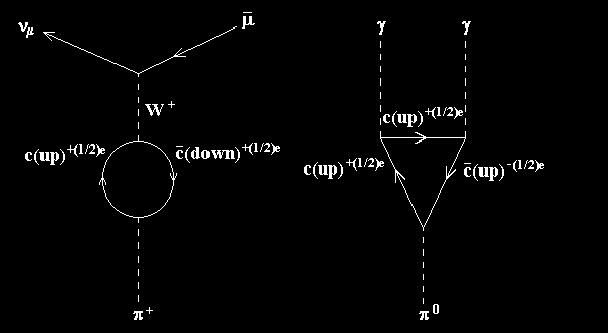
Fig.B Decay of Pion (ex.)
The above Lagrangian density is developed and transformed with these formulae. The interaction terms in the Lagrangian density are;

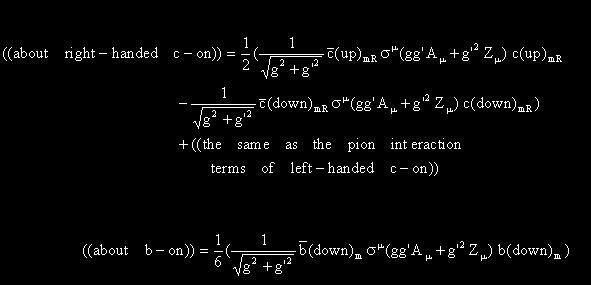
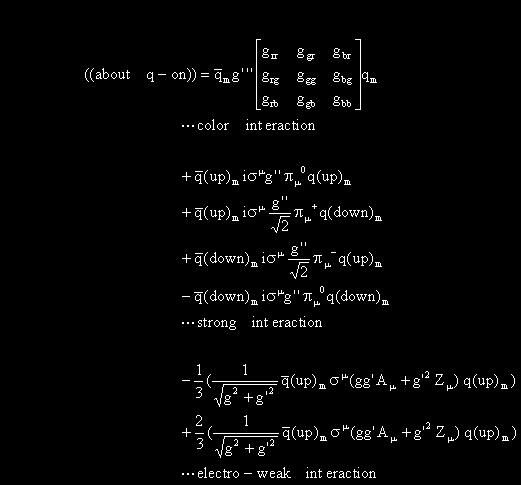
As shown above, the hard core has the interaction with pion, therefore it is thought that the scattering sectional area of hard core is measurable with pion bombardment, not electron. Though the hard core is neutral electrically, each q-on has electrical charge, especially two up q-ons in the hard core are repulsive each other due to their electrical chage. This repulsive force is canceled out by the asymptotic attractive interaction with gluons among q-ons. But that repulsion energy is preserved as "combination energy" in the hard core. Please recall the mass deficit occurs after the fission of U235 and this mass deficit is equal to the combination energy in U235. In the case of hard core, that combination energy is equal to the mass of hard core. Quark gets the mass by similar mechanism. But in this case the attractive interaction is brought by Z boson insead of gluon. The electrical repulsion in up quark is stronger than that in down quark because both of the electric charge of c-on and b-on in up quark are positive. Therefore the mass of up quark is thought to be heavier than that of down quark.
If we ignore the time development, the orbits of quarks around the hard core are described with a kind of static Schloedinger equation. The wave function is degeneratede about spin and flavor. In other words it is possible there are 4 different types of quark in the same orbit, that is,

I'll sketch here two examples applied by the above Pauli's principle. First Delta++ is thought to be composed of three up quarks, namely,

However in the right side, first two up quarks can not occupy the same orbit in Delta++ due to the above reason and one of these up quarks must remove energetically higher orbit. In other words Delta++ is in an "excited" state. (See Fig.C)
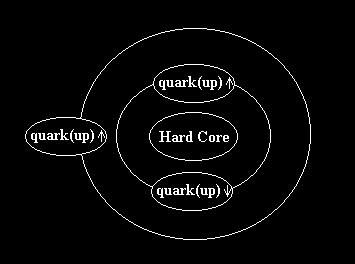
Fig.C Structure of Delta++
Secondly the configulation of deuterium on this model is illustrated on Fig.D. Each orbit includes possible four quarks, that is, u(spin: up), u(spin: down), d(spin: up), d(spin: down), hence this system is stable due to Funt's law. There is obvious analogy between this and the stability of hydrogen molecular.
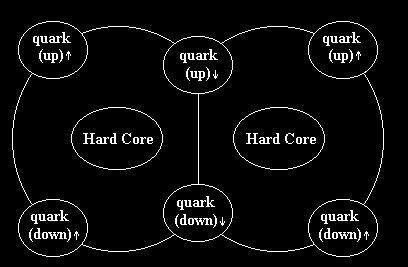
Fig.D Structure of Deuterium