Structure of Lepton
Lepton is thought to be a point-like object. However lepton has various properties such as electric charge, flavor or generation, so it might be possible to consider lepton as the composite of more fundamental substance. Here lepton is supposed to be composed of two different particles "a-on" and "b-on" as shown in the following picture.
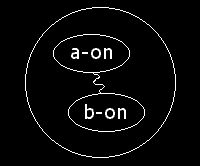
Structure of Lepton
a-on and b-on have electric charge and flavor, but don't have the property of spin. Namely these particles are neither fermion nor boson. In this meaning they might not be entitled as "particles". Here a-on and b-on are called "mhon". Mhon is supposed to have the fractional electric charge as shown below:
|
Flavor:up |
Flavor:down |
| a-on |
+e/2 |
-e/2 |
| b-on |
(not exist) |
-e/2 |
where -e is the electric charge of electron. a-on doesn't have chiral symmetry, but b-on has. It is supposed that b-on having the flavor up does not exist in the nature. It is also supposed that any mhon doesn't have original mass. Therefore it is meaningless to consider the property of generation on mhon. Later the difference of mass of leptons which belong to different generations is explained with the difference of eigenstates for interaction between a-on and b-on.
The electroweak interaction for electron is interpreted with that for a-on and b-on. Since mhon doesn't have mass, the equation of motion for mhon can be described with Weyl equation. Gauge invariability is imposed on the Lagrangian deriving Weyl equation. Firstly the Lagrangian density for left-handed a-on LaL is described as,
LaL = aL* ism (¶m - (ig/2) s·Am) aL
(sm¶m = s0¶0 - s1¶1 - s2¶2 - s3¶3
s: Pauli's matrices *: Hermite conjugate)
where the field of left-handed a-on aL is the doublet as,
aL* = [a(up)L* a(down)L*]
Since b-on has chiral symmetry, the corresponding Lagrangian density also has chiral symmetry. It is described as,
Lb = b(down)* ism (¶m + (ig'/2) Bm) b(down)
The total Lagrangian density for left-handed lepton is the sum of these Lagrangian density.
LL = LaL + Lb
Setting the quartet lL as,
lL* = [a(up)L* a(down)L* 0 b(down)*]
the Lagrangian density LL is described with lL as,
LL = lL* igm (¶m - (ig/2) s·Am + (ig'/2) Bm) lL
This expression coincides with the ordinary Lagrangian density for left-handed lepton on the standard model formally. Now the electron is supposed to be composed of down-a-on and down-b-on. The interaction terms of Lagrangian density for left-handed electron are,
LeL = (-1/2) a(down)L* gsm A3m a(down)L + (-1/2) b(down)* g'sm Bm b(down)
Using the expressions of weak bosons with the field Am and Bm such as,
Wm- = 20.5 (A1m + iA2m), Wm+ = 20.5 (A1m - iA2m)
Zm = (g2+g'2)-0.5 (-gA3m + g'Bm), Am = (g2+g'2)-0.5 (g'A3m + gBm)
the above LeL is rewritten as,
LeL = (-1/2) gg'(g2+g'2)-0.5 {a(down)L* smAm a(down)L + b(down)* smAm b(down)}
+ (-1/2) (g2+g'2)-0.5 {-a(down)L* g2smZm a(down)L + b(down)* g'2smZm b(down)}
Physically the term LeL indicates that the electric interaction of down-a-on in the electron has the same strength as that of down-b-on but their interaction causes repulsion. That effect is reasonable because both of down-a-on and down-b-on have the same electric charge -(1/2)e. It also indicates that the strength of weak interaction of down-a-on in the electron is different from that of down-b-on but their interaction causes attraction, and it is mediated by Z boson. When down-a-on and down-b-on are very close, it is thought that the attraction mediated by Z boson is much stronger than electric repulsion between them due to the reason discussed later. And that electric repulsion energy between down-a-on and down-b-on in the electron is stored as "binding energy", or converted to the rest mass of electron as shown later.
Since both of left-handed and right-handed electrons have the same mass, it is thought that the electric interaction of a-on and b-on in the right-handed electron is the same as left-handed one. As discussed later, since the difference of mass among generations is caused from the individual eigenstates under the weak interaction mediated by Z boson, it is thought that the weak interaction of a-on and b-on in the right-handed electron is also the same as left-handed one. Consequently the interaction terms for a-on and b-on in the right-handed electron is supposed to be described as,
LeR = (-1/2) gg'(g2+g'2)-0.5 {a(down)R* smAm a(down)R + b(down)* smAm b(down)}
+ (-1/2) (g2+g'2)-0.5 {-a(down)R* g2smZm a(down)R + b(down)* g'2smZm b(down)}
Thus the interaction terms of Lagrangian density for right-handed a-on are,
LaR = (1/2) {a(up)R* gsmA3m a(up)R} - (1/2) {a(down)R* gsmA3m a(down)R}
Neutrino is supposed to be composed of up-a-on and down-b-on. The interaction terms of Lagrangian density for neutrino are,
LnL = (1/2) a(up)L* gsm A3m a(up)L + (-1/2) b(down)* g'sm Bm b(down)
= (1/2) gg'(g2+g'2)-0.5 {a(up)L* smAm a(up)L - b(down)* smAm b(down)}
+ (-1/2) (g2+g'2)-0.5 {a(up)L* g2smZm a(up)L + b(down)* g'2smZm b(down)}
Since up-a-on and down-b-on have the electric charges +e/2 and -e/2 respectively, it is reasonable that the electrical interaction terms in the above expression indicates the attraction between up-a-on and down-b-on. However the weak interaction terms in the above expression indicates repulsion between them. Now it is necessary to introduce the "second" spontaneous break of symmetry. This spontaneous break of symmetry occurs in Lorentz space, not in the inner space where gauge transformation is applied, owing to the mass of gauge boson. Namely if the second spontaneous break of symmetry occurred on the coordinate, say x2, the field of mhon y is expressed around the ground state of potential as,
y = y(t, x1, x2-l, x3)
where l is a constant and the point (0, l, 0) in the space is the locally ground point for the potential. When there is the second spontaneous break of symmetry happening, it is suggested that the interaction around the ground state is always attraction even if the total potential indicates the repulsion. The following figures show the examples of potential. The left and right figures are the potentials of attraction and repulsion having second spontaneous break of symmetry respectively. The regions encircled with red are the locally minimal states causing attraction.
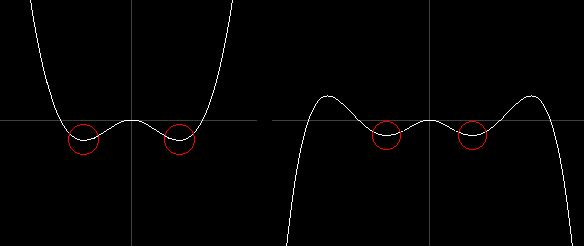
An analogy is also suggestive. When pushing an elastic stick which stands vertically on the desk, it settles the stablest state which breaks the rotational symmetry. Any small displacement around that stablest state causes the setting back force. That setting back force is interpreted as attraction when the repulsion is represented by the elasticity of that stick.
Another significant feature on the second spontaneous break of symmetry is that attraction around the ground state affects only one dimensionally. This is derived from the fact that the second spontaneous break of symmetry still keeps the symmetry of potential under the rotation around the global origin. Namely the potential changes locally along only the direction to the global origin. For example, it is easily confirmed that the gradient of the potential V = -(x12+x22+x32) + (x12+x22+x32)2 on the ground point (0, 2-0.5, 0) is null except x2-component. Since the quantization of field is applied around the ground point of potential, the vibration of harmonic oscillator on that point does not propagate except the direction x2.
Now the current-current interaction of down-a-on and down-b-on is calculated under the supposition that the second spontaneous break of symmetry has happened on the weak interaction mediated by Z boson in the electron. From the interaction terms of Lagrangian density for electron, it is expressed in energy-momentum space as,
HeL/R = -(e2/4) a(down)L/R* sm a(down)L/R (1/k2) b(down)* sm b(down)
- (e2/4) a(down)L/R* sm a(down)L/R [(gmn-kmkn·MZ-2)/(k2-MZ2)] b(down)* sn b(down)
(Ü g2g'2/(g2+g'2) = e2)
= -(e2/4) a(down)L/R* sm a(down)L/R (1/k2) b(down)* sm b(down)
- (e2/4) a(down)L/R* sn a(down)L/R [1/(k2-MZ2)] b(down)* sn b(down)
(Ü kn b(down)*sn = 0 since b(down)* satisfies Weyl equation)
= -(e2/4) a(down)L/R* sm a(down)L/R (1/k2) b(down)* sm b(down)
- (e2/4) a(down)L/R* sn a(down)L/R [sgn·t-2/(k(0)2-k(j)2-MZ2)] b(down)* sn b(down)
(Ü only (0)- and (j)-component of energy-momentum k survived due to
the second spontaneous break of symmetry.
sgn is a constant depending on whether the global interaction is attraction or repulsion.
In this case sgn = -1.)
where MZ is the mass of Z boson (unit: m-1). t2 is thought to be the extent of Z boson. Down-a-on and down-b-on in the electron are regarded as connected by a "string" which has the extent of Z boson. Here t2 is called T-area. (remark)
Next the expression of current-current interaction HeL/R is transformed into Lorentz space. We suppose it doesn't depend on time. Then it is expressed as,
HeL/R = òd4k eikx HeL/R
= -(e2/4) a(down)L/R* sm a(down)L/R (4pr)-1 b(down)* sm b(down)
- (e2/4) a(down)L/R* sn a(down)L/R (2t2MZ)-1exp(-MZ|x(j)|) b(down)* sn b(down)
(Ü remark)
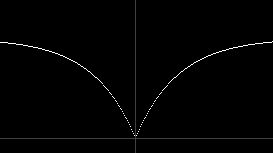
The above expression indicates the potential of weak interaction mediated by Z boson has the form: -exp(-MZ|x-y|) where |x-y| is the distance of down-a-on and down-b-on in the electron. Since potential has the physical meaning in its relative difference, it can be rewritten as V = (e2/4)(2t2MZ)-1{1-exp(-MZr)} where r = |x-y|. The following figure is the illustration of that potential.
Although a-on and b-on are not recognized as particles as mentioned before, it is thought their kinetic motions are still described with conventional physical laws, i.e. the energy E and momentum p of a-on and b-on satisfy the following equation in the free state.
E2 = p2 (Ü mhon (a-on/b-on) doesn't have rest mass)
However in electron, down-a-on and down-b-on are combined with the potential V. Thus the above equation is modified as,
E2 = p2 + V2
Supposing the condition of down-a-on and down-b-on doesn't depend on time and transforming the coordinates so as to put down-b-on on the origin of potential, the down-a-on in electron satisfies the following equation.
p(x(j))2 + V(|x(j)|)2 = E2
where E is constant. Quantizing the equation, we get the following Schroedinger-type equation.
-(h/2p)2c2·d2f(x)/dx2 + V2f(x) = E2f(x) (Ü p ® i(h/2p)c·d/dx)
where f(x)* = [f1(x)* f2(x)*] is the wave function of down-a-on. Since f1 and f2 are the independent solutions for the above equation, we choose one of these solutions and write it as f from now on. It should be noticed although f is the function of the distance from down-b-on which resides on the origin, down-a-on has the certain extent equivalent to T-area on the plane which is vertical to the direction to down-b-on, or the origin of potential.
You might notice that the effect of electrical interaction between down-a-on and down-b-on in the electron is neglected in the previous discussion. That's correct. It is shown numerically later the electrical effect is relatively smaller than that of weak interaction, however that electrical effect between down-a-on and down-b-on generates the mass of lepton and the difference of mass among generations is directly linked to the eigenstate appearing on the above equation.
We apply WKB method to solve the eigenvalue problem for the above equation. Firstly the above equation is rewritten as,
d2f/dx2 + (h/2p)-2c-2 (E2-V2)f = 0
then WKB requires the following equation should be satisfied.
òABdx (h/2p)-1c-1 (E2-V2)0.5 = (n+1/2)p (n = 0, 1, 2, ...)
where E = V when x = A and B. Approximating V as,
V @ (e2/4)(2t2MZ)-1MZx
we get (approximative) energy eigenvalue En as,
En = {2(h/2p)ce2(8t2)-1(n+1/2)}0.5 ...A)
Now we set following suppositions.
1. Total of generations are three.
2. Mass of lepton is caused from electrical repulsion between down-a-on and down-b-on.
If a particle belonging to the forth generation is found, the following calculations should be altered. The second supposition implies the mass of not only lepton but also quark is caused from electrical repulsion between more fundamental substance in it. From the above suppositions, it is guessed the electron corresponds to the eigenstate which has the energy E2. Roughly supposing that the down-a-on resides on the position r where E2 = V, i.e.
E2 = (e2/4)(2t2MZ)-1{1-exp(-MZr)} (r: distance between down-a-on and down-b-on) ...B)
the potential of electrical repulsion between down-a-on and down-b-on is calculated with that r as,
Pe = (e/2)2(4pr)-1
From the second supposition shown above, Pe is just equivalent to the mass of electron, i.e.
Me = Pe ...C)
In the equations (A) and (B) the unknown parameter is only t, therefore from the equation (C) we can calculate the concrete value of t using the actual mass of electron. The result is,
t = 1.016´10-19m (Ü remark)
namely the T-area is,
T-area = t2 = 1.032´10-38m2
Using this value the mass of muon is calculated. Since muon is thought to correspond to the eigenstate which has the eigenvalue of energy E1, the following equations should be satisfied.
E1 = (e2/4)(2t2MZ)-1{1-exp(-MZr')}
Pm = (e/2)2(4pr')-1
Mm = Pm
where r' is the distance between down-a-on and down-b-on in muon and it is calculated from the first equation shown above using T-area. The result is,
Mm = 113.69[MeV]
which is relatively close to the experimental value: 105.7 MeV. However when calculating the mass of tauon with similar way, the result is considerably different from experimental value. When supposing down-a-on in tauon is on E0 state, the calculated mass of tauon is,
Mt = 285.62[MeV]
and the mass of tauon obtained from experiment is 1784 MeV. That difference is thought to be caused from the previous rough approximation about the position of down-a-on in the lepton, i.e. down-a-on has been supposed to reside on the position where E = V. However obviously the distribution of down-a-on varies continuously following the previously mentioned Schroedinger-type equation:
-(h/2p)2c2·d2f/dx2 + V2f = E2f ...D)
In the cases of electron and muon, the peaks of distribution are certainly seen around the position where E = V as shown in the following figures. However in the case of tauon, since E0 state is in "zero-point vibration", the peak of distribution is seen at the center of potential as shown in the following figure, not the position where E0 = V. Therefore the effect of electrical repulsion should be considered much more than that of previous calculation.

Distribution of down-a-on in electron, muon, and tauon
The following applet solves the above equation (D) numerically and shows the wave function and probability distribution of down-a-on in the lepton.
On the panel "E (GeV)" means the energy E in the equation (D). As the default, E is set the energy corresponding to the eigenstate of electron. After clicking "Start" button, yellow, gray curves and blue line are shown.They indicate the wave function of down-a-on, potential of weak interaction mediated by Z boson, and inputted energy level respectively. If you tick on "f^2", then the probability distribution of down-a-on is shown instead of wave function.
As you might notice from the scale of energy level shown on the applet, the potential of weak interaction mediated by Z boson is very deep. Even in the base state the energy eigenvalue E0 is around 180 Gev, which is almost twice mass of Z boson. Hence the influence of electrical repulsion between down-a-on and down-b-on in lepton to the energy eigenvalue is almost negligible.
As previously mentioned, neutrino is thought to be composed of up-a-on and down-b-on. Since the electrical charge of up-a-on and down-b-on are +e/2 and -e/2 respectively, there is an electrical attraction between them. In the case of ne, the attraction has the same strength of the repulsion between down-a-on and down-b-on in electron. However that attraction is thought to be canceled out with the centrifugal force between up-a-on and down-b-on in neutrino. Consequently there isn't any mass observed for neutrino. However in the viewpoint of quantum field theory, the current-current interaction discussed above is regarded as the first-order approximation of perturbation for the Hamiltonian including interaction. When the second or higher order approximation is considered, neutrino may have its original mass (honestly saying I haven't calculated, though...)
Relativistic motion of electron interacting electromagnetic field is described with Dirac equation. Therefore the model of electron described above should be consistent with Dirac equation under the influence of electromagnetic field. In this case the weak interaction is not considered in Lagrangian form. Namely the Lagrangian density for down-a-on and down-b-on are simplified as,
Ldown-a = a(down)* ism (¶m + i(g/2) Am) a(down)
Ldown-b = b(down)* ism (¶m + i(g/2) Am) b(down)
since electric interaction has chiral symmetry, the symbols L and R are omitted. The total Lagrangian density for electron should include the interaction term derived from weak interaction between down-a-on and down-b-on. As described above, the electric interaction is negligibly smaller than weak interaction in electron, therefore that interaction term should be almost independent from electric interaction, i.e. it is written as,
Lint = a(down)* M b(down) - b(down)* M a(down)
where M corresponds to the electric potential energy between down-a-on and down-b-on in electron and it is equivalent to the rest mass of electron. Thus the total Lagrangian density for electron is,
Lelectron = Ldown-a + Ldown-b + Lint
Solving the equation:
d òd4x Lelectron = 0
we get,
ism (¶m + i(g/2) Am) a(down) + M b(down) = 0 ...E)
ism (¶m + i(g/2) Am) b(down) - M a(down) = 0 ...F)
(H.C.)
Let 4-component field y as,
y* = [a(down)1* a(down)2* b(down)1* b(down)2*]
then from the equations (E) and (F), we know y satisfies following equation,
gm (¶m + i(g/2) Am)y + M y = 0
where gm is Dirac's matrix. This equation is modified by appropriate gauge transformation as,
gm ¶m y' + M y' = 0
This is just Dirac equation. Next we consider to express the spin of electron using down-a-on and down-b-on in the electron. Since the constant M appeared in (E) and (F) has the unit: m-1, we rewrite M with the rest mass of electron Me as,
M = Mec/(h/2p)
The coupling constant g is expressed as e/{(h/2p)c}, therefore the equation (E) and (F) are rewritten as,
ism (¶m + ie/{2(h/2p)c} Am) a(down) + {Mec/(h/2p)} b(down) = 0 ...G)
ism (¶m + ie/{2(h/2p)c} Am) b(down) - {Mec/(h/2p)} a(down) = 0 ...H)
Since a(down) and b(down) are the solutions of the same Dirac equation, they have the same energy if they have positive energy. Now the gauge field Am is supposed to be independent from time, and a(down) and b(down) are supposed to be expressed as
a(down)(x, t) = a(down)(x, t=0)·exp{-iEt/(h/(2p))}
b(down)(x, t) = b(down)(x, t=0)·exp{-iEt/(h/(2p))}
then the equations (G) and (H) are rewritten as,
isk (¶k + ie/{2(h/2p)c} Ak) a(down) + {E/((h/2p)c) + ef/((h/2p)c) + Mec/(h/2p)} b(down) = 0 ...I)
isk (¶k + ie/{2(h/2p)c} Ak) b(down) + {E/((h/2p)c) + ef/((h/2p)c) - Mec/(h/2p)} a(down) = 0 ...J)
where Ak and f are vector potential and scalar potential respectively. Supposing,
E = Mec2 + ENR |ENR|, |ef| << Mec2
the equation (J) is modified with the above approximations as,
a(down) @ -{i(h/2p)/(2Mec)}sk {¶k + ieAk/(2(h/2p)c)} b(down)
Substituting a(down) in the equation (I) with the above expression, we get,
[-{(h/2p)2/(2Me)}{¶k + ieAk/(2(h/2p)c)}2 + {e(h/2p)/(4Mec)}skBk - ef] b(down) = ENRb(down)
(Ü formula: (skak)(sjbj) = albl + isl(a´b)l)
After appropriate gauge transformation, it is modified as,
[-{(h/2p)2/(2Me)}¶k¶k + {e(h/2p)/(4Mec)}skBk - ef] b(down) = ENRb(down)
Physically this equation means the b(down) has the magnetic moment -e(h/2p)/(4Mec) under the Coulomb potential -ef and magnetic field B. Similarly it is shown that a(down) also has the magnetic moment -e(h/2p)/(4Mec). Therefore the total magnetic moment is -e(h/2p)/(2Mec) and it is equivalent to that of electron.
Any Comment Welcome