SPORADES:
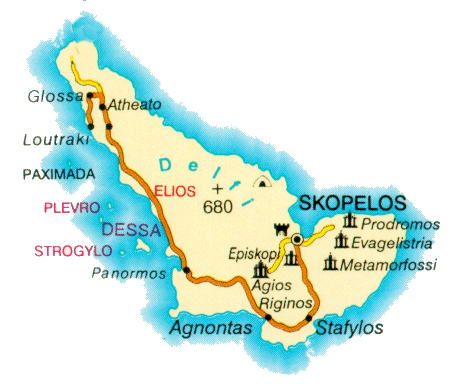
The island of SKOPELOS
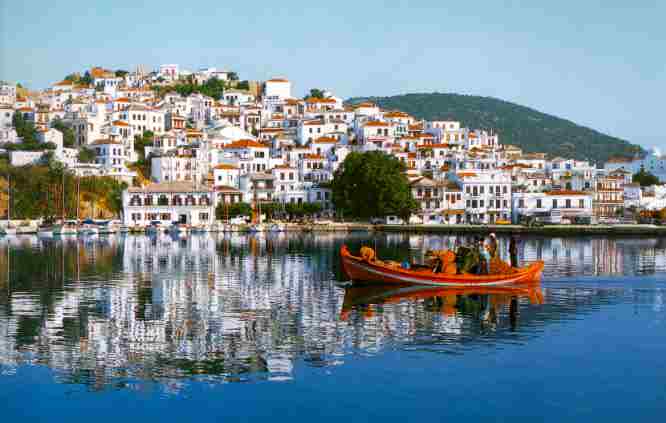
A view of Chora
SKOPELOS,
the ancient Peparethos, separated from Skiathos
by the Skopelos Channel, grows grape-vines, olives, almonds, pears, and
other fruit. A well-watered island of 95 sq. km., it is more intensively
cultivated than Skiathos.
Its 4500 inhabitants are more scattered, less seafaring, and more conservative.
Local costume may be seen on feast days and pottery is made.
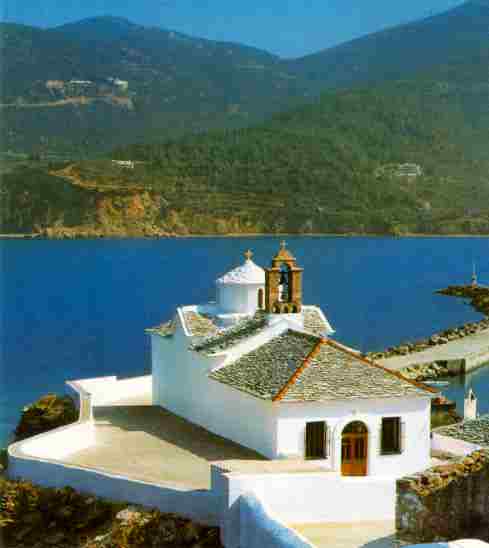
The church of
"Panayia tou Pyrgou"
HISTORY
OF SKOPELOS: The island was known as Peparethos in antiquity and its present
name first appeared in Hellenistic times (2nd century BC). According to
mythological tradition, the island was colonized by the Cretan king Minos
and its first inhabitants came here led by Stafylos, son of Dionysos and
Ariadne, and his brother Peparethos, landing in the bay still known as
Stafylos bay. In fact, archaeological evidence indicates that the island
was inhabited in Mycenaean times (1600-1700 BC). A tomb discovered in 1927
at the Bay of Stafylos is thought to be Stafylos' tomb. Among the lavish
grave offerings found in it was a sceptre of solid gold which is in the
Archaeological Museum of Volos and a large gold hilt from a sword which
is in the Archaeological Museum of Athens.
The
island was colonised by the Chalkidans in the Archaic period (700 - 500
BC). A member of the Athenian League, it passed under Macedonian rule (340-168)
and then returned to the Athenians. At the end of the following Roman period,
the patron saint of the island,Ayios Reginus was martyred there.
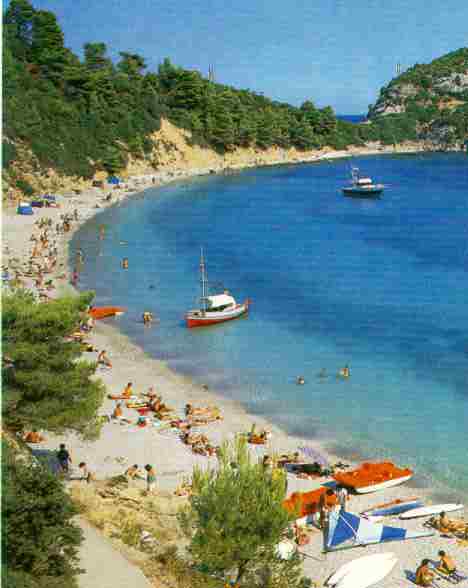
The beach of Stafylos
During
the Byzantine period, Skopelos was used as a place of exile. In 1204 it
was occupied by the Venetians to be re-occupied later by the knight Lokarios
of the Byzantine emperor Michael VIII Palaeologus and it remained in Greek
hands until 1453 when Constantinople fell to the Ottomans. This was followed
by renewed Venetian occupation under the family of Ghisi during which the
island was attached to the duchy of Naxos. In 1538 the Ottoman admiral
Haradin Barbarossa occupied the island and slaughtered all its inhabitants.
Skopelos was deserted for many years and only during the 17th and 18th
century did it begin to be inhabited once more; it then became organized
and also took part in the Greek War of Independence of 1821 and acquired
its freedom in 1832, along with the rest of the Sporades.
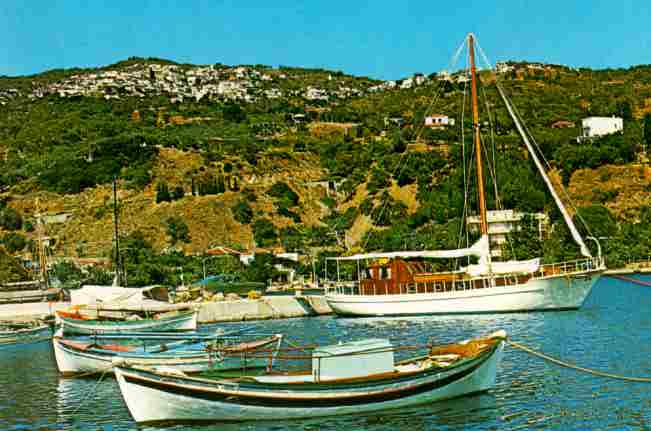
A view of Skopelos,
Glossa
SIGHTS-MONUMENTS
OF SKOPELOS: The capitol Chora Skopelourises imposingly on slopes above
a roadstead exposed to the blasts of the meltemi winds. The houses
have characteristic blue slate roofs quartered by white ridge tiles. Blindingly
white in the sun are th many little churches, said to number 123, some
of which, notably the Panayitsa, stand high on the steep W scarp
of the town. Their ikons and screens (17-18 C) are of good local workmanship,
notably those in the church of Khristo, which has a gilded 'choros'
or corona lucis. Pleasant black ware is produced by a local potter. Beyond
his workshop, E of the town, on the shore are vestiges of a Classical building
(Asklepieion?), fast being eroded by the sea. Farther on is Moni Episkopi,
former seat of the bishopric of Skopelos, suppressed in the last century.
Fragments remain of the church of 1078, possibly on the spot where Reginus,
first bishop and patron saint of Skopelos, was martyred in 362.
A
road crosses the island to Agnonda, a sheltered harbour on the S
coast where the boats call if the meltemi blows. It passes the bay of
Stafylos. Glossa, above the W coast facing Skiathos,
and Klima, a smaller village to the E, are reached from their little
port, Kalamaki, at which the steamers call. Glossa has Venetian
remains.
 Back to Sporades
read about greek
language
|



buck
to main page
|
| Skiathos
| Alonissos | Skyros
|
 Back to DUTh