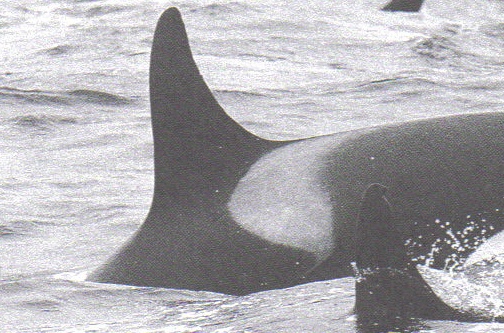
One of the greatest mysteries of the orca world is the sudden appearance of the offshore population.
The offshore orcas are a separate population from the residents (northern or southern) or transients. They have not been seen to interact with the other populations, and genetic evaluation has proven that, like transients and residents, offshores do not breed with the other populations.
So just who or what are the offshores?
Well, that's a hard question to answer. We really don't know much about them, although we are slowly learning more. They are harder to research than the others because, as their name suggests, they spend most of their time 'offshore'. This means that most of the time, they are out to sea. This is probably why we didn't notice them right away. Since they resemble residents, at first, if we did see them, we probably assumed they were just unidentified residents.
But then one day, a researcher discovered that the orcas surrounding the boat were not residents. Nor were they transients. Indeed, no one knew who they were. And so the mystery began.
We know few facts about the offshores. They typically live out to sea, and seem to occasionally wander inland. When they come to the coast, they appear curious and explore places before heading back out. They seem to be coming inland more and more, with them coming in 6 times last year. Or maybe we're just better at finding them.
It's not known how the other populations regard the offshores. However, there have been a few instances with residents. One, a pod of offshores came inland and was making their way into territory usually home to the residents. At the same time, Helena at OrcaLab was watching as the A30 matriline, lead by Tsitika/A30 herself, paced rather hesitantly up and down the entrance to the Strait, until the offshores ambled away. Researchers speculated that, perhaps, Tsitika was tentatively saying, "This is our home." She must have heard the offshores' calls, which was the most likely cause of their pacing. Was she defending her 'territory', her family, or was she just saying, "I don't know who you are, but we're the A30s and we live here"? Truth is, we don't really know. It seems impossible that the residents are as clueless as we are about the offshores; they must have met them before.
The offshores travel in large groups, larger than the residents, sometimes numbering up to 100. It's not known exactly what they eat, but researchers have long suspected that they follow resident eating patterns. There's been no evidence that they eat mammals. When a group of offshores became trapped in an inlet and later, sadly, died, those studying their bodies found that their teeth seemed unusually worn down. This lead researchers to speculate that perhaps they were eating sharks; the tough, sandpaper-like skin of sharks could account for the worn-down teeth.
There's a few physical differences that differentiate the offshores. They seem to be typically smaller than the residents/transients, and their newborns are especially tiny. Their saddle patches can be open (with some black in them) or solid grey, like the residents. Their fins also resemble residents; they are rounded and swept-back, but the tip is usually completely rounded, without the sharp angle that most residents have in the back.
Over 100 offshores have been identified by researchers, but this isn't really that much compared to the other populations. It seems that every time they show up, there are new whales that haven't been identified yet! But researchers are slowly making progress; thanks to diligence, hard work, and the growing number of offshore encounters, we are coming to learn more and more about who and what the offshores are.
On one last, interesting note, there's also a Stubbs-lookalike among the offshores! Stubbs/A1, the first orca to be photo-ID'd, had a fin that was cut down to a stubb, supplying her name. There is a offshore whale that also has a decapitated fin, who has been identified in at least two encounters.
That's all I know about offshores right now. Hopefully we can expect an ID book for them, but probably not for a while. If you have any info, IDs, or photos on them, EMAIL ME and make me happy :)
More photos:
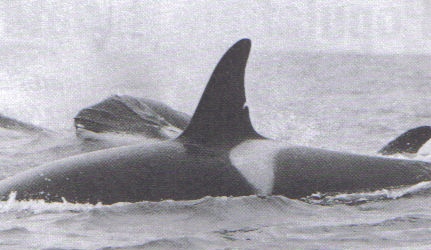
Above; O3, one of the ID'd offshores, off the Queen Charlottes. Scanned from the Blackfish Sounder.
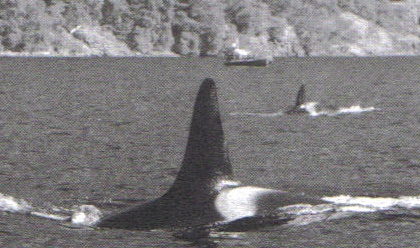
Above; A group of offshores in Saanich Inlet, September 2002. Scanned from the Blackfish Sounder.