|
|
|
Leeds were back in the European Fairs' Cup once again, and they made a convincing start in the tournament with an aggregate 6-0 triumph in the opening round against the Norwegian amateurs from Sarpsborg, but far stronger foes loomed up in round two, in the form of Dynamo Dresden of East Germany. Dresden were by no means as delicate as their famous china, and indeed they were decidedly rugged, as well as skilful, when they restricted United to a 1-0 victory in the first leg at Elland Road and because of that scoreline they felt capable of winning the tie behind the Iron Curtain. The second leg match was again a mixture of fierceness and brilliance, and at the final whistle Dresden had won the game 2-1, yet still went out of the Fairs' Cup as the aggregate scores were level, and because of an incredulous ruling, United's away goal counted double and they went through to the next round. Czechoslovakia provided the next challenge, but Sparta Prague put up only token resistance and Leeds swept them aside with scores of 6-0 at home, and 3-2 away - so entering the quarter-final - but before they met their Portuguese opponents in the next round, United were to experience the most humiliating defeat in their history. It was significant that the F.A. Cup fifth round was played on the 13th February, as far as Leeds United were concerned, for they were up against Fourth Division Colchester United on that modest club's tiny ground in Essex, and being given a difficult time even before the home team sent the crowd wild by taking the lead. But that was only the beginning of a nightmare for Leeds, who found themselves 3-nil in arrears after an hour's play, with the local fans by then in a state of frenzied euphoria, which was only slightly tempered when Norman Hunter and Johnny Giles pulled two goals back and precipitated a final desperate assault. Colchester held out for a deserved and famous victory, which turned football form upside down, but also showed how much Leeds could miss the driving force of skipper Billy Bremner, who was absent with a persistent leg injury which caused him to miss several matches, and it left one wondering just what effect such a shattering result might have at a vital stage of the campaign. Typically, United came straight back with five wins in succession, the last of which was against Vitoria Setubal, who were beaten 2-1 at Elland Road but - like several other sides before them - felt they could still win by a big enough margin on their own ground to enable them to go through to the Fairs' Cup semi-finals. However, like their predecessors Setubal found United a very hard nut to crack and the best they could manage was a one-all draw in Portugal. At one stage of the season Leeds United were seven points in front of their only serious rivals Arsenal, at the summit of the First Division table, but the Gunners had two or three games in hand and when they won those matches the gap closed considerably, before vanishing when West Bromwich Albion went to Elland Road with only four League fixtures remaining. Albion won the match 2-1, but their second goal caused great controversy, with a forward standing in an offside position a few yards from the ball and the referee overruling the linesman's raised flag to let play continue, and the consequent goal to stand - a decision that infuriated the fans so much that a few of them ran onto the pitch and the other linesman was hit by a thrown beer can. Leeds picked themselves up, as usual, winning by three clear goals at Southampton, and when Arsenal visited Elland Road two days after that for the 'crunch' game of the season, it was they who felt aggrieved at losing the match to a single Jack Charlton goal that appeared to be as blatantly offside, as Albion's second had been nine days earlier. Television later showed the referee to be probably correct in his ruling on Charlton's score, and some of the Arsenal players themselves conceded this, but it turned out to be of only academic importance anyway when the London side went to Tottenham for the last Division One match of the 1970-71 season needing either a scoreless draw to win the title on goal average or a win to take it outright. Arsenal beat Spurs 1-0, and completed a League and F.A. Cup double five days later when they defeated Liverpool at Wembley, and there was no doubting that it was a tremendous feat of resilience, consistency, and also skill - a word which had been used sparingly when people were describing Arsenal's attributes. |
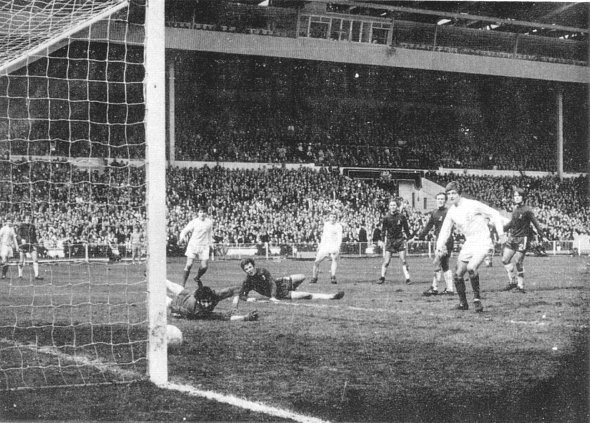 April 1970: The moment Leeds thought they had won the F.A. Cup as Mick Jones (socks rolled down) drives the ball in after 83 minutes at Wembley, but alas Chelsea fought back to equalise and win the re-play. |
|
The situation for Leeds United meantime, was by no means unfamiliar, for the European Fairs' Cup was the last hope they had of winning anything, with the crack Italian side Juventus to be overcome in the two legged final, if United were to lift that trophy for the second time in three years. To help them in that difficult task was Billy Bremner, who had returned to the team for the first leg of the semi-final against Liverpool at Anfield, and he had headed the goal from a Johnny Giles free-kick that won that match, and also the tie, as the return game at Elland Road, although at times superb, failed to produce any goals. Leeds had a frustrating experience in Turin when the first leg of the final had to be abandoned after 51 minutes due to torrential rain, with the scoresheet blank, but two days later it was re-played, and though twice behind United fought back each time to force a highly creditable 2-all draw, with Paul Madeley and Mick Bates scoring their goals. At Elland Road it was Leeds who took the lead through Allan Clarke, but the cool, skilful Italians kept playing their football and equalised before half-time, and then survived a second-half barrage from United to finish level at 1-1, which meant that Juventus had gone right through the tournament without losing a match. It was hard on them therefore when Leeds United took the Fairs' Cup on the away goals counting double ruling, and it was to the Italians credit that they accepted their 'defeat' sportingly with praise for United's display and congratulations on their success, but it reflected badly on the Fairs' Cup organizers that they should allow such an important competition to be decided in such an unsatisfactory manner.
|
|
|