b06navbackside.gif
Contact
Contact
b06navbacknorm.gif
 Locascio
  AP Biology 
b06navbackside.gif
Home
Home
b06navbacknorm.gif b06navbackside.gif
Syllabus
Syllabus
b06navbacknorm.gif b06navbackside.gif
Tutorials
Tutorials
b06navbacknorm.gif b06navbackside.gif
Notes
Notes
b06navbacknorm.gif b06navbackside.gif
Essays
Essays
b06navbacknorm.gif
Copyright © 2001 Locascio.org
Natural Selection
 

Natural Selection operates with four conditions:

  1. Reproduction
  2. Heredity
  3. Variation in individual characters (size, shape, height, color)
  4. Variation in the fitness of organisms (number of offspring, reproductive success)

What are the forces at work that bring about evolutionary change?

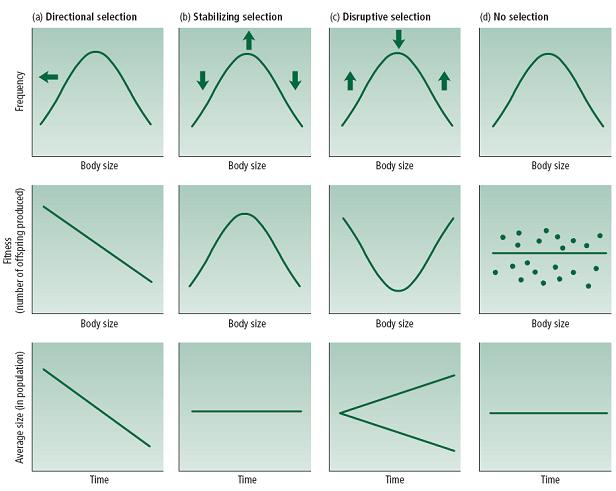
Directional Selection - Directional selection favors one extreme value for a particular trait in a distribution of these values. (example: smaller body size birds produce more offspring than larger birds, decreasing body size in a population)

Stabilizing Selection – Reduces phenotypic variance in a population (example: medium body size over extreme sizes keeping the population constant through a long period of time)

Disruptive Selection - Disruptive selection increases the population’s phenotypic variance.


b06navbackside.gif
Labs
Labs
b06navbacknorm.gif b06navbackside.gif
Links
Links
b06navbacknorm.gif b06navbackside.gif
FAQs
FAQs
b06navbacknorm.gif