The main islands in the Andamans are Land Fall Island, Middle Andaman, South Andaman, Port Blair and Little Andaman. Nicobar, lying to the south, comprises of Car Nicobar, Great Nicobar, Chowra, Teresa, Nancowrie, Katchal and Little Nicobar. The two groups of islands, Andaman and Nicobar, are separated by a deep ten degree channel. 12 of the islands, particularly Car Nicobar in the north, are inhabited, while Great Nicobar, the largest and southernmost island in the group, is virtually uninhabited. The capital of this Union Territory is Port Blair, on the Andaman Islands.
The existence of these islands was first reported in the 9th century by Arab merchants, who sailed past them, on their way to the straits of Sumatra. The first Western visitor was Marco Polo, who called it `the land of the head - hunters'. The islands were annexed by the Marathas in the late 17th century. In the early 18th century, the islands were the base of Maratha admiral Kanhoji Angre, whose navy frequently captured British, Dutch and Portugese merchant ships. Angre remained undefeated by the combined British / Portuguese naval task force, right up to his death in 1729.
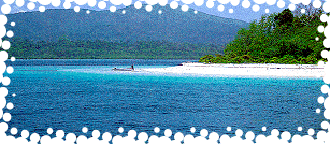
Jolly Buoy Islands, Andaman Island
The Andaman and Nicobar Islands were finally annexed by the British in the 19th century, and used as a penal colony for Indian freedom fighters. The penal settlement, known as Kala Pani or Blackwaters, was the `Siberia of India', where hard - core criminals were sent, never to be seen again. In the notorious `Cellular Jail', many of the inmates were executed, both judicially and clandestinely. Today, the infamous jail has been emptied, renovated and converted into a museum of freedom fighters. During World War II, the Japanese occupied the islands, and created their own record of cruelty. The local tribes took up guerrilla activities against the Japanese. After India gained independence in 1947, the islands were incorporated into the Indian Union.
The main aboriginal group in the Andamans are the Onges, who live on Little Andaman. Onges, like other Andamanese tribes, are of Negrito origin. They practice food - gathering, hunting, honey - collecting and fishing, and are the only tribe on the islands, who freely accept contact with the outside world. In the Nicobars, the only aboriginals are the Shompens, who are averse to any contact with the outside world. The Nicobarese, the largest group, seem to be of mixed Burmese, Malay, Mon and Shan origin. They are a friendly and cheerful lot, who do not accept money and prefer the barter system. Communing with the dead is one of the many intriguing rituals practiced in Nicobar.
Port Blair, which is the landing and departure point for boat excursions in the Andamans, is an ideal base for touring the archipelago of 321 islands. The island has been named after Lt. Reginald Blair, who conducted a survey of the area, in 1789. One of the fascinating features of the land, that can be seen throughout the islands, is that of houses built on poles. The island also houses all the administrative and government buildings, and people from all parts of the world live here, thus, giving it a rather cosmopolitan look.
Luxurious rainforests make the Andamans a 'gold mine' of timber. Tropical fruits are found on the hilly parts of the islands in abundance, while the fishery potential here, offers industrial possibilities. Paddy is the main cash crop here, while coconut and arecanut are the main cash crops of the Nicobar islands. Field crops namely pulses, oilseeds and vegetables and spices like pepper, cloves, nutmeg and cinnamon are also cultivated. Rubber, red oil, palm and cashew are grown on a limited scale on these islands. The major industries in the region include PVC conduit pipes and fittings, paints and varnishes, fibre glass, soft drinks and beverages, and steel furniture.
The islands are thickly covered by deep green jungles, inhabited by unique species of birds, and dotted with divine, sandy beaches on the fringes. The real attraction for the tourist lies in the crystal clear seas, that harbour some of the world's richest and unspoilt marine reserves. Filled with dazzling fish and kaleidoscopic corals, and roamed by schools of dolphins and sharks, the waters are perfect for snorkelling and scuba diving. This island is splendid with its golden, crescent - shaped beaches, mangrove forests, rich marine life, exotic flora and fauna.



