Himachal Pradesh is a mountain state, of charming crystal lakes, pretty flowers, ancient shrines and beautiful people. This state lies in the northern part of the country, in the lap of the mighty Himalayas, at an altitude that varies from 460 to 6600 metres above sea level. It is surrounded by Jammu and Kashmir, Uttar Pradesh, Haryana, Punjab and Tibet. Himachal Pradesh is enveloped by the Pir Panjal and Dhauladhar ranges in the northwest, dominated by the great Himalayas in the north and east and marked with lower ridges of the Shivalik ranges in the south-east.
Himachal has five mighty snow-fed rivers flowing through it - the Chenab, Ravi, Beas, Sutlej and Yamuna. Climatically, this state is divisible into two regions - the south which is as warm as the plains, and the north where the summers are temperate and winters are extremely cold.
History
The earliest known inhabitants of this region were tribals called Dasas, who entered the hills from the Gangetic plains, between the third and second millenium B.C. They were joined by the Aryans around 2000 BC and a number of tribal republics, called the janapadas, began to emerge in geographically separate regions of this state. The close of the 10th century saw the entry of Muslim rulers, in North India, through the north western passes. The Mughals were followed by the British, who were so taken up by the beauty of the state, that they made it the summer seat of the British viceroy. After Independence, 30 princely states of the area were united and Himachal Pradesh was formed on 15 April, 1948. With the reorganisation of Punjab on November 1, 1966, certain areas belonging to it were also included in Himachal Pradesh. It was declared a state of the Indian Union with Shimla as the capital, on January 25, 1971.
The people of Himachal Pradesh are simple and unsophisticated, lively and good natured, with a penchant for fairs and festivals. Most of them are fair complexioned with sharp Aryan features, while some have pronounced Mongloid features. The clothes of the Himachalis are colourful and each region is characterised by a typical dress. The headgear worn by both men and women is the unique feature of their attire. Hindi is spoken throughout Himachal, though each valley has its own dialect.
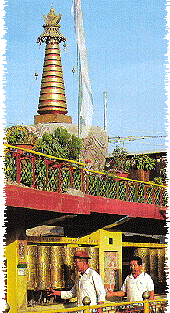
Buddhist temple in Dharmasala
Culture
Himachal also has a rich cultural heritage, and has a variety of dances, musical forms and architectural styles. Apart from the strong Shaivite influence and emphasis on the worship of Goddess Kali, there is also a large Buddhist following in the state. Each village also has its own patron saint or God. Himachal folklore is replete with legends, tales and songs of chivalry, love and victory of good over evil. The fairs and festivals celebrated here, are a veritable riot of colours. Kullu Dussehra (October), Lavi fair (November), Minjar fair (August-September), Manimahesh fair, Shivaratri fair (February-March), and Navratri fair (April and October) are among the famous religious celebrations of Himachal. The 200 odd temples of Himachal Pradesh, diverse in style are dedicated mainly to Shiva, Durga and Buddha. Baijnath, Chintpurni, Jwalamukhi and the Laxmi Narayan temples are a few of these shrines.
Sports
The snowy peaks, rugged slopes and wide valleys offer splendid opportunities not only for mountaineering, rock climbing and skiing, but also for hand gliding and river rafting. The state is an ideal place for trekking enthusiasts, and the trekking routes take you to remote, undisturbed locales.
Himachal is also a popular site for winter sports. Courses and competitions in skiing and mountaineering, carnivals, cultural evenings, and open air skating facilities form the traditional part of winter sports. Recently added attractions include hand gliding and river rafting.
Tourism
For the tourism enthusiasts, Himachal Pradesh can be divided into a number of circuits- the Dalhousie, Chamba and Bharmour circuit gives a glimpse into the romance and tradition of the state; Shimla, Chail and Narkhanda, forming the heart of Himachal, offers an excellent skiing base with eternal snowhives and 'darshans' at famous temples; Nahan, Renuka and Paunta is a small circuit with an enchanting assortment of lakes and legends; Kulu, Manali and Keylong with picturesque surroundings are a must on the Himachal tour; and, Palampur, Kangra and Dharamshala form the pilgrimage circuit.
Himachal Pradesh, a predominantly agro-pastoral economy has over three-fourths of its population, directly engaged in these sectors. Holdings are marginal with over 83.7 per cent of the farmers falling in the small and marginal category. Diverse agro-climatic conditions afford excellent opportunities for horticulture and cash crops.
The state's industrial policy aims at rapid, balanced and simultaneous growth of cottage, tiny , small, medium and large scale industries and service establishments. Priority is now being given to industries based on agro-horticulture produce, herbal resources, wool and sericulture and electronic industries. It now has 144 large and medium units, and 24,143 small scale units which provide employment to over 100,000 people.



