Lucknow, took almost two centuries to grow to the size of a metropolis. The first hundred years of success, belonged to the Nawab Wazirs who, in different degrees contributed to its growth and transformed it into, what has been metaphorically called, the "Shiraz of Avadh", and the "Constantinople of India". The Nawabs were responsible for imparting a distinct image to the city, which indeed, is unique. They worked meticulously to dress Lucknow, with religious and secular edifices of unsurpassed excellence. The city of Lucknow, spread evenly on both sides of the river Gomti, offers the tourist plenty of places of historical interest.
Sightseeing
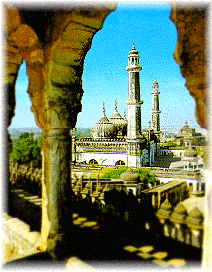
Bara Imambara
This magnificent edifice, recalling the past glory of the Nawab of Oudh,
is known for its simplicity of style, proportion and symmetry. Apart from
religious significance, this Imambara was built by Nawab Asafuddaula, to
provide relief to his subjects, during the famine of 1784. The absence
of pillars or supports in the main hall, which is over 50 feet in height,
is a unique achievement of architecture. This structure is also famous
for its fantastic labyrinth.
Chhota Imambara
This magnificent monument, built by Nawab Mohammed Ali Shah ( 1837 - 1842
) stands to the left of Rumi Darwaza, and is rather ornate in design. Chandeliers,
gilt-edged mirrors, colourful stuccos and the king's brilliant throne adorn
the interior of this tomb.
Lucknow Residency
Built during 1780-1800, it was once the political residence of the British
officials. Some of the bitterest eruptions of 1857 occured here. Cannon
marks can be espied on the walls all around.
Shah Najaf Imambara
A large white domed building, it houses the tomb of Nawab Ghaziuddin Haider,
and his family. Floral designs and chandeliers adorn the interior, and
the tombs are plated in gold and silver.
Rumi Darwaza
It is a fine massive gateway at the western edge of the Bara Imambara,
built by Nawab Asafuddaula, in 1784. On both sides of the gate, are beautiful
ornamental designs, radiating at the base and meeting at the top.
Jama Masjid
This grand mosque was built by Muhammad Ali Shah. Built in typical Mughal
style, it lies to the west of the Chhota Imambara.
Vidhan Sabha Building
One of the most imposing buildings in the city, it houses both bodies of
the State Legislature of the state.
La Martiniere
Adopting the salient features of Italian architecture, and blending them with the finest, indigenous architectural attributes of the Mughal and Hindu styles, Claude Martine, a French soldier, designed this building. Today, it houses one of the leading educational institutions of the city.
Husainabad Picture Gallery
Facing the Husainabad tank, is the Husainabad Picture Gallery, housing
portraits of the rulers of Avadh.
Zoo
The Zoo has some very rare species of birds and animals.
Access
Air: Indian Airlines connects Lucknow with Delhi, Patna, Calcutta and Mumbai.
Rail: Lucknow is an important junction of the Northern and North Eastern Railways of India.
Road: Lucknow is well connected with some major cities like Agra (363 km), Allahabad (225 km), Calcutta (985 km), Delhi (497 km), Kanpur (79 km) and Varanasi (305 km).
Accomodation
Taj Residency, Vipin Khand, Gomti Nagar. Tel: 393939, 391201-3. Fax: 392282
Hotel Gomti, 6, Sapru Marg. Tel: 232291, 234708, 220624. Fax: 231360
Arif Castles, 4, Rana Pratap Marg. Tel: 231313-17. Fax: 231360



