Meghalaya or 'abode of the clouds', is a source of inspiration to any poet, a dramatic canvas for an artist's dream, and the ideal retreat for people in search of beauty and solitude. Declared as a state on 21st January, 1972, Meghalaya is one of the most picturesque states of India, offering a spectrum of sylvan surroundings, rich cultural heritage, misty heights, breathtakingly beautiful waterfalls, luxurious vegetation, flora and fauna.
Carved out of the former state of Assam, Meghalaya is one of the seven sister states of the North-Eastern region, bordered by Assam in the north and Bangladesh in the south. Meghalaya is divided into five administrative districts of the Jaintia hills, East and West Garo hills and East and West Khasi hills. It is among the wettest places on earth - little wonder that Meghalaya means, Abode of Clouds. The state has a picturesque colonial capital, Shillong, and is home to an extraordinary diversity of people, which includes the Khasia, Jantia and Garo tribes.
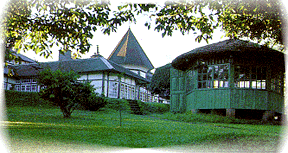
Raj Bhavan, the Governor's residence, Shillong
 Meghalaya
experiences the two seasons, of winter and monsoon, and is characterised
by a cool climate throughout the year. The Cherapunjee - Mawsynram belt
in the southern slopes of Khasi Hills records the heaviest rainfall in
the world. Numerous rivers flow through Meghalaya, although none of them
are navigable, due to rocky beds and strong currents.
Meghalaya
experiences the two seasons, of winter and monsoon, and is characterised
by a cool climate throughout the year. The Cherapunjee - Mawsynram belt
in the southern slopes of Khasi Hills records the heaviest rainfall in
the world. Numerous rivers flow through Meghalaya, although none of them
are navigable, due to rocky beds and strong currents.
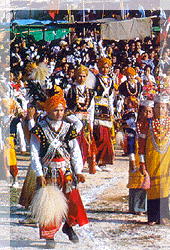
Dancers
 A
predominantly tribal population, the original inhabitants of this state
are Khasis, Jaintias and Garos. Khasis and Jaintias trace their ancestry
to the Mongolian race, while the Garos belong to the Tibeto-Burman race.
Their cultural traits and ethnic origins remain distinctive, mainly due
to their geographical isolation. The Khasi language spoken here, is believed
to be one of the few surviving dialects of the Mon-Khmer family of languages,
in India.
A
predominantly tribal population, the original inhabitants of this state
are Khasis, Jaintias and Garos. Khasis and Jaintias trace their ancestry
to the Mongolian race, while the Garos belong to the Tibeto-Burman race.
Their cultural traits and ethnic origins remain distinctive, mainly due
to their geographical isolation. The Khasi language spoken here, is believed
to be one of the few surviving dialects of the Mon-Khmer family of languages,
in India.
A common cultural tradition of all the tribes of Meghalaya is the matriarchal law of inheritance by which, custody to property and succession of family position runs through the female line, passing from the mother to the youngest daughter, instead of the male line as is common elsewhere in the country.
Short, muscular, robust and of complexions that vary from fair to dark brown, the tribal people of Meghalaya are sociable, cheerful, hardworking and great lovers of music and beauty. A unique characteristic is their habit of chewing unripe betelnut with dried tobacco, betel leaves and lime. The traditional costume of this place is the 'Jainsem' and the 'Dhara', though the younger generation has now taken to western clothes. The common food of the people is rice with meat and fish preparations. Rice beer is a favourite drink among the menfolk.
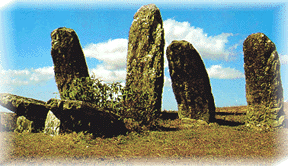
Monoliths erected by Khasi tribals in memory of ancestors
The majority of the population here has converted to Christianity, while non-Christians continue to worship, and practice old cultural beliefs. Colourful dances and festivals of the tribals, vary according to the region and tribe to which they belong.
The Government of Meghalaya, in order to render the festivities a major tourist attraction, organises annual festivals. Festivals, apart from those of the Christian faith, are held to signify occasions where ancestral spirits are appeased, following sowing and harvesting. Ka Pomblang Nongkrem, popularly known as the Nongkrem dance, is one of the most important festivals of the Khasis. It is held as a thanksgiving ceremony to God Almighty, for the harvest and as a prayer for peace and prosperity. Shad Sukmynsiem is another important festival of the Khasis. Behdiengkhlam, the most significant festival of the Jaintias is celebrated annually at Jowai in Jaintia Hills, during the month of July. The prominent festival of the Garos is Wangala, observed to honour and offer sacrifices to their principal deity, Saljong (Sungod).
Agriculture is the main occupation of Meghalaya, with eighty three percent of the total population, dependent on it for their livelihood. Rice and maize are the major food crops. Important fruits grown here are orange, pineapple, lemon, guava, jackfruit and bananas, while potato, jute, mesta, cotton, arecanut, ginger, turmeric, betel leaf and black pepper are the chief commercial crops. 'Jhum' or the shifting system of cultivation is being replaced with scientific methods, bringing land under permanent cultivation. Forest resources from pine and other timber products bring in the major chunk of state revenue. The state has many small scale industries in furniture making, iron and steel fabrication, tyre retreading and baking, to name the principal ones.
Meghalaya is dotted with a number of divine tourist spots, where Nature unveils herself in all her glory. Shillong, the capital city has a number of beautiful sites like, Ward's lake, Lady Hydari park, Polo ground, Mini zoo, Elephant falls and Shillong peak, overlooking the city and the golf course, one of the best in the country.



