A state, whose name is synonymous with high spirits, prosperity and passionate involvement with life, Punjab or 'Panj Aab' literally meaning five rivers, has distinct characteristics.
Situated in the north-west, the state of Punjab is bound by Jammu and Kashmir in the north, Himachal Pradesh in the north-east and Haryana and Rajasthan in the south. Pakistan lies to the west of Punjab. Blessed with extremely fertile soil, Punjab is watered by the rivers Beas, Sutlej, Ravi and Ghaggar.
History
Ancient Punjab formed a part of the vast Indo-Iranian region. It was subjected to repeated onslaughts from the Persians, Mauryans, Seithians, Parthians, Kushans and the Muslims.
The 15th and 16th centuries marked a watershed in the history of Punjab. In this period, the Bhakti movement received a great impetus with the advent of Sikhism on the scene. This was a socio-religious movement, which was directed at fighting the evils in religion, and society of the times. However, over a period of time, Sikhism acquired a militant flavour and challenged Mughal rule in northern India. Sikh Gurus like Guru Nanak, the founder of the faith, Guru Arjan Dev, Guru Harkishen and Guru Gobind Singh, the last Sikh Guru played important roles in the evolution of Sikhism, and also in the history of Punjab.
With the death of Guru Gobind Singh, the political influence of the Sikhs started dwindling. It was only after the weakening of the Mughal stronghold in Delhi, that the Sikhs reorganised themselves, and formed confederacies to present a united front. After two abortive Anglo-Sikh wars, Punjab was finally annexed to the British empire in 1849.
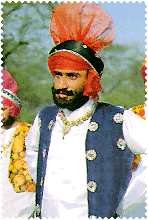
Bhangra artiste
 India's
independence from British rule in 1947, also saw the partitioning of the
country and the division of Punjab. Consequently, the state was reorganised
twice, and it was only in 1966, that the present Indian state of Punjab
came into being in its present form.
India's
independence from British rule in 1947, also saw the partitioning of the
country and the division of Punjab. Consequently, the state was reorganised
twice, and it was only in 1966, that the present Indian state of Punjab
came into being in its present form.
Economy
Punjab witnessed heavy destruction and damage during partition, yet it is one of the most affluent states in the country today. The mainstay of Punjab's economy, and the source of its affluence, is agriculture. Nearly 84 percent of the total geographical area of the state is under cultivation. Punjab alone contributed about 62 per cent of wheat, and 50 per cent of rice, to the central pool in the 1994-95 seasons, despite the fact, that it comprises only 1.53 per cent of the area in the country. Besides wheat and rice, the other crops grown in the state are maize, gram, pulses, cotton, oilseeds, sugarcane, potato, onion, mustard and sunflower.
Punjab's contribution to the industrial development of the country is mainly through its 1,88,000 small scale units which have a capital investment of Rs. 19,730 million. These units produce bicycle parts, sewing machines, hand tools, machine tools, auto parts, electronic items, sports goods, hosiery, knitwear, textiles, sugar, surgical and leather goods. Besides these, there are 475 large and medium scale units with an investment of Rs. 64,200 million. Attracted by the improved investment climate in the state, a number of foreign investors have come forward to set up industries, and to collaborate with the existing units.
The major city in Punjab is Amritsar, the holy town of the Sikhs. The famous Golden Temple stands in the middle of this city, which is visited by people from all over the world. Other places of tourist interest in Punjab are the Durgiana Mandir and Jallianwala Bagh in Amritsar, Takhat Kesgarh Sahib in Anandpur Sahib, the Bhakra Dam complex and the Sodal temple at Jalandhar.
Festivals
Punjabi festivals are celebrated with great gusto. Baisakhi (in April) is the most famous of Punjabi festivals. It is of special significance for the Sikhs, for it is on this day in 1689, that Guru Gobind Singh organised the Sikhs into the 'Khalsa'. During Basant (January/February), Punjabis welcome spring, when the mustard fields turn golden and winter is practically over. Punjabis in yellow garments hold feasts and kite-flying competitions, and take part in community singing and dancing. Another great festive occasion is the Jor Mela, when thousands of people gather at Sirhind, in rememberance and devotion to Guru Gobind Singh. Hymns and recitations of the holy epics by folk minstrels and poets come together with the joyous cadences of folk music and the earthy, invigorating rhythms of the popular dances: the exuberant Bhangra and Gidda. Besides the Guru-ke-Langar (free meals) which cater to the throngs of devotees, one can also enjoy scrumptuous regional dishes while browsing through a variety of exotic handicrafts, jewellery, traditional weapons and costumes.
Holi,Dussehra and Deepawali, the common festivals of India are celebrated in Punjab with great joy and abandon. They also observe the birth anniversaries of the ten gurus with special devotion and enthusiasm.



