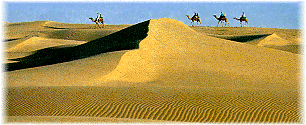
 Rajasthan,
the erstwhile abode of princes, is India at its colourful best. The earliest
inhabitants of this part of western India were tribes who settled in a
few fertile tracts, and groups of nomads, who travelled with their herds
from one oasis to another. These tribes were ruled by chieftains, who gradually
carved out their own fiefdoms. These early fiefdoms developed into flourishing
kingdoms, over a period of time. These kings constantly fought each other,
and each one developed a warlike ethos and a defensive style of architecture.
Trade sustained these kingdoms, for the trade route into India passed through
the deserts of western India. Collectively, these princely states came
to be known as Rajputana or the Land of the Kings, and today it is known
as the modern Indian state of Rajasthan. Rajput kings controlled this part
of India for over 1000 years, according to a code of chivalry and honour,
which was marked by pride and independence. The charismatic Rajput warriors
were known for their bravery.
Rajasthan,
the erstwhile abode of princes, is India at its colourful best. The earliest
inhabitants of this part of western India were tribes who settled in a
few fertile tracts, and groups of nomads, who travelled with their herds
from one oasis to another. These tribes were ruled by chieftains, who gradually
carved out their own fiefdoms. These early fiefdoms developed into flourishing
kingdoms, over a period of time. These kings constantly fought each other,
and each one developed a warlike ethos and a defensive style of architecture.
Trade sustained these kingdoms, for the trade route into India passed through
the deserts of western India. Collectively, these princely states came
to be known as Rajputana or the Land of the Kings, and today it is known
as the modern Indian state of Rajasthan. Rajput kings controlled this part
of India for over 1000 years, according to a code of chivalry and honour,
which was marked by pride and independence. The charismatic Rajput warriors
were known for their bravery.
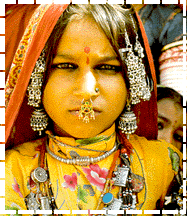
Young Rajasthani girl
With the arrival of the Muslims to India and with the rise of the Mughals, most Rajput kingdoms gradually lost their independence, and became a part of the mighty Mughal empire. With the decline of the Mughals, the Rajputs gradually clawed back their independence through a series of spectacular victories, but, by then a new force to reckon with, had emerged on the scene in the form of the British. Most Rajput states entered into alliances with the British, which allowed them to continue as independent states, each with its own maharaja, subject to certain economic and political constraints. These alliances proved to be the beginning of the end of the Rajputs, and soon the extravagance and indulgence of the rulers led to the disintegration of the Rajput kingdoms.
After 1947, most Rajput rulers were allowed to keep their titles and property holdings but in 1970, these titles were abolished. While some of these rulers have survived, by converting their forts and palaces into museums and hotels, many have been unable to cope with the financial demands of the 20th century.
Although the glorious fortunes of its former rulers may have vanished, the culture of Rajasthan, with its numerous forts, palaces, its riotous colours and its romantic sense of valour, honour and courage is still very much alive. The inherent buoyancy and charisma of the land is evident in every aspect of the lifestyle of the people, and also, in the colourful turbans and soup-strainer moustaches sported by the men, and bright mirrored skirts and silver jewellery worn by the Rajasthani women. Tourism has obviously made inroads here, but the traditional sense of honesty and the essential vitality of the Rajasthanis has not been affected.
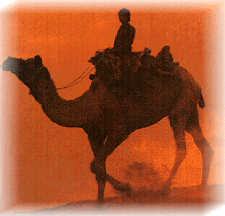
Though parts of the state are extremely dry, and are covered by the Thar desert, some areas are used for agricultural purposes. The total cultivable area in the state is 27,465 thousand hectares, and the sown area, 20,167 thousand hectares. Principal crops cultivated in the state are rice, barley, gram, wheat, oilseeds, pulses, cotton and tobacco. Other crops are red chillies, mustard, cumin seeds, fenugreek seeds and asafoetida.
Rajasthan is also endowed with rich mineral resources, and the state is fast emerging on the industrial scene of India. Zinc and copper are the important minerals found here. Industrial undertakings include textiles and woollens, sugar, cement, glass, vegetable dyes, pesticides, zinc, fertilisers, synthetic yarn and railway wagons.
Rajasthan is also a land of festivals and fairs. Besides the national festivals, birth anniversaries of gods and goddesses, saints, folk heroes and heroines are celebrated in this state. Important fairs are Teej, Gangaur and Urs at Ajmer, Kumbh mela at Baneshwar, Kartik Poornima and the Cattle Fair at Pushkar-Ajmer.
Rajasthan is recommended as a tourist destination even on a short trip to India. Tourist centres in Rajasthan include Jaipur, Jodhpur, Udaipur, Bikaner, Mount Abu, Sariska tiger sanctuary, Ajmer, Jaisalmer, Chittaurgarh and Bharatpur.
Jaipur, the stronghold of a clan of rulers in the past and now the capital of Rajasthan, has three hill forts and a series of palaces as its major attraction. Western Rajasthan itself forms a convenient tourism circuit, in the heart of the Thar desert. The three cities of Jodhpur, Jaisalmer and Bikaner create a perfect portrait of this beautiful desert land. Jodhpur, on the edge of the desert was once the capital of the state of Marwar. Dominating the city is the hilltop fort of Mehrangarh, one of Rajasthan's great hilltop forts. From the fort, one gets a magnificent view of the Umaid Bhawan palace, built of golden sandstone in the early part of this century. Jaisalmer lies deep in the heart of the desert. The Jaisalmer fort rises out of a sea of sand, its rounded battlements of golden stone echoing the colour of the desert sand. The other chief attractions of this city are a lacy filigree of pierced stonework facades of private houses, and a series of ornately carved Jain temples. Bikaner also stands as an impressive testimony to the past, with its amazing sandstone palace, temples and cenotaphs.
In the north of Rajasthan, is the Shekhavati region easily approachable from Jaipur, by road. The greatest attractions here, are the deserted mansions of local merchants, decorated with a profusion of wall paintings. The subjects and styles vary greatly and are not encountered elsewhere in India. Nearby are Dundlod and Mandawa, the rugged forts which are now converted into hotels, surrounded in an aura of rare medieval charm.
In the south west of Rajasthan are Bundi, Kota and Jhalawar famous for their palace-forts, galleries of fine frescoes, and stunning temples. For lovers of wildlife, Kota also has the Dara wildlife sanctuary where tigers, bears, wild boars and spotted deer roam the thick green jungles.
About 135 kilometres southwest of Jaipur lies Ajmer, the most sacred of all Muslim pilgrimage sites in India. 14 kilometres from Ajmer is Pushkar, placed in the top rung, in the hierarchy of Hindu places of pilgrimage. Here, every year, on the full moon in November, thousands of pilgrims gather to bathe in the sacred lake. This is also the occasion for one of the largest cattle fairs in Rajasthan.
Udaipur, the erstwhile royal house of Mewar has a profusion of palaces, lakes, temples and cenotaphs. The places to visit in and around Udaipur are the City Palace, Pichola Lake, Jag Niwas, Jagdish Temple, Eklingji Temple, Nathdwara, Rajsamand and Jaisamand. Chittor, Kumbalgarh and Mandalgarh also lie near Udaipur, and are famous for their almost impregnable forts.
Situated on an isolated plateau, about 1200 meters above sea level, Mount Abu, famous for its exquisitely carved Jain temples is a delightful summer and winter resort. The main attractions here are the Dilwara Jain temples, of which two, the Adinath and Neminath, display an incredible wealth of carving in white marble.



