Tripura is mainly a hilly territory with altitudes varying from 50 to 3080 ft above sea level, though the major population of the state lives in the plains. Characterised by moderate temperatures and highly humid atmosphere, Tripura is best visited after the south west monsoons in October.
Today, Tripura is largely a Bengali community, inspite of the 19 Scheduled Tribes, that form a major chunk of the population. Hinduism, Islam, Buddhism, and Christianity are the main religions followed in Tripura.
The tribals, with a rich and varied culture, belong mainly to the Reang, Chakma, Halam and Usai communities. The majority of tribals live in elevated houses of bamboo called 'Tong'.
To welcome, recognise, help and patronize art and culture, whether alien or native, has always been a Tripuran tradition. Rabindranath Tagore was first recognised for his genius in the Royal Court of Tripura, and his long association with the ruling family of Tripura, has inspired the Bengali community here, to adopt the Rabindra style.
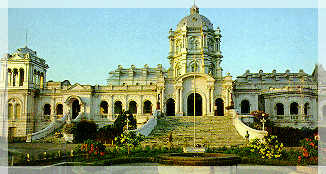
Rajbari in Agartala
 Music
and dance are an integral part of Tripura. Joy and sorrow are marked by
dances, that mirror the myriad emotions of the people. Garia dances held
for the prosperity of the people during Garia Puja; dances of the Reang
community; 'Bizu' dances by the Chakmas denoting the end of the Bengali
calendar year; 'Hai Hak' dances of the Halam community; and the Cheraw
dance associated with the confinement of Lusai woman, are evidence of the
Tripuran passion for dance. 'Basanta Raas' is the charming dance of the
Hindu Manipuris, in Tripura.
Music
and dance are an integral part of Tripura. Joy and sorrow are marked by
dances, that mirror the myriad emotions of the people. Garia dances held
for the prosperity of the people during Garia Puja; dances of the Reang
community; 'Bizu' dances by the Chakmas denoting the end of the Bengali
calendar year; 'Hai Hak' dances of the Halam community; and the Cheraw
dance associated with the confinement of Lusai woman, are evidence of the
Tripuran passion for dance. 'Basanta Raas' is the charming dance of the
Hindu Manipuris, in Tripura.
Handlooms and handicrafts of Tripura reflect the inherent quality of workmanship, and uniqueness of the people. Simple materials such as bamboo, cane, palm leaves and ordinary yarn are used to create a fascinating variety of handiwork. Intricately designed handlooms and silk, cane and bamboo works are the main industries. Furniture, toys, objects of daily utility such as lamp shades, baskets, calendars, ivory work and Tripuran tribal jewellery, make shopping here a fantastic experience.
Durga Puja, Kharchi Puja, Diwali, Doljatra (Holi), Paus Sankranti Mela, Ashokashtami and Buddha Jayanti are the main fairs and festivals of Tripura. Ker Ganga and Garia Puja are the traditional tribal festivals.
Tripura has a lot to offer to the tourists. Agartala, the picturesque capital, with its beautiful palaces, gardens, hills, temples and lakes, scenic Tirthamulkh with its lakes; waterfalls and reservoir are all worth visiting. Pilak Pather and Lungthung are virtual treasure troves for those, historically inclined. Jampol hills, Rudrasagar and Neer Mahal—the lake cities, Sepahijala—the wildlife sanctuary, and the temples in and around Udaipur, are the other major places of interest in this tiny state.
A visitor to Tripura, would be witnessing the awakening of a land, hitherto bound by tradition. Traditionally an agricultural land,Tripura is slowly making advances into the industrial field, with the Oil and Natural Gas Commission having set up one of its sprawling complexes on the green hills of Baramura.



