 |
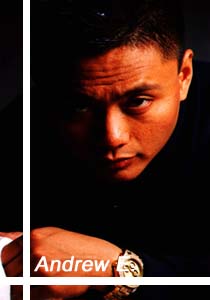
Andrew E.
It's not a surprise to find Andrew E. hollering up on the finer points of pop culture, Filipino or otherwise. It's in his rapper's interest to do meticulous research on just this sort of thing, nicking off bits and pieces from the psyche of youth and serving them up in soundbyte chunks in the in-your-face idiom of hiphop. People who know Andrew know that this local boy takes his hiphop seriously, and is trying to find ways to legitimize the genre in a Filipino context. Since 1983, when he saw a black guy rapping in a gas station near Subic Bay, he has been fascinated with hiphop. "You'll really discover a lot about black culture when you listen to rap albums," he says. The much-maligned use of slang--particularly the subject-verb disagreement ("Give me a rap song that has an 's' ending the verb!")-- is a celebration of the rhythms of ghetto speech as well as defiance of the white man's crusty use of correct grammar. "The whole thing is really a process of loving one's culture," he adds. "Like that bit about 'never correcting my broken English.' We can identify with that." Starting his showbiz career as a DJ in Euphoria disco in 1989, Andrew E. catapulted to fame in 1991 with the monster hit, "Humanap Ka Ng Pangit," a novelty song about taking the path of least resistance when it comes to choosing a partner for life. Rapping about the virtues of the plain looking and not exactly being matinee-idol material himself struck the public as funny and amusing, but it also opened Andrew E. to censure from certain quarters. It didn't help that the song also launched a successful movie career, with the rapper getting choice leading ladies in the 22 movies that followed his rise to stardom. Another song, "Binibirocha," gave him infamy to spare. There was talk of his songs being banned from radio, and made Andrew E. even more a household name. Success may be a lot sweeter this time. Apart from his Sony album, Andrew E. just has become the first Filipino artist to cut a record in Nihongo. June 3 last year, he released the mini-disc "Bakajanai" in Japan under the newly formed Tobita Music World label, an independent outfit which is distributing the record in Tokyo, Osaka, and Nagoya, three major cities. Prospects for a major hit in this highly inaccessible market are good, he says. Translated, "Bakajanai" means "Hindi Ako Gago," and apart from chronicling the misadventures of a tourist (he styles himself in Japan as Anduru E.) in Tokyo, the single is remarkable for the boldness of its title. "Japan is a very polite society. This is the very first song in Japan, which used the word, 'gago.' Hearing the word is enough to get their attention. More so when they listen to the story, which is about a tourist who wanted to go to the club district of Shinjuku but ended up in very wa-class Shimbashi. And yet he claims hindi siya gago." And because rapping goes against the grain of traditional Japanese hospitality ("Even when they're angry, they're so formal," he observes.) and pop fare ("There, it's either all love songs o mga kanta ng mga walang pag-asa sa buhay"), he has a swell chance of carving a niche for himself. Since 1997, Andrew E. had been making annual trips to perform in Japanese clubs. On his third stint April this year, he caught the fancy of Yukio Tobita, a Japanese businessman who was so delighted with his songs and performance style he set up a label just for the rapper. Andrew E.'s two-song mini-disc (the other cut is "Setagaya Girl," which he says is sort of like the Japanese equivalent of his hit "Alabang Girl") is distributed along the Osaka-Tokyo-Nagoya bullet-train commuter route, thus giving it major exposure in the Japanese market. His recent releases Wholesome and Much More Wholesome are still selling high in record stores. (source: Sony Music Philippines) |