 |
 |
 |
|
|
|
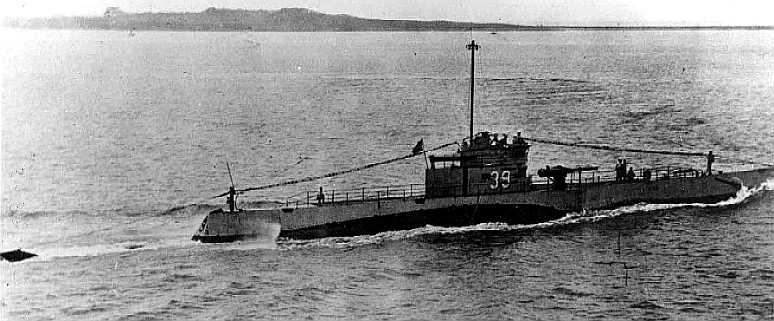
After commissioning and fitting out, USS S-39 (SS-144) joined Submarine Force, Battle Fleet, and, from October through December 1923, conducted maneuvers off southern California. With the next year, 1924, she moved south to the Panama Canal, thence proceeded into the Caribbean for final trials, further exercises and training dives. By April, she was back at Mare Island for her first overhaul.
On 17 September, S-39 departed San Francisco for the Philippines. Steaming via Pearl Harbor and Guam she arrived at Manila on 5 November, joined the Asiatic Fleet as a unit of Submarine Division 17 (SubDiv17); and commenced local operations and drills in the Luzon area. In mid-May 1925, she sailed for the Asiatic mainland with her division; and, after brief stops at Amoy and Hong Kong, arrived at Tsingtao, whence she operated until early September. She then returned to Manila and for the next 16 years maintained, with few interruptions, a similar schedule: summers based at Tsingtao, with patrols along the China coast; and winters in the Philippines, for overhauls, engineering trials, joint Army-Navy maneuvers type training exercises, and short patrols.
Just prior to the entry of the United States into World War II, S-39 patrolled off southern Luzon. After 8 December, she moved into San Bernardino Strait to impede Japanese mining activities. The escorts screening the minelayers, however, kept the American submarine at bay with persistent depth charging. On the 11th, S-39 endured a day-long pounding. She then turned to a more hopeful mission, cutting into the Japanese supply line. On the13th, she contacted and attacked an enemy freighter, but, again escorts interfered and her crew was prevented from verifying a sinking. She continued her patrol, unsuccessfully chasing other targets, until 21 December when she returned to Manila.
Increased enemy air activity soon rendered naval installations in the area untenable, and S-39 was ordered to Java to join what would become, in mid-January 1942, the ABDA command. Conducting her second war patrol en route, she arrived at Surabaya on 24 January; underwent an abbreviated availability; and departed for her third patrol. Operating in the South China and Java seas, she reconnoitered Chebia Island, in the former sea, in search of British refugees from Singapore. Unsuccessful, she returned to the Java Sea and, on 4 March, sank a 6,500-ton tanker. Two weeks later, she arrived at Fremantle Australia; and, by the end of April, had moved on to Brisbane, whence she departed on her fourth patrol on 10 May. During the next four weeks, she reconnoitered designated areas of the Louisiade Archipelago, then operated in the Solomons.
After having started twice for her fifth patrol, and being forced to return to Brisbane because of major breakdowns S-39 once more was faced on 7 August 1942 with the necessity for heading toward land. Her XO had been put on the sick list on 5 August, and two days later his condition warned of the development of pneumonia, so Brown asked for instructions and was directed to proceed to Townsville, on the northeast coast of Australia. On 10 August in the smooth waters of Townsville harbor, the officer was transferred for further medical treatment, and S-39 once more got underway for her patrol area off the southeast coast of New Ireland.
During the night of 13-14 August, S-39 struck a submerged reef off Rossel Island, in the Louisiade Archipelago. The boat took a port list of 30 to 35 degrees, and was jolted heavily due to heavy following seas breaking over the deck. Backing the screws had little effect, even after all possible fuel and ballast tanks had been blown dry. The boat began swinging broadside to the sea and was being washed farther up on the rocks, so all fuel and ballast tanks were again flooded to hold her steady.
At high tide on the morning of 14 August the screws were backed and twisted until the low voltage limit on the batteries was reached. The boat backed about 50 feet, but again listed about 30 degrees to port and pounded heavily on the rocks. Ballast tanks ruptured by the rocks were again flooded in an effort to ease the pounding. In the afternoon word came from Australia that HMAS KATOOMBA would arrive the following morning to lend aid.
Throughout the day breakers 15 to 20 feet high broke over the boat. Efforts were made to charge the batteries, but several cells had been reversed and only the after battery could be charged. Shortly after dawn on the 15th, the torpedoes were inactivated and fired. Again Brown tried backing on the after battery, but the screws were too high and had little effect. With the termination of backing efforts, the ship rapidly rolled over until the list was 60 degrees port. Fearing the seas would roll the boat entirely over, the Commanding Officer gave permission for anyone who desired to swim to a nearby reef, although he was not ready to abandon ship. No one ventured into the water, but Lt. C.N.G. Hendrix volunteered to swim to the reef with a line and then to haul the two mooring lines to the reef as a riding line for the rest of the crew.
When Hendrix had gained the reef and was having a difficult time with the lines, due to the seas, W.L. Schoenrock, CCStd(PA), offered to swim ashore and help. The two men pulled in the lines and secured them to one of the torpedoes, which was resting on the reef. Thirty-two men reached the reef via the line, and twelve remained aboard when KATOOMBA arrived shortly after noon.
By 1000 on 16 August KATOOMBA's boats had made three trips to
shore and all hands were safely aboard the ship. It was felt that S-39
would soon be broken up by the pounding seas, and no attempt was made
to shell her from KATOOMBA. the S-39 crew members arrived
in Townsville, Australia, on 19 August 1942, and were assigned further
duty in submarines.