|
|
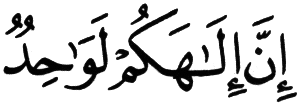
Since the total submission of one's will to Allah represents the essence of worship, the basic message of Allah's divine religion, Islam is the worship of Allah alone and the avoidance of worship directed to any person, place or thing other than Allah. Since everything other than Allah, the Creator of all things, is Allah's creation; it may be said that Islam, in essence calls man away from the worship of creation and invites him to worship only its Creator. He is the only one deserving man's worship as it is only by His will that prayers are answered. If man prays to a tree and his prayers are answered, it was not the tree which answered his prayers but Allah who allowed the circumstances prayed for to take place. One might say, "That is obvious," however, to tree-worshippers it might not be. Similarly, prayers to Jesus, Buddha, or Krishna, to Saint Christopher, or Saint Jude or even to Muhammad, are not answered by them but are answered by Allah. Jesus did not tell his followers to worship him but to worship Allah. |
|






PRAYER (Salaah) : Salaah
is the name for the obligatory prayer which are performed five times a day, and are a
direct link between the worshipper and God. There is no hierarchical authority in Islam
and no priests, so the prayers, are led by a learned person, chosen by the congregation
who knows the Qur’an. These five prayers contain verses from the Qur’an, and are
said in Arabic, the language of the Revelation, but personal supplication can be offered
in one’s own language.
A TRANSLATION OF THE CALL TO PRAYER:
Allah is most great. Allah is most great.
Allah is most great. Allah is most great.
I testify that there is no God but Allah.
I testify that there is no God but Allah.
I testify that Muhammed is the messenger of Allah.
I testify that Muhammed is the messenger of Allah.
Come to prayer! Come to prayer!
Come to success (in the life and the hereafter)!
Come to success!
Allah is most great. Allah is most great.
There is no God but Allah.
COMPULSORY CHARITY
(Zakaah): One of the most important principles of Islam is that all things belong to
Allah, and that wealth is therefore held by human beings in trust. The Arabic word zakaah
means both ‘purification’ and ‘growth’. Our possessions are
purified by setting aside a portion for those in need, and, like the pruning of plants,
this cutting back balances and encourages new growth. In most cases this involves the
payment each year of two and a half percent of one’s surplus savings.
FASTING (Sawm):
Every year in the month of Ramadan, all Muslims fast from the first light until sunset.
Abstaining from food, drink, and sexual relations. Those who are sick, elderly, or on a
journey, and women who are pregnant or nursing are permitted to break the fat and make up
an equal number of days later in the year. If they are physically unable to do this then
they must feed a needy person for every day missed. Children begin to fast (and to observe
prayer) from puberty, although many start earlier. By fasting, one cuts himself off from
worldly comforts, for a short time and gains true sympathy with those who go hungry which
leads to growth in one’s spiritual life.
PILGRIMAGE (Hajj):
The annual pilgrimage to Makkah- the Hajj - is an obligation only for those who are
physically and financially able to perform it. Nevertheless, about two million people go
to Makkah each year from every corner of the world providing a unique opportunity for
those of different nations to meet one another. Although Makkah is always filled with
visitors, the annual Hajj begins in the twelfth of the Islamic calendar (which is
lunar and not solar, so that Hajj and Ramadan fall sometimes in summer, sometimes
in winter). Pilgrims wear special clothes: simple garments which strip away distinctions
of class and culture, so that all stand equal before God.


 THE MESSAGE OF ISLAM