Explorations





Geographically, Ecuador can be divided into three primary regions: the Coastal Lowlands, the Central Highlands, and the Eastern Rainforest Basin.
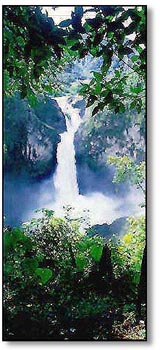
The inhabitants of the coastal lowlands, especially those of Guayaquil, have long considered themselves a breed apart. Though travelers are greeted warmly, the coastal regions were so resistant to the Spanish that African slaves had to be brought in to provide a labor base to work the rich farmland. Tied to this independent sentiment is a land of roaming beaches, luxuriant plains, and dense mangrove forests. Some of the world's best preserved mangrove forests can be found along the northern coast. A ride on a pongu boat through the dark, hidden world of the mangrove tree enlightens the visitor to one of the most ecologically important environments in Ecuador. More than beautifully intricate, the meshy roots of the mangrove offer protection to the spawn of oceanic fish, which come to the forests to breed. In the branches above, colorful toucans and a host of other birds provide dizzying acoustics.
Guayaquil
Located at the mouth of the Guayas River, this coastal city has always been the largest and most liberal-minded in Ecuador. Its fiercely independent and progressive populace has at times rebelled against the government in Quito. Today, it is a city of 2 million, and some historians explain that the reason Guayaquil is not the nation's capital is because the Spanish found Quito easier to control. Guayaquil's history of trading dates back thousands of years, and its markets are still a big attraction. People come from all over Ecuador to hawk their goods here, and bargains abound.
The most dramatic geographical feature of Ecuador is its central highlands. Here, a soaring stretch of the Andes splits into two local ranges, demarcating a magnificent central valley. The German explorer Humbolt aptly dubbed this valley the Avenue of the Volcanoes, for along it range most of Ecuador's 51 volcanic peaks, 21 of which are presently active. Many wear snowy crowns all year round. The highest peak is Chimborazo, rising 6,310 meters. At the northern end of the valley is Ecuador's capital city, Quito.
Quito
At 2,850 meters (9,360 ft), Quito is the second highest capital in the world. It is also one of South America's most entrancing cities, possessing a balmy climate, a wealth of fine Spanish colonial architecture, and a magnificent setting at the base of Pichincha volcano. Quito was a major stronghold of the Inca, defended by the general Ruminahui for two years after the Spanish arrived. Realizing that the Spanish would eventually take the city, Ruminahui destroyed it himself and fled. The chagrined Spanish quickly rebuilt upon the site, and today it has a population of just over a million.
Quito has been the seat of Ecuadorian government since 1830 and a bastion of conservatism throughout Ecuador's modern history. The old city center harbors many of the country's museums as well as markets and plenty of colonial churches and plazas. An infamous and periodically violent rivalry exists between Quito and the coastal city of Guayaquil.
Cotopaxi National Park
It is hard to miss this park's main attraction, even from twenty miles away. At 19,460 feet (5897 meters), Mount Cotopaxi is the world's second highest active volcano. Worshipped by locals for its remarkable symmetry, the mountain has been known to reward adoration with destruction. Since 1534, when the invading Spanish were dumbstruck by an eruption, the Cotopaxi has erupted nine times, most recently in 1942. In 1887, mud slides blasted down its slopes after an eruption sparked glacial melting, annihilating several nearby cities. For climbers, as for local residents, the mountain is a pilgrim's destination. It was first scaled in 1872 by Wilhelm Ross, a German, and Colombian Angel Escobar. A later ascent from the North by the British Edward Whymper established the most popular route to the crater. Cotopaxi lies about 40 miles south of Quito.
Chimborazo National Park
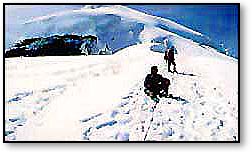 Located about 100 miles south of Quito, this
park is the site of a uniquely insensible geographical marvel--the misty peak of Mount
Chimborazo, which marks the farthest point from the center of the Earth. The distinction
is caused by planetary bulging at the equator. The peak of this monstrous volcano is
Ecuador's highest point at 20,823 feet.
Located about 100 miles south of Quito, this
park is the site of a uniquely insensible geographical marvel--the misty peak of Mount
Chimborazo, which marks the farthest point from the center of the Earth. The distinction
is caused by planetary bulging at the equator. The peak of this monstrous volcano is
Ecuador's highest point at 20,823 feet.
Cuyabeno Wildlife Reserve
There are more species of birds in the Amazon than anywhere else on the planet. One-third of those species roost here, making Cuyabeno's 85,000 acres the most diverse avian sanctuary on the planet. A roam along the well-developed trails blesses hikers in this park with an unforgettable experience. In the trees above, macaws, toucans and endless breeds of other birds flash staggering colors while the air pulsates with their songs and calls. Bring binoculars, as well as a flashlight to view the nocturnal species.
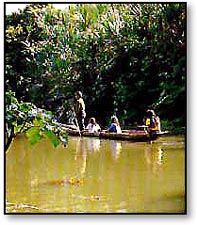 Along the eastern slope of the Andes is found one of the world's richest and
most accessible rainforest regions, an area that vibrates with life. An astounding
one-third of all the Amazon's bird species can be found here, as well as 10 percent of the
world's tree species. Massive flows of water from the Andes collect in the Napo and
Aguarico river basins, creating the foundation for the Oriente's teeming biodiversity. It
typically rains at least once a day, and rubber boots are highly recommendable. The Napo
is one of the Amazon River's principal tributaries, and included in its fauna are sloths,
caymans, jaguars, monkeys, tapirs, pink dolphins, and over 1,000 species of birds.
Along the eastern slope of the Andes is found one of the world's richest and
most accessible rainforest regions, an area that vibrates with life. An astounding
one-third of all the Amazon's bird species can be found here, as well as 10 percent of the
world's tree species. Massive flows of water from the Andes collect in the Napo and
Aguarico river basins, creating the foundation for the Oriente's teeming biodiversity. It
typically rains at least once a day, and rubber boots are highly recommendable. The Napo
is one of the Amazon River's principal tributaries, and included in its fauna are sloths,
caymans, jaguars, monkeys, tapirs, pink dolphins, and over 1,000 species of birds.
Cayamba-Coco Ecological Reserve
Located in the Oriente, Cayamba-Coco is Ecuador's largest national park. It is, quite simply, a gigantic swath of life bursting off the face of the Earth. Ten million acres of rainforest and cloud forest rest here in the shadows of the Andes. Daunted by the task of developing the huge reserve for tourism, the government has done very little with Cayamba-Coco. Tourists tend to stick to the beaten path and the amenities it offers, making this park a truly wild experience. In addition to the countless bird, mammal, and tree species found everywhere in the Oriente, Cayamba-Coco also provides a good place to spot the rare Andean Vulture.
Copyright (c) 1998-2005 interKnowledge Corp. All rights reserved.