Indonesia Adventure Travel in Indonesia | Asia Homepage | The World Unity in Diversity, the national motto of Indonesia, is a term that strikes deep into the heart of this dynamic and attractive Southeast Asian nation. Few places offer such cultural variety and geographical complexity as Indonesia, and no two journeys here are ever alike. Location, Geography and Climate
The world's largest archipelago, Indonesia's constellation of islands straddles the divide between the Asian and Australian continental plates. As a result, the islands offer a stunning variety of topographies and ecologies Mist-shrouded volcanoes and mountains, unexplored rain forests, thousands of miles of beaches, and endless offshore reefs support a dazzling abundance of wildlife, making Indonesia an ideal destination for adventure and eco-travel. The great majority of the country's constituent islands are of negligible size, but it does hold--wholly or in part--several islands that are enormous. These include Sumatra, Kalimantan (formerly Borneo, and shared with Malaysia), Sulawesi, and Java. The Indonesian state of Irian Jaya occupies the western half of New Guinea, which is the world's second largest island (behind Greenland). The most populous of the Indonesian islands by far is Java, home to the sprawling capital city of Jakarta. Other notable islands include the exotic, popular resort island of Bali, Lombok, Catholic Flores, and Komodo, home of dragons. There are two discernible seasons in Indonesia: the dry season, which extends from June to October, and the rainy season, which lasts from November to March. Both are hot. The coastal regions, however, are often cool, and in the mountains the air is often chilly. History & Culture
The sixteenth century marked the arrival of the Portuguese, the first Europeans in Indonesia. Although the Portuguese broke the Islamic hold on Indonesia, they were eventually displaced in turn by the Dutch, who named the area the Dutch East Indies. Although a revolt led by Javanese Prince Diponegoro in 1825 briefly threatened Holland's empire, Dutch rule continued until W.W.II and invasion by the Japanese. The Indonesian revolutionary nationalist movement, led by Sukarno, welcomed the Japanese as a potential force of liberation, and at the war's end the movement embarked upon a bloody war of independence against the restored Dutch rule. Although the war dragged on for four long years, from 1945-1949, the independence movement was ultimately victorious. Turmoil characterized the first decade of Indonesian independence, until in 1957 Sukarno unified power in his own person. An attempted coup against Sukarno in 1965 brought renewed turmoil; however, the army led by General Suharto restored order and initiated a purge of communists. Eventually Suharto eased Sukarno out of the presidency and assumed office himself. Suharto's rule ushered in a period of stability and economic development. His retirement is expected in 1998. Indonesia's varied past has produced a remarkable array of vibrant cultures, making it one of the world's most diverse and fascinating travel destinations. Today, Indonesia is the fifth most populous nation on Earth, with over 180 million citizens comprising over 300 ethnicities. Most Indonesians are of Malay or Polynesian descent, though the country's history has produced minority populations from India, China, Arabia, and Persia, as well as from European colonial powers such as Portugal, Holland, Spain, and England. Although primarily a Muslim nation, Indonesia is marked by wide religious tolerance. Hinduism thrives on Bali, and Christianity has a significant presence on Flores, Timor, and several other islands. Indonesians speak numerous languages and dialects, but the common language is Bahasa Indonesia. English and Dutch are also widely spoken. Adventure Travel in Indonesia | Asia Homepage | The World |
|
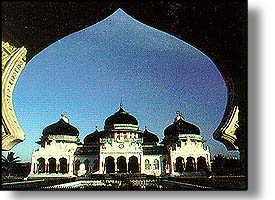 Indonesia is composed of seventeen thousand
islands that stretch over five thousand miles along the
equator. The Malay peninsula and Indochina are situated
to the north-west, and the continent of Australia lies
due south. Northward lie the Philippines and Micronesia.
Indonesia is composed of seventeen thousand
islands that stretch over five thousand miles along the
equator. The Malay peninsula and Indochina are situated
to the north-west, and the continent of Australia lies
due south. Northward lie the Philippines and Micronesia. 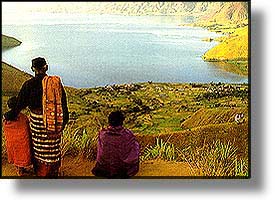 As early as the seventh century, powerful
Buddhist and Hindu empires challenged each other for
supremacy in Indonesia: the Buddhist Srivijaya were
centered in Sumatra, while the Hindu Mataram located
their capital on Java. The rich architectural and
cultural legacy that remains from that time forms the
basis for Indonesia's national identity. In the
thirteenth century, the Hindu Majapahit of Java faced a
strong challenge from Muslim forces, which spread south
from the Malay peninsula. Slowly losing ground, the
Hindus retreated to Bali, where they remain today. The
rest of the islands became Muslim, and various sultanates
were established.
As early as the seventh century, powerful
Buddhist and Hindu empires challenged each other for
supremacy in Indonesia: the Buddhist Srivijaya were
centered in Sumatra, while the Hindu Mataram located
their capital on Java. The rich architectural and
cultural legacy that remains from that time forms the
basis for Indonesia's national identity. In the
thirteenth century, the Hindu Majapahit of Java faced a
strong challenge from Muslim forces, which spread south
from the Malay peninsula. Slowly losing ground, the
Hindus retreated to Bali, where they remain today. The
rest of the islands became Muslim, and various sultanates
were established. 
ph 91- 9347107468