Please ask permission to use articles to:
copyright@exakta.org
 Exakta Diamant Prototype or private venture ? Dr. Rex Watson Exakta Times, Number 7, June 1992
He was joined by Hans Kefle who prepared a text which went beyond the exhibits alone to become a history of camera development. The reulting book, "Historische Kameras" was published by VEB Fotokinoverlag of Leipzig in 1989. 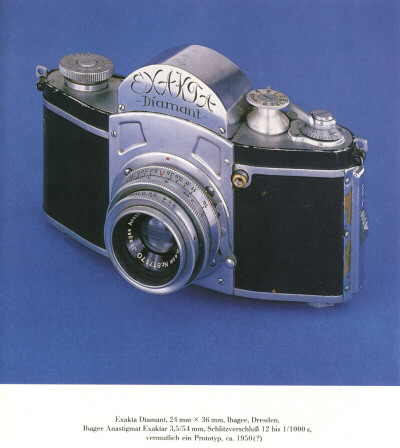 Among the pearls to be found illustrated is the Exakta Diamant, which is said to be a prototype of around 1950 vintage. It was at this time that both Ihagee and KW were introducing pentaprism accessory finders for their 35mm SLR's. These were made by Carl Zeiss, Jena, and whilst the Exakta version had a rounded hump (see Aguila and Rouah page 152), the more elegant KW version for the Praktica followed the outline of the pentaprism, a shape generally used in later fixed and accessory pentaprism.
 It is possible that the Diamant finder is a cut down version of the Zeiss accessory, fitting directly into the camera body instead of into the waist level finder. But we can believe that an Ihagee employee would have been allowed (or have wished) to perpetrate such an inelegant lettering in capitals of the precious Exakta name? Was there any point in the "Diamant" version when we see the Varex prism? Perhaps there are clues in the well used camera body that suffered the indignity of the ill shaped Diamant. Whoever built the camera had access to a flash socketless body and an unengraved front plate of a Kine Exakta version 5 (Aguila and Rouah) or Type 4 (Wichmann) or even Type 4 (Exakta Circle). The lens is the prewar own brand Ihagee Anastigmat Exaktar, 3,5/5,4cm that appears in the 1939 catalogue, (not the 3,5/5,0cm shown by Aguila and Rouah), and would have been readily available. So could this camera have been the product of an instrument maker with access to Exakta parts, but without a sense of Exakta style? |
Traduzione
Se desiderate leggere queste pagine in italiano potete
cliccare qui