

![[LineDraw]](images/rainbow.gif)
The theatrical or musical occupation was considered the lowest class in the society. Opera performance used to be a male dominated profession. Mixed performance was prohibited. All the roles were played by male. Most of the actors entered the Training School as apprentices in their childhood because their parents could not feed them. They had to absolutely obey the commands of the school master and teachers. Any of the failure or even success would result in some heavy slashes or other physical punishment. Far earlier than the dawn, they had to get up to practice their voice and performance skills and do their mandatory works. Director CHEN Kai-Ge's film Farewell my Concubine gives a picture of the situation. Female were rare and usually took this profession because of their family background. But this also gives an account on how hard they should practice their skill in order to be a successful player. It is said that a flash in the stage is a reflection of ten years unremitting hard work.
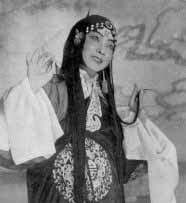 A
superlative singer, actor and dancer of Beijing Opera female role Qing
Yi and a towering figure in the Chinese theater.
A
superlative singer, actor and dancer of Beijing Opera female role Qing
Yi and a towering figure in the Chinese theater.Mei Lan-Fang was born October 22, 1894 in Tai Zhao of China's Jiangsu province. His grandfather and father were all famous opera actors. Mei began studying Beijing Opera at eight and played his debut role at 12. His performance in "Shattering Flowers" won him a special fame. He joined Xi-Lian-Cheng Theatrical Company at 14 and performed in Shanghai and elsewhere thereafter. He acquired a national reputation and was regared as the leader of the Pear Garden (A name refers the opera community circle). Western world began to know Beijing Opera through his performances. He toured Japan twice (1919 and 1924), the United States once (1930), and the Soviet Union twice in 1932 and 1935.
After the outbreak of Resistance War against Japanese in 1937 he settled in Hong Kong. He then returned to Shanghai but stopped his performance for five years. He then maintained his beard and mustache, and refused to perform for the occuping Japanese army. He resumed his stage career after the end of the war in 1946. Thereafter he did both stage and film work. There is a film Mei Lan-Fang's Stage Arts featuring his stage performances including several play sections. His last masterpiece "Recommanding the Army" was shot into a colored film. He served as director or member of several cultural organizations.
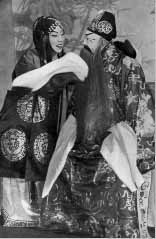 MEI
Lan-Fang rediscovered many long-neglected theatrical masterpieces and brought
them back on stage with his enforcements. He was credited with having revived
the traditional Chinese arts of dancing and pantomime. He also enriched
the stage performance by learning from Chinese Kungfu, like the swordplay
in his Farewell My concubine. He put special attention on the ladyship
of his performance. He was said that once he even pretended to assault
his wife to observe her frightened reaction and then apologize to her
Because he did not satisfy with one of his actions in a play.
MEI
Lan-Fang rediscovered many long-neglected theatrical masterpieces and brought
them back on stage with his enforcements. He was credited with having revived
the traditional Chinese arts of dancing and pantomime. He also enriched
the stage performance by learning from Chinese Kungfu, like the swordplay
in his Farewell My concubine. He put special attention on the ladyship
of his performance. He was said that once he even pretended to assault
his wife to observe her frightened reaction and then apologize to her
Because he did not satisfy with one of his actions in a play.
Mei Lan-Fang died on August 7, 1961 in Beijing. His masterpiece plays include "Farewell My Concubine", "The Drunken Concubine (or Drunken Beauty)", "Recommanding the Army", "Scattering Flowers", and "Eternal Regret" etc. A bunch of female role actors and actresses follow his style, among which his son, MEI Bao-Jiu, is a superb.
(Photos: MEI Lan-Fang as Zhao Gao's daughter in Beauty Deflies Tyranny).
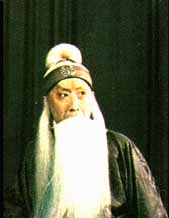 A
male role Lao Sheng player and the founder of the MA Style.
He was a graduate of the famous Beijing Opera training school Xi Lian
Cheng. He apprenticed JIA Hong-Ling, and then followed YU Shu-Yan.
Later he formed his own style with characters of sweet, fluent and natural,
which is best known as MA style. His preserved plays include "
Orphan
of Zhao Family", "Borrowing Eastern Wind", "Gan-Lu
Temple", "Meeting of the Heroes", etc.
A
male role Lao Sheng player and the founder of the MA Style.
He was a graduate of the famous Beijing Opera training school Xi Lian
Cheng. He apprenticed JIA Hong-Ling, and then followed YU Shu-Yan.
Later he formed his own style with characters of sweet, fluent and natural,
which is best known as MA style. His preserved plays include "
Orphan
of Zhao Family", "Borrowing Eastern Wind", "Gan-Lu
Temple", "Meeting of the Heroes", etc.(Photo: MA Lian-Liang as Cheng Yin in Orphan of Zhao Family).
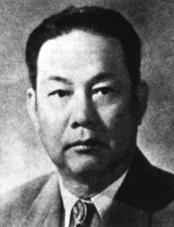 A
Lao Sheng player and the founder of the QI Style. (His stage
name is Unicorn Boy Qi Ling Tong, which also homonymly means
seven-year-old).
Staged first at seven, he was the flag of Beijing Opera in south China
while MA Lian-Liang the north. He was not with the perfect conditions for
a Beijing Opera player. But he was excellent in using his strongness and
developed a characterized style of his own. He enriched the performance
by learning skills from other operas. His preserved plays include "
Four Scholars" , " Hurry to the City Wall", " Chasing
Han-Xin", etc.
A
Lao Sheng player and the founder of the QI Style. (His stage
name is Unicorn Boy Qi Ling Tong, which also homonymly means
seven-year-old).
Staged first at seven, he was the flag of Beijing Opera in south China
while MA Lian-Liang the north. He was not with the perfect conditions for
a Beijing Opera player. But he was excellent in using his strongness and
developed a characterized style of his own. He enriched the performance
by learning skills from other operas. His preserved plays include "
Four Scholars" , " Hurry to the City Wall", " Chasing
Han-Xin", etc.
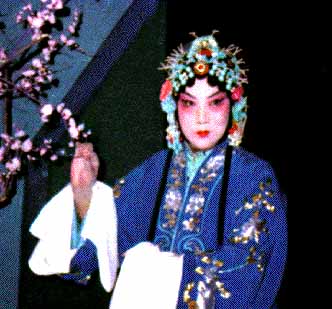 A
female role Qing Yi performer. His style is recognized as ZHANG
Style. His plays include " River-Facing Paguda", "Meeting by
poem" etc. He was regarded the number one
of the Four Junior Great Female Role Players.
A
female role Qing Yi performer. His style is recognized as ZHANG
Style. His plays include " River-Facing Paguda", "Meeting by
poem" etc. He was regarded the number one
of the Four Junior Great Female Role Players.(Photo: ZHANG Jun-Qiu as CHE Jing-Fang in Meeting by Poem)
First edition: November 11, 1995
Last revision: April 2, 1997
Copyright 1995-1997 by Xu-Ming Wang
![[LineDraw]](images/marble.gif)