

Right, the first thing you will be requiring is a place where you can make
a tremendous mess without your mother/girlfriend/wife/daughter/consious
bothering you. For me this place became the basement of my flat. Of course
you sweep the floor once in a while, but that will be mostly because you
are looking for some of your tools, which you suspect to be burried under
the dust and sand particles.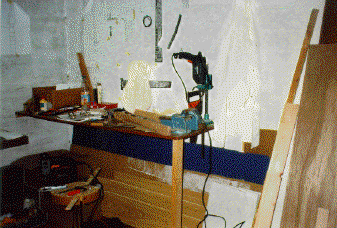 | 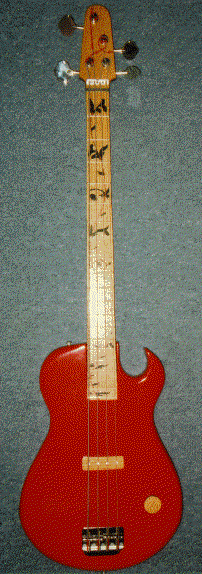 |
 |
The choise of wood is up to you, I used meranti for the neck. Meranti is a
relative cheap hardwood, usually used for the making of window frames. I
found it easy to work with, it seems stable, and it doesn't give way to
string tension. I had the neck (without fretboard) stringed up at an extra
high tuning for 3 days but couldn't measure more than 0.5 mm torsion.
The body is made out of pine. Extremly cheap and easy to work with, but
there is a hunch: you also get dents VERY quickly. The fretboard, the
pedgehead plane and all decoration wood work are made of american oak.
Great stuff, but with a lot of small holes so, you need to fill before you
can paint. |
Information is vital, get a book and read the newsgroups and webpages, some are mirrored right here. So look at : Guitar building links on the web
|
You start with a drawing. This should preferable be a full scale drawing.
Get a shape you like, draw it and use a photo copier to blow the drawing up
to a full size guitar. Then stick it to the wall and look at it for about a
week. You're going to invest a lot of time in it so it better becomes
something you will like. Keep the thing in your hands as if it was the real
MacCoy, it's the only way to find out if you like where the knobs are going
to be, how's the scale length, can you reach the upper frets with the
cut out you designed, where to put the pickup etc. When you're happy, go and get your woods and copy the drawing to the wood. You may have to laminate (glue pieces of wood together) the body first. I used three pieces of wood for the body. Use clamps and be sure all angles are 90 degrees. I spent a lot of time sanding the curvature out of the body. If you still like the design, use the bandsaw to cut out the shape, slowly and keep checking to the lines on the wood. The neck requires several cuts, be careful that you don't accidently remove a piece of neck that really should have stayed there. When finnished sand all smooth and get the shape right using the files. The tricky part is the rounding of the neck, gradually increasing in depth, and still keeping it round is an awarding but difficult job. Since my piece of neck wood wasn't wide enough, I had to attach some "ears" to the pedgehead, to get the width I wanted. Keep sanding with different sizes of paper, going from rough to fine will speed up the sanding process considerably. When you are happy withy the shape of both neck and body, (day's, weeks, months later) it is time to integrate the both. Use a large ruler and use the heart lines of body and neck to allign them both and watch out ! if you mount the neck even under a slight angle, it's going to be a lot of work to correct it (believe me). Now trace the outline of the neck on the body and root out the cavity, watch your depth ! |
|
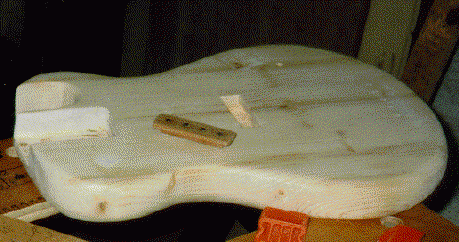
Now you can also root out the cavity for the electronics. I cut out the
coverplate first and traced the outline on the back of the body. I rooted
it out first at 5 mm depth and then a smaller outline at full depth. This
allows me to countersink the cover plate. On the front side, the pick-up
cavity is made slightly deeper and wider than the pick-up itself since I
have no idea how thick the paint will be. The next challenge is the
drilling of the wire tunnels. If you're lucky it is possible from the
electronics cavity to drill a small hole to the pick-up cavity. (I was
lucky) If not, you require a long drill and you can drill from the neck
cavity, through the pick-up cavity to the electronics cavity. Last is the counter sinking of a tunnel for the jack plug. I use a small round piece of oak to hold the plug. Matching the fretboard colour very nicely. |
|
|
Sand the whole body fix the neck in it and drill the holes for the
bolts, I countersinked the nuts in the neck since they must be covered
by the fretboard. Now make a countersink in the body as well, to hide
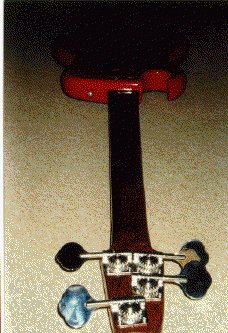
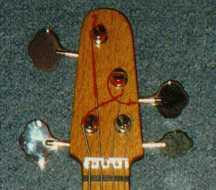
your bolt heads, and you're almost done with the body. It's time for the pedgehead. Get a suitable piece of wood, sand it smooth, and glue it to the top of the neck. Draw the outline of the pedgehead shape you like, and cut it out. The tricky part is getting all the round curves nicely ROUND instead of approximatly round. When you are happy with the way it looks and feels, locate your tuners. A huge drill is required to drill the holes (at least for bass) so I drilled the holes slightly smaller to save the wood around and used files to enlarge the hole. The great thing about that is the posibilty to correct the errors you made during the drilling.(pfieuw) At this point I made the mistake of shaping the fretboard to the neck, this is a problem when you want to saw the groves for the frets. So let's not do that again shall we ? |
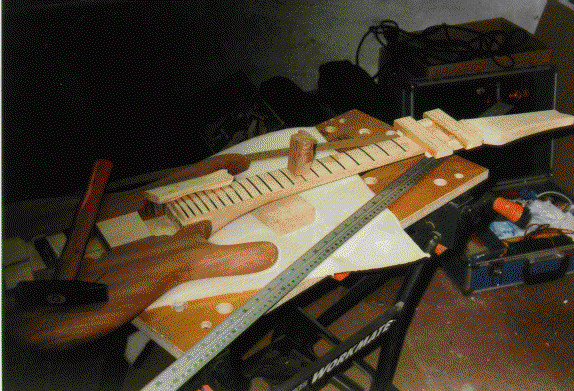
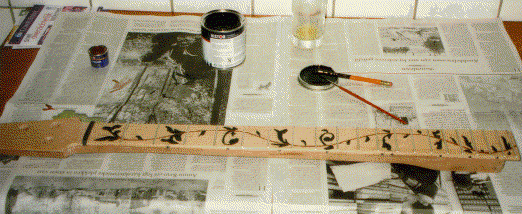
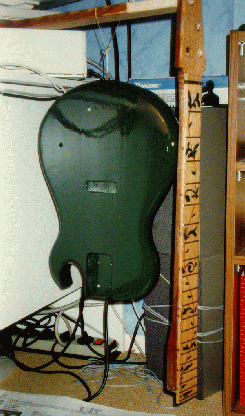
| Now shape the fretboard to the shape of the neck and use it to clamp the nut at it's proper place, carefully check the alignment with the fretboard, for the zero fret (the nut) must be parallel with the other frets. If all looks well, sand the neck for the last time and glue the fretboard in place. |
 |
 |
|
Now the nut can be filed and for this bass a string guider has been
installed. The body was spray painted by someone else, (muchias gracias) so
I thought that i was about finished. However, the lacquer i used reacted
with the paint, making one big mess of the surface. You can find my cries
for help in rec.music.makers.builders and rec.woodworkers or so. Any way,
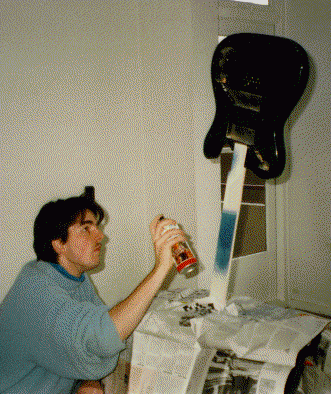
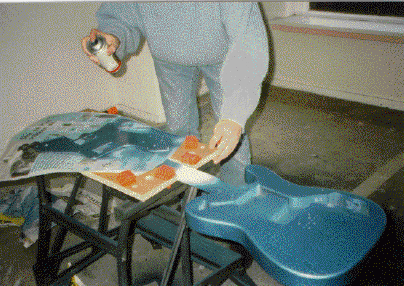
i needed to sand off the old finish, respray and relacquer. the pictures
show the spraying event of my old telcaster, but the bass spray went just
the same.
Use a well ventilated room or you'll poisson yourself in it ! make a
pseudo-neck out of a piece of scrap and spray the baby, fast ! You will
spray in thin layers, every 2 min or so. Totaling up to a layer of 5, than
let dry for a day, remove all obstacles and spray another 5 layers. Just
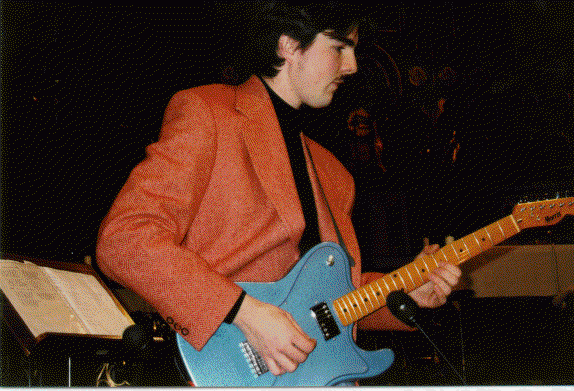
repeat the sequence until you are happy. You're almost there now ! just screw all parts together, don't forget to lead a ground wire to the bridge, insert the pickup, and wire the pots to the plug. (piece of cake) Close the coverplate, string her up, plug in and ROCK ! |
TOOL |
USE |
NEEDED ? |
| Straight edge, 18 in. | Checking fingerboard straightness | or any long piece of STRAIGHT wood |
| Steel ruler | Measuring fret spacing | "duimstok" is enough |
| Pencils | Marking wood layouts and measurements | oh dear, really ? |
| Square | Squaring lines on drawings, wood, & parts | we may asume some geometrical capabilities |
| Clamps (various) | Holding laminations | at least 10 ! |
| Spokeshaves | Shaping neck | round, halve round and flat, i prefer the round ones |
| Wood rasps | Shaping neck and body contours | round, halve round and flat, i used mainly the half round/td> |
| Chisels | Removing excess wood from cavities | yup |
| Files (various) | Shaping wood, bevelling frets, detail filing | yup |
| Coping saw | Various cutting jobs | a small iron saw is ok |
| Hack saw | Various cutting jobs | a small iron saw is ok |
| Dovetail saw | Cutting fret slots | a small iron saw is ok |
| Screwdrivers | Mounting harware | of course |
| Pliers | Bending fret wire, holding parts, tightening bolts | yup |
| Socket set | Mounting hardware | and fixing the neck to the body |
| Masking tape | Covering parts during finish | yup |
| Double stick tape | Holding router templates | not needed, but probably handy |
| Titebond glue | Laminating wood, installing inlays | wood glue and super glue |
| Lacquers (colored, clear) | Painting, finishing | yup, use yacht lacquer it's the strongest |
| Stains | Staining, finishing | yup |
| Soldering iron (+ supplies) | Installing electronics | yup |
| TOOL | USE | NEEDED ? |
| Band Saw (10 in. minimum) | Cutting body and neck shapes | i used a hand held power saw which worked out fine |
| Drill, drill press (+bits) | Drilling screw holes, removing wood | you really need this one |
| Router (+bits) | Cutting cavities | no way around it, borrow or buy |
| Detail sander | Sanding difficult areas | not needed, but probably handy |
| Hand sander | Basic sanding jobs | very handy ! |
| Small belt sander | Larger sanding jobs | not needed, but probably handy |
| Sand paper (see grits below) 60, 80, 120, 150, 220 320, 400, 600, 1000 (wet/dry) |
Rough to final sanding Finish sanding |
an absolute must, i used at least 10-15 sheets |
| Dremel moto-tool (+bits) | Inlay routing, detail routing, polishing | no, i improvised, could be handy |
| TOOLS | USE | NEEDED ? |
| Fretboard radius sanding blocks | Sanding the fretboard to a specific radius | i made a straight fretboard |
| Fret file | Reshaping frets | not needed |
| Fret nippers | Cutting fret wire | use a pair of pincers |
| Fret puller | Pulling frets | use a pair of pincers |
| Fret hammer | Installing frets | any hammer will do |
| Fret slotting saw | Cutting fret slots | a small iron saw will do, watch the width though ! |
| Fret planes (w/paper) | Leveling fingerboard, frets | use scrap wood |
| Fret dressing file | Crowning and shaping frets | ? |
| Router templates Pickup, tremolo, Electronics cavity |
Accurate cavity routing | not needed, could be good ! |
| Precision nut files (set) | Filing string slots in nut | not needed, could be good ! |
Below is a sample cost list for a simple guitar. Remember, this does not include any tools, glues, sandpaper, or finishing materials! In many cases, the lower priced items are chosen, for example, a rosewood fingerboard instead of ebony. The prices are from Stewart-MacDonald's Guitar Shop Supply catalog. Your prices may vary. -- Bill Wyza
So I added my prices ......| Item/Part | Cost (US $) | My Cost (DGLD) |
| Body Wood (alder 1 3/4 x 13 3/4 x 20") | 57.50 | |
| Neck Wood (Mahog, 2 x 5 x 30") | 37.82 | |
| Fret wire (6 feet of Jumbo wire) | 11.10 | |
| Nut (graph-tech) | 4.48 | |
| Fingerboard (rosewood, 12 in radius) | 13.98 | |
| Trussrod | 12.89 | |
| Trussrod cover | 1.23 | |
| Trussrod cover screws | .60 | |
| Side dot material | .99 | |
| Pearl inlays (6mm dia) | 4.86 | |
| Schaller bridge pickup | 52.96 | |
| Schaller neck pickup | 52.96 | |
| Pickup mounting rings (2) (w/screws and springs) | 7.94 | |
| Control pots (4) | 9.72 | |
| Pickup selector switch (5-way) | 10.59 | |
| Capacitors | 3.60 | |
| Circuit wire (25 feet) | 9.50 | |
| Control knobs (4) | 7.96 | |
| Strap locks | 11.30 | |
| Neck plate (w/screws) | 4.86 | |
| Jack plate (w/screws) | 6.32 | |
| Output jack, mono | 1.99 | |
| Electronics cavity cover plate | 8.95 | |
| Tremolo cover plate | 2.84 | |
| Cover plate screws (10) | 2.60 | |
| Floyd-Rose tremolo/bridge | 184.29 | |
| Sperzel Locking tuners (6 inline blk) | 58.90 | |
| GHS Boomers | 4.89 | |
TOTAL |
587.62 |
This price is not too bad when you don't count tools etc. Also, figure in for sandpaper and paint.
Back to the main page.
