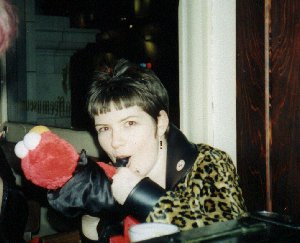
Poppy Z Brite must inhabit the best and worst of all possible worlds. Such is her seductive force as a writer that, like a Siren, she draws you into the dark whirlpools of the human psyche, promising any number of fleshly delights and, when you least expect it, she turns into a Scyla slavering for your blood and bones.
Her decadent world is one of perpetual darkness and rain, if not external, then certainly internal. A darkness that harbours outcasts, freaks, and the dangerous-to-know angelic demons that roam a no-man's land. They are some of the most bewitching people you could ever hope to meet. People you want to kiss and fuck. People who would want to kiss you back. People who would love you so much, they would rip you apart -- literally.
In creating her gallery of rogues and grotesques, Brite takes her place among artists who link violence with the Art of Seduction to create a sepulchral poetic beauty of undeniable force.
In this interview Poppy Z Brite talks about her early influences, her identification with outcasts, the psychology and possible meaning behind many of her obsessions, and the delight of peeing on her husband.
Dmetri Kakmi: Poppy, you've been interested in the internal workings of the body from a very young age, that's where "The Dangerous Mouse" story comes from, and you've translated that interest into your writing. Have you asked yourself how this interest came to be?
Poppy Z Brite: I have. I was thinking about it today because I was recording an introduction for "The Bad Mouse", and the publisher had asked me to sort of muse upon how a three-and-a-half-year-old mind was able to come up with this story, and I just had to say I cannot analyse it beyond a certain point. I don't know, it's just something that I was always curious about and I would suggest that most children are curious about it, and end up either being educated out of it or growing out of it. Or simply taught that culturally that's disgusting and not something we like to think about. Maybe some of them become doctors, pathologists, whatever . . .
DK: Serial killers.
PZB: . . . or horror writers, serial killers, too. Serial killers maybe if there's another factor added into the equation, such as they grew up in a fundamentalist religious family, like Jeffrey Dahmer. Something that makes them feel twisted for even thinking these things. I was certainly never made to feel like that. No I think that's a fascination that a lot of kids have. I guess I never grew out of it, and don't really plan to.
DK: Reading your work, particularly "Exquisite Corpse", is like looking at a Francis Bacon painting. You use words the way he used paint. Like him you distort the human body. It's like you're pushing and studying the boundaries of the body, and reading it for signs which will reveal some mystery to you. What do you think is in there?
PZB: I guess that's what I've always been so interested to know. Not only what is in there, because you can see it in anatomy books, but what would be my reaction to it? What would it make me feel like? What would it do to someone to see these things that are for some reason culturally taboo, but that we all have inside of us. And that they're never supposed to be revealed, and if they are revealed then we're in big trouble. Peter Straub wrote a blurb for "Exquisite Corpse", and part of what he said was it treated the human body like a communion wafer. I think that's very apt. Not even in a religious sense, but just a sense of transference of eating the flesh and having that become part of you as is the belief with communion. Another part of it is, in my readings about serial killers, I was always fascinated by how completely they were able to objectify the human body. How it was so important to them, and yet they were completely able to disassociate themselves from consciences that they did seem to have at times . . . Dahmer being the primary case that I studied, was able to arrange his dismembered victims and their parts in an artistic manner and actually painted some of them, made compositions with them and photographed them. You can't get much more objectified than that. It's certainly not a desirable thing, but it was very interesting.
DK: You've said you write about the poetry of violence in order to see what lies beyond the gore to any truths it may hold. You've written five novels now and two collections of short stories, have you had a glimpse at what that truth may be, or is it unattainable?
PZB: It's not so much absolute truths that I'm looking for. I don't know that I even believe in those, and I certainly don't believe that I'm going to come up with any of them on my own. What I'm looking to prove is that it is possible to find beauty in that sort of thing. I know that that is true for me, it always has been, and I'd like to be able to communicate this to the reader. To make them able to see the beauty in something that they would otherwise find disgusting, and beyond that to possibly make them disturbed at their ability to see this beauty. To put something in their mind that wasn't there before, but then they'll never be able to get rid of. [laughter]
DK: Poppy, let's talk a little bit about where you grew up, what sort of parents you had, why high school was so awful for you.
PZB: I was born in New Orleans and I spent my earliest years here, where I live now. Both of my parents are from Kentucky. When I was young I had an atrocious Kentucky accent. If you get to hear my CD of the story I was talking about, "The Bad Mouse", you'll hear my accent. My parents are very intelligent people who encouraged my creativity. They were never hippies as a lot of people expect. My father was a graduate student in economics, and now he's a professor of economics. My mother was not working at the time, but she's now a business manager. They divorced when I was five, and my mother and I moved to North Carolina, where I lived for the next thirteen years. The place has had a lot of influence on my work. I guess traumatic experiences started when I was thirteen and fourteen in junior high school. That's when, rather than individuality, which is more tolerated in elementary school, popularity and fitting in seemed to be the key to everything. It was obvious it was never going to work for me, so I gave it up and became the weird kid, the scapegoat. Later on I started an underground newspaper, and enjoyed my weirdness and learned to actually revel in it, and use it for my own pleasure. But before that it was just really bad, as it is for any weird creative kid.
DK: When you say 'weird', what do you mean? Were you a goth?
PZB: I wasn't really a goth until later. I was kind of a hippy kid. I got into the Beatles and the Stones. I became a kind of vegetarian communist, which is so far from what I am now. I know it's hard to believe, but it went deeper than how I identified myself socially or how I dressed. It was just that I was interested in different things. I was interested in reading and writing. I was vocally supportive of gay rights, which was, of course, very strange and very horrible to most kids. And as a result of that I spent most of high school with people assuming that I was a lesbian, which I never thought that I was. But you know, people don't assume when they hear a girl talking about that that she's a gay man in a female body, so . . . naturally I was a lesbian. And saying that it was not an insult to me, did not help matters. And saying that no, I was actually a fag, definitely did not help matters!
DK: Poppy, the gay thing is something I want to touch on a bit later on. But how did this come about? Was it something that was simply there all the time and you started voicing it? Or did you have gay friends, or a relative . . .
PZB: Not that I knew of. I don't think there were any gay people in my family. As for friends . . . not that early. Later, definitely I did, but growing up in . . . it wasn't really rural North Carolina but it was a very small town and if anyone was gay at that stage they were not going to admit it. The earliest intimations I had that there was a gay culture that wasn't considered wrong or bad was from reading. So coming upon books where the gay characters didn't end up suffering, and dying horribly was important to me, even if the books were really bad. There was a series about Charlie and Peter, and it was this soft core gay male erotica. The characters were really buff and studly, but it was so nice to read what could almost be termed love stories, and not have them getting punished at the end for it.
DK: There's a great deal of anguish and torment in your books. It's almost like your characters are trying to break out of their flesh and bone cages into something else. Is suffering a gateway to higher knowledge?
PZB: I certainly think that it can be. I no longer think that's the only way to attain higher knowledge, or art. I certainly did when I was nineteen. I thought that suffering was noble and absolutely necessary. That suicide was definitely the way to go, and death was glamorous, all those things that we think when we're that age. And drinking too much, and being possessed by our own creativity. But most of the gifted artists that I know certainly have suffered a lot. Generally they've come to terms with it. They've found ways to deal with it and get through it. They've not been subsumed by their own depression. You can find obvious exceptions, like Kurt Cobain. He was an incredible talent, and I think his own talent combined with his own depression completely destroyed him. But most of the ones that I really admire have found ways to get through that however they can.
DK: It seems to be a prerequisite.
PZB: I think it's a prerequisite, but I also think that if you're completely subsumed by suffering then there will come a point where you're not able to do art anymore.
DK: Exactly. Now, in my opinion, next to Dennis Cooper and James Purdy, you are one of the most intriguing gay male writers working today. How do you feel about that?
PZB: You must have read enough about me to know that I don't think of myself as particularly female. I've always felt like a transgendered person. I've never had any real urge to have the surgery, but I do think of myself, if I had to choose, more male, and it's affected every romantic relationship I've ever had. I've had more success in romantic relationships since I started admitting this to myself and making it clear to other people.
DK: Is that how Lucrece [the transsexual character in "The Lazarus Heart"] was born?
PZB: Lucrece is actually not as symbolic as she might seem because she's strongly based on a friend of mine, who is in fact a male to female transsexual. I was attracted to my friend at the beginning of our relationship because we seemed to have similar kinds of gender issues and experiences, but she's since become a close friend on a lot more levels than that. So Lucrece is very strongly influenced by her.
DK: You're married now. How does your transgendered self work within a relationship. How does your husband cope with a transgendered person?
PZB: The most important thing I should say about my husband is that he calls me 'Sir', and he means it. He was not bisexual when we met, he certainly has engaged in some experimentation since then. We both have, and now we're monogamous with each other, which is much easier to deal with at this point. But if I hadn't been with someone who was open-minded enough to let me experiment, and do a lot more growing up, I don't think we'd still be together. It's probably the only successful relationship I've ever had. I hope that I'll be in it for the rest of my life. He's amazing to be able to deal with me on any level, on all levels, not just the gender thing but absolutely everything.
DK: Poppy, because of this transgendered thing, I was expecting to meet someone who was a lot more masculine, harder . . . but you're not like that at all.
PZB: Yes, I've never had any success with androgyny whatsoever.
DK: So, you've tried?
PZB: I've sort of tried at home in front of the mirror. Even then it was so obvious that it wasn't working that I've never taken it outside the house. I think from a very early age I was a Nellie Queen. I was never meant to be macho. The first two albums that I fell in love with at age three were show tunes, Broadway soundtracks. What more proof do you need? It was "Camelot" and "Man Of La Mancha". [laughter] I don't like that sort of stuff any more, but if I was meant to be a man, that's the sort of man I was meant to be.
DK: I'm glad you're a woman! I'm fascinated with this phenomenon of women who say they feel like gay men. I dated a woman who felt like that in my early twenties. Like you she had a gothic sensibility, and a sense of darkness. Is this a genetic or psychological mutation? Do you have any thoughts on this subject?
PZB: I certainly don't see where else it came from in myself. The transgendered people I know who have actually undergone physical transgendering of any sort, I certainly think that they were born with it. It's very difficult for me to believe, having known as many differently gendered people as I have, that this is not something that they're born with. It just seems so deeply a part of them. I don't think it has anything to do with 'screwed up in early childhood' or anything like that because most of them aren't screwed up. They're just different. That's one reason why I like the word 'queer' so much. It's one of my favourite words because it includes a lot of us who don't really fit into any other label. Not gay, not straight, not bisexual, not male, not female, but definitely queer.
DK: In my opinion you are a truly 'queer' writer because you reflect life in all its facets and permutations, without pushing some overt political agenda like most gay writers do. In that sense "The Lazarus Heart" is a remarkable 'queer' book. Do you have a clearer perspective because you are looking at this from an outsider's perch?
PZB: Could be. I don't really feel that I've ever been an insider with any group. So, yes, I've definitely felt like an outsider most of my life. It's reflected most strongly in "The Lazarus Heart".
DK: In "The Lazarus Heart", I get the impression you believe the androgyne holds the secret not only to the mysteries of sexuality, but also to the complexities of life. At least that's what the serial killer who's cutting up transsexuals believes. Do you see angrogyne as the optimum state for humanity?
PZB: Let me preface this by saying that the serial killer in "The Lazarus Heart" . . . I didn't start out with this character, he began like any other character, but by the end of the book I was thinking of him as a stand in for the entire traditional horror genre that has this fascination with the freak, that ultimately has to destroy it. Either destroy it in order to see how it's made, or because it's different and therefore must be a threat. In my own work, which I'm not sure that I should call horror, I'm not interested in good, evil, in that age-old battle. I'm only interested in exploring the grey areas, the unclaimed zones, and I'm absolutely interested in exploring the character of the freak, the outcast, in writing from their point of view. In telling their story, not in telling how they're different and therefore must be driven out, punished and destroyed. It's difficult for me to imagine anything different. So yes, the androgyne is one particular type of freak that has always fascinated me because of its sexual implications. But freaks in general, and I'm using the word in an extremely positive way, not a pejorative way.
DK: A film which was universally condemned, but one that you enjoyed was "Natural Born Killers". You saw it primarily as a predatory love story, which is also the theme of "Exquisite Corpse". Is a chirpy kind of love, one without darkness, possible or even desirable?
PZB: Without darkness? No, if you're not able to see the darkness in the other person, I don't think you know them very well. I don't think it's possible to know a person very well at all without encountering some of their darkness, without exposing some of your own. They say that relationships where the two people never fight are incredibly unhealthy, and I completely believe that. I've certainly had relationships where I fought way too much, but I can't imagine a relationship where I couldn't argue at all. There would be nothing there, they wouldn't know me.
DK: Sexuality is not just some feel good activity for you is it? I think, like suffering, you use sexuality as a gateway to something.
PZB: Well, yeah, I think sex and love are inherently very scary things. Trust is not a terribly easy thing for me. I don't think it is for most people as far as leaving yourself open to knowledge, to possible hurt, as far as making yourself vulnerable by showing pleasure or pain. That can be difficult, that can be frightening. I think that's probably at the root of the connection between horror and eroticism. Everyone asks about that, and to me that is so obvious. It's almost as if what is there to write horror about? That to me seems by far the most obvious, the most natural.
DK: Do you think AIDS is the reason why in the 80s and 90s horror has well and truly fused with sex? Whereas before it was sublimated.
PZB: AIDS is just another catalyst for that, just as sexual repression was in the Victorian era. It's hard to find a book now that's dirtier than "Dracula" was in its day.
DK: Did you ever use either drugs or alcohol to open up the doors to perception in order to influence your writing?
PZB: Oh, frequently. Particularly with "Lost Souls". I had written a novella that ended up in the book, and I knew I needed to write some kind of prologue to tie the whole thing together. And one night I got drunk on rum and stayed up all night, and basically the prologue of "Lost Souls" was written drunk on rum. Of course, it was revised sober. There was also the scene for Christian, the old vampire, where he meets a kid in a goth bar and takes him down to the river. I wrote that on acid, but only a tiny dose of it. It was a very important scene, it had to be fabulous. I don't know if it shows in the finished book, but in the process of writing it it was a hump that I had to get over.
DK: It's actually my favourite scene in the book. I read it once, then went back and read it again and jerked off over it.
PZB: Oh, great! That's so gratifying. I get that a lot. [laughter]
DK: For me you belong to that line of artists like Sade, Poe, Francis Bacon and Mapplethorpe who use art to explore and work through their own personal demons and along the way they create universal art. All artists do that in a sense, but with some you feel like they've opened up their chests and given you a peek at their hearts of darkness. Have you broken through any personal walls, and are you concerned that if you do it might rob you of your creativity?
PZB: My instinctual answer is to say that I have to break through personal walls every time in order for the work to have any quality. It would be difficult for me to articulate what those walls are. As far as robbing me of creativity, I think the danger of that lies in not confronting those walls. In doing work that's safe, that resembles work that you've done before. As long as I am doing work that comes from my obsessions, and comes from my heart, I know that's not something I'm going to worry about, losing my creativity.
DK: Before I let you go, I'm going to ask you something personal. I read somewhere that you wanted to pee on your husband and he wouldn't let you do it. Have you done it yet?
PZB: Yes, yes, yes! The day that Allen Ginsberg died. He did it for Allen. It was great. He knew Allen would want it that way. [laughter]
DK: Perfect present!
PZB: He was pretty squeamish about it. He got in the bath tub first. I'm glad somebody cares. But yeah, it was Allen that did it for me. I never liked his poetry much, but I'm eternally grateful to him now. [more laughter]
"The Lazarus Heart" is currently on release through HarperPrism. "Courtney Love: The Real Story" is available through Simon & Schuster or Orion. "Are You Loathsome Tonight?" will be released in October by Gauntlet Press.
You may email Poppy Z. Brite at PProze@aol.com
Amazon.com: How did you begin writing? Did you intend to become an author, or do you have a specific reason or reasons for writing each book?
P.B.: I've been writing ever since I can remember, and I think I can honestly say on this eve of my 30th birthday that if I hadn't made it as a writer, I'd be dead in a gutter somewhere.
Amazon.com: What authors do you like to read? What book or books have had a strong influence on you or your writing?
P.B.: My earliest influence was E.B. White; my latest is Lisa Carver. I love Paul Theroux, Stephen King, Dennis Cooper, Shirley Jackson, Kathe Koja, W.S. Burroughs, William Faulker, Ramsey Campbell, Carson McCullers, Ray Bradbury ... the list goes on & on with no real coherence.
Amazon.com: Could you describe the mundane details of writing: How many hours a day do you devote to writing? Do you write a draft on paper or at a keyboard (typewriter or computer)? Do you have a favorite location or time of day (or night) for writing? What do you do to avoid--or seek!--distractions?
P.B.: I like to write at night, in my office, which is lit mostly with Christmas lights. I work on a computer but still keep a lot of notebooks. My worst distraction is probably the Internet.
Amazon.com: Do you meet your readers at book signings, conventions, or similar events? Do you interact with your readers electronically through e-mail or other online forums?
P.B.: I do events such as tours, conventions, signings, but I no longer answer much of my own mail due to time constraints -- not that I get such a huge volume of fan mail, just that I'm a slow writer. People who write to me or e-mail me get a free subscription to my newsletter, Purple Proze.
Amazon.com: When and how did you get started on the Net? Do you read any newsgroups such as rec.arts.books and rec.arts.sf.written, mailing lists, or other on-line forums? Do you use the Net for research--or is it just another time sink? Are you able to communicate with other writers or people you work with over the Net?
P.B.: I got online in '93, had a brief, emotional encounter with Usenet and have stayed away from it since, and mostly use it for email and (Web) research.
Poppy Home