
| The Impossible Conference, 23-24 April 1998 | Lizzy Graham (lizzythebassplayer@cheerful.com) |
I’m attempting something impossible. I’m going to try and communicate to you my enthusiasm for a two-hour contemporary opera (which you’ve probably never heard of) called The Second Mrs Kong, and throw some light on its cultural implications, all in under thirty minutes.
Since our section heading is ‘Invisible Language’, let me begin by saying something about invisibility. If you search this University’s library catalogue using the keyword ‘invisible’, you uncover quite an interdisciplinary range of material. It gives a kind of sketch of what this culture (however narrowly you want to define culture) thinks of as invisible.
These ‘invisibles’ range from subversive literature, to individuals and groups which society refuses to acknowledge, to ideas and influences which the authors think nobody knows about, to inscrutable or ‘difficult’ poetry, like that of TS Eliot or Medbh McGuckian. In the context of this conference’s rubric, it is interesting that the unrealized or incomplete text is also termed ‘invisible’. Making visible the invisible, is a volume of essays on film acting. A film script, while clearly tangible and visible as words on a page, is ‘invisible’ compared to the actualized, completed film itself.
This is the libretto, or ‘little book’ containing the words and stage directions of the opera The Second Mrs Kong, published in 1994. The librettist is Russell Hoban, and his acknowledgement reads:
As these pages are being prepared for the printer the first performance is still months away. If this text turns out to be stageworthy it will be largely due to the help I had from Tom...Cairns [the director] and Harry Birtwistle [the composer].
This text is incomplete, it needs music and staging to make it real.
The list of ‘invisibles’ goes on, into economics, with concepts like ‘invisible exports’ and the ‘invisible hand’. Turner’s Invisible Empires: multinational companies and the modern world points to the fact that a commercial empire can be so physically disparate that it is un-see-able, but it is held together essentially by an idea (a notion I will return to later).
Also invisible are non-physical entities such as knowledge, belief, God: and anything which exclusively inhabits or emanates from the mental sphere, from the imagination or from the memory. Mary Watkins’ fascinating book Invisible Guests: the development of imaginal dialogues is in this category. Let me read you the quote which prefaces her book:
The purpose of poetry is to remind us how difficult it is to remain just one person, for our house is open, there are no keys to the doors, and invisible guests come in and out at will.(1)
This seems to be akin to how the librettist Russell Hoban feels about the characters who populate his opera.
| Interviewer: | How exactly did the motley cast list come about? |
| Hoban: | Orpheus and Euridice and such people as Anubis and Inanna and all kinds of others are simply part of the cast of characters in my head as a little repertory company. and they come round, they say "Got any work for us today?" "Yea, I can use a jackall-headed guy and, yea, you there, Inanna, come up closer; yes, I think I've got a part for you." It's like that. |
Myths, re-told stories and artistic concepts are found here in the realm of ‘invisibles’, together with irrational n-dimensional numbers, and inventions such as the microscope and radio astronomy, which, in a different way, make the invisible visible. The idea that our culture needs such sites of invisibility, needs specialisms and exclusive areas of expertise which are inscrutible and invisible to the majority, is an intriguing one, which I cannot possibly explore here.
For now, my last ‘invisible’ is radio; technologically inscrutable, exclusively aural rather than visual, inhabiting and encouraging the life of the imagination (the pictures, of course, are always better on the radio) it is a marvellously ‘invisible’ mode of communication. I’m now going to play you the beginning of the Radio 3 broadcast of The Second Mrs Kong, with music by Harrison Birtwistle. Like the libretto, this is just one element of the totality that makes up opera. I suggest you close your eyes.
Towards the end of that extract we heard the entry of Anubis, the jackal-headed ferryman of the world of shadows. Together with music and words, the visual element (the staging, costumes, movement) completes the tri-disciplinary medium which we traditionally recognise as opera.

The Second Mrs Kong, however, breaks some of the barriers of traditional operatic language, incorporating elements alien to the genre. Whereas traditionally, opera plots are based on literature or myth, the scenario here is entirely original. Mythical characters, such as Anubis, Inanna, Orpheus and Euridice are supplemented by Madame Lena, a humorous contemporary sphinx-cum-customs official, and Swami Zumzum, the archetype of the ageing Californian hippy. The lead soprano is a character, not from literature or myth but from fine art. She is Pearl, brought to life from Vermeer’s portrait Girl with a Pearl Earring. Act 1 Scene 2, which we’ll hear next, consists exclusively of a short chorus episode accompanying the visual spectacle of hundreds of reproductions of this painting displayed in swirling patterns across the rear wall of the stage, in the manner of Warhol’s Marilyns. While the musical language here is clearly contemporary, it follows a well-known tradition of imitating its visual or verbal counterparts. Listen to the overlapping phrases on the words “hundreds and thousands”, which give the impression of the confusion of a myriad of identical, whirling images. This reminds me irresistibly of Bach’s St. Matthew Passion, where each of the disciples at the Last Supper asks Christ who is going to betray him. Different voices of the chorus enter again and again with the words “Is it I?” There are exactly eleven entries, because, or course, Judas does not need to ask.
It is this Pearl who is the eponymous (and impossible) second Mrs Kong.
King Kong is, of course, imported from the film genre, and is accorded
mythical status by Hoban and Birtwistle. The opera incorporates film in
the manner of montage, as we can hear in this next extract, which follows
almost directly from the previous one. The last clip we hear is from the
scene in the 1933 RKO film in which Kong is finally shot down by
aeroplanes. 
Kong, as an idea, an image, has become legendary: as Norma Douglas famously remarked “Everything becomes legend, if the gentlemen will have the goodness to wait”. As fiction becomes myth; as a single story, such as that of King Kong, is retold and re-imagined by a culture; the single thread fragments and becomes multiple. This is what Birtwistle explored in his 1986 opera The Mask of Orpheus, attempting to tell the story from all perspectives at once, incorporating every version and mutation.
Essentially I'm concerned with repetition, with going over and over the same event from different angles so that a multi-dimensional musical object is created, an object which contains a number of contradictions as well as a number of perspectives. I don't create linear music, I move in circles; more precisely, I move in concentric circles.
What also happens as fiction becomes myth is that it becomes increasingly transparent to interpretation. Birtwistle’s librettist for his 1968 opera Punch and Judy, Stephen Pruslin(2), warns against interpreting their work in any single way - a lone interpretation becomes “opaque” and specific, whereas myth should be “transparent”, susceptible to many interpretations.
The use of aural montage, the multiplicity of myth, the myriad images of the Vermeer Girl, and indeed the bizarrely heterogeneous cast list, are all clues, I think, to the ‘impossible’ identity of this opera. The comments of Yves Lomax on photographic montage are a challenging gloss on this material:
I would say the politics of montage is that there is no pretence to make all the bits fit into a neat, seamless whole. I would say that montage is concerned with bits as bits, not as fragments broken from some original whole, nor as special detachments, representations of some greater whole. I would say that the politics of montage concerns the way in which we negotiate heterogeneity and multiplicity.(3)
So, to recapitulate, opera has traditionally consisted of three elements; words, music and staging. While these three elements have never, since the first operas (around 1600), ceased to jostle for primacy, there has nevertheless been a genre called opera, with a reasonably distinct identity, shading off into music-drama at one corner (which contains spoken dialogue), and into oratorio at another (which is sung but not acted).
The question I am asking in this paper is whether The Second Mrs Kong, in incorporating so many other, disparate elements into itself, actually dis-corporates itself as an opera. It is still totally sung, there is no spoken dialogue as such, and it relies very much on acting and staging; but as we’ve heard, it takes in also the areas of film (both aurally and visually) and fine art. It also incorporates the telephone - seen and used on stage, with the ringing tone imitated in the orchestra - and email, with a conversation between Pearl and Kong, mediated through the metaphor of stocks and shares (invisible assets), appearing typed on a vast screen, while they each simultaneously sing other dialogue.
What has happened to genre here? Is this opera impossible?
To answer this question, I’d like to step down for a moment from discorporation on the level of genre, to discorporation at a lower level within this particular opera.
The chorus, and most of the main characters, are dead; they populate the world of shadows; they are ghosts; they are disembodied. And their language is similarly stripped down. They often sing irrational gibberish. The refrain “Ahzumdoo! Besgave! Museyou! Nameyou! Euryou! Losyou! Zumdoo!” etc. is the first thing we hear them sing, in response to Anubis at the opening of the opera.
The words are strangely dismembered and re-membered fragments of names and ideas in the opera. We’ve got the syllable “Zum” from Zumzum, “Eury” from Euridice: there’s also a hint of a quest for identity in “Nameyou” and of Orpheus’ sorrow in “Losyou”. There’s something rather Freudian in all this, as if the words are bubbling up from decaying psyches in the sleep of death. As their limbs would rot and their bodies fall apart, so do their words. This verbal decay returns further down this page. Here we have unfinished little utterances, splintered thoughts, confused reversals.
In the first scene, Anubis orders the dead to “Stop that gibberish” and to act out moments of their lives for him. This they do repetitively, and their initially complete utterances are gradually dismembered until only one syllable remains to accompany their speeded-up actions. This is a comic scenario, which also makes a convincing demonstration, I think, of the way that signs gain meaning from a context - a meaning which lingers even when the contextual scaffolding is taken away. We are to understand the surrounding words as if we still hear them, as well as to take in the new connotations of certain naked syllables, like the nonsensical “Stine!” (all that remains of the accusation “Philistine!” which Inanna directs at her husband, who has just discovered her in bed with Swami Zumzum).
In this episode, words and syllables disappear, are dismembered, become invisible, inaudible, but the idea of them is not discontinuous. Indeed, these decomposed syllables turn out to be the very ones which make up the refrain we began with. These dead merely recapitulate themselves, endlessly cyclical. Cyclicality, if you remember, was an essential concern of Birtwistle’s, in creating a multi-dimensional musical object.
| Orpheus, already dead, is physically dismembered in the opera, as he is in his myth. His head is ripped off, to dramatic music, by Terror. Both Birtwistle and Hoban are old hands at disembodied heads. The hero of Hoban’s novel, The Medusa Frequency, for instance, frequently hallucinates cabbages and footballs into the singing head of Orpheus, and Birtwistle’s opera Gawain contains the terrifying spectacle of the decapitated Green Knight, who goes on singing. The Mask of Orpheus used head masks, and Punch and Judy was based on the original puppet characters, which were, of course, essentially wooden heads with dangling cloth bodies. Russell Hoban also uses the Punch and Judy tradition in his novel Riddley Walker, in which real human severed heads are placed on poles as oracles. | 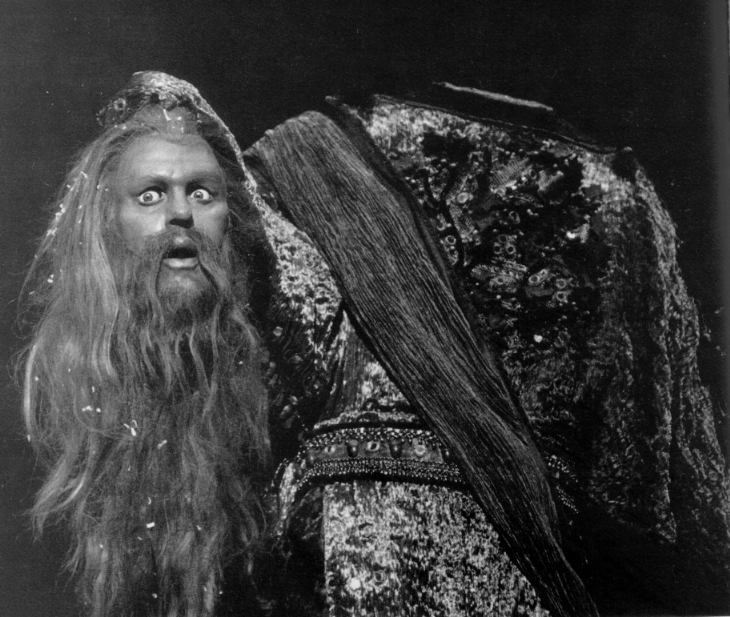 |
 |
Pearl, though reconstructed from a portrait which shows only her head and shoulders, is a complete, even three-dimensional character in The Second Mrs Kong. Though Inanna’s dialogue accuses her of being “two-dimensional, for God’s sake! She’s all front, she’s got no back side at all!....all she’s ever done is hang on walls”, this is mere comic rivalry from a dead, jealous fertility goddess. Birtwistle maintains that Vermeer treats his model three-dimensionally, and that his music can also add dimension to character. One assumes, moreover, that the soprano who plays the part is not going to be flat, in either sense of the word. Kong also starts his life dis-membered. In the making of the 1933 film, they used an 18 inch model, filmed in stop-motion, plus a giant head and shoulders, a giant foot and giant hand. The singing Kong knows this: “I’m not the giant head, the giant hand, the little puppet moving on the screen - there never was a giant ape!” “Who am I?” asks the dismembered ape. |
The answer Kong eventually finds to the mystery of his identity, during his quest for Pearl, is that he is “the idea of Kong”, an idea that can never die. The disparate, dismembered bits of him are held together by this invisible ‘idea’, just as in the notion of the invisible commercial empires earlier. If this sounds vaguely popular-Platonic, then you will not be surprised to learn that Kong (an idea) and Pearl (an image) cannot finally consummate their seemingly predestined love in the closing moments of the opera. What Kong is the idea of, says Hoban, is precisely that within us which can never have what it wants, “The wild and wordless, lost and lonely child of all the world”. Plato’s definition of love as a longing which is unfulfilled has been re-membered in so many genres. Marvell's version is perhaps my favourite.
In Hoban’s libretto, it is the character of Mirror who reflects, and reflects upon, reality. And it is she who states for Pearl and Kong that “It is not love that moves the world from night to morning....It is the longing for what cannot be.”
The Second Mrs Kong is an opera about aloneness, discorporation, separation and dis-paration. It is about impossibly disparate and disjunct elements held together, bound together, by ideas.
And it is, of course, words, language, which carry the burden of this contradiction. When Kong and Pearl first become aware of each other, and begin to fall in love, they do so through the medium of language - firstly through written language on a computer screen, then through electronically transmitted speech on the telephone. These mediating media bring them closer together, but also place a barrier between them. Language is a membrane: it acts as an interface, in allowing them to communicate at all, but it is, inevitably, also a barrier to full communion. Without the distance that email and the telephone provide, Pearl and Kong cannot express their love. And it is the Mirror, the personification of reflection, of thought, of language, who tells them:
“Look at me, see in my silver-shadowed waters yourselves together and apart for ever.”
While natural languages such as English have the best claim to this paradox, other communicative media - film, fine art, music, stage design - are all to some extent membranes, having the dual effect of joining and separating one human and another. Language, defined widely or narrowly, is not the perfect, invisible medium it might seem to be: it is not direct but arbitrary. It can get us a long way, but it can never take us home. Derida’s phrase “The thing itself always escapes,” and the concept of an endless chain of signifiers, resonate with Hoban’s description of the Vermeer Girl
No matter how steadily I look at her I cannot see her continuously;she is like music, always partly now and partly remembered.(4)
She has to be re-membered from disparate parts, not a unified entity, but a chain of dependant links; as Pearl herself sings at the end of the opera “Always and always the question unanswered”.
This is the language barrier. The is the impossible opera - the ‘work which cannot be done’.
In summing up, let me relate my ideas to those of Peter Kivy, in his book on the philosophy of opera, Osmin’s Rage.(5) Dr. Johnson’s famous definition of opera as “an...irrational entertainment” (as well as being apt for this conference) provides an irresistible stimulus for Kivy’s philosophical arguments. He maintains that 18th Century Italian opera was “an aesthetically rational solution to the problem of realizing drama in musical form.” As he traces the history of opera from Monteverdi to Mozart he exposes the deep tension that existed between the representational imperative in drama, and the demands of musical parameters. These are two languages so different as to be almost irreconcilable into a unified art form.
Kivy suggests that in Handel’s opera seria and Mozart’s opera buffa, musical forms were perfected which matched the dramatic and emotional practices and beliefs of their times, and thus the problematic disjunct within opera was temporarily repaired, resulting in masterpieces. When this disjunct was not sufficiently repaired, comments like this one arose:
To hear Kings, Warriors, Statesmen, Philosophers, Patriarchs, Saints, and Martyrs holding long Conversations with each other in musical Recitative, is a Circumstance so totally out of Nature, that the Imagination immediately revolts, and rejects the Representation as absurd and incredible.(6)
A century or two later, and the demand for representation has somewhat diminished:
The texture and the tension are those of tragic opera, where the very artificiality of the medium both in the recitative and in the arias, serves to eliminate the irrelevant dead level of normal existence and to set off in high relief the deeds and sufferings of the characters.(7)
By the time we reach the end of the 20th Century, and The Second Mrs Kong, the demand for Representation is drama has become openly questionable, and the very “revolt of the Imagination” which John Brown assumes to be negative, becomes positively desirable, foregrounding the artificiality of opera. Thus any disjunct, any contradiction, conflict, or bubble of irrationality is brought to the surface. To “reject the Representation as absurd and incredible” is to begin to see it as art, as an artificial membrane, which both joins us and separates us from each other’s worlds.
Just as Kong discovers that his disparate parts come together in his identity as “the idea of Kong”, so the ‘impossible opera’, as I have termed it, is possible, more possible, indeed, than its historical predecessors. It is possible as “the idea of an opera”, a self-aware, self-referential, reflexive entity, acknowledging its creative paradoxes.
As a genre which has always been disjunct, multi-disciplinary and artificial, heretofore against its will, opera has the potential to come into its own in the 21st Century, to finally find its identity.
|
opera seria |
Kong |
|
|
framework (invisible philosophical scaffolding) |
irrational (struggles with tension between representation and pure music) |
rational (by foregrounding the tension, theory is free to make a coherent statement of universal incoherency) |
|
foreground (plot, characters...) |
rational (attempts realism) |
irrational (attempts artificiality) |
Since Handel and Mozart, then, the site of irrationality in opera has moved from the unacknowledged background framework of assumed philosophical scaffolding, where the disjunct was hidden and papered over where possible; to the foreground, where it is proclaimed openly. I might go out on a limb here and say that foregrounding, admitting, to our problematics, as a culture, leaves our framework level, our theory, free to make the coherent statements it craves, albeit in this case a statement of universal incoherency. Our fascination with the multi-disciplinary, the disparate, the dismembered, and the un-stable, may in fact be our generation’s attempt to fulfil the “longing that moves the world from night to morning”, the longing for stability, for security.
I’ll let Habermas have the last word:
The new value placed on the transitory, the elusive and the ephemeral, the very celebration of dynamism, discloses a longing for an undefiled, immaculate and stable present. (8)
Thank you all for being present.
(1) Czeslaw Mllosz, "Ars Poetica?", Bells in Winter, New York: Ecco Press, 1974
(2) Stephen Pruslin, Sleeve notes to Punch and Judy,London: Decca HEAD 24/25, 1980
(3) Yves Lomax, "Montage?" Camerawork 24, March, 1982
(4) Russell Hoban, libretto The Second Mrs Kong, London, Universal Edition, 1994, preface
(5) Peter Kivy, Osmin’s Rage, Princeton UP, 1988
(6) John Brown, A Dissertation on the Rise, Union, and Power, the Progressions, Separations, and Corruptions of Poetry and Music, London, 1763
(7) Isaiah Berlin, "Winston Churchill in 1940" in Personal Impressions ed Henry Hardy, Harmondsworth: Penguin, 1980
(8) Jurgen Habermas, in David Harvey The Condition of Postmodernity Cambridge MA: Blackwell 1990