HAJO
(THE BLESSED LAND)
 |
|
|
Hajo is one of the most interesting place in Assam and perhaps the only place in the state one may find shrines and temples dedicated to Vishnu,Siva,Durga, the Buddha and Muslim saint. It was an important seat of rule of three powerfull royal camps of medieval Assam. i.e. the Koches, Mughals and the Ahoms. Accoring to the census Report of 1971 HAJO has an area of 4.01 square kilometers with 1,662 households and a total population of 10,269.
The
name & boundaries of Hajo have changed in different period of history. The place
was known by various names, such as, Apunarbhava, Vishnupuskara,Manikutagram,
Sujabad and Hajo. In the KALIKA PURANA(10th-11th century A.D.) we get an idea
of the area and boundaries of HAJO for the first time. The PURANA states that
HAJO was boundad by the river LAUHITYA in the east & south. River VARNASA was
snaking its course through the boundary while the LAUHITYA sea was situated
to the western boundary of it.
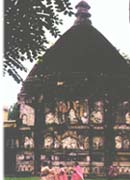
HAYAGRIVA-MADHAVA is the most important temple of HAJO. In fact, this temple can be termed as the nerve centre of the socio-cultural life of the area.The temple is situated at the top of a hillock called MANIKUTA. The temple was constructed by the Koch king RAGHUDEVA- NARAYANA in 1583A.D. There is another temple like building adjacent to the main temple. It is called DAULA-GRIHA and was constructed by king PRAMATTA SINGHA in 1750 A.D.
The second importent Hindu temple is dedicated to KEDARESWARA or KEDARA SIVA. It finds mention both in the Kalika Purana and the Jogini tantra.The main idol of Kedara is a big linga of stone. It is called a svayambhu linga.This linga appears to be an ardhanariswara form of Lord Siva.The linga is kept always covered with a big metal bowl.In 1753 A.D. King Rajeshwar Singha adjoined two walls in the gateway of the temple.
The temple of KAMALESWARA was one of the prominent Siva temple of Hajo. The temple of Kamaleswara was built by King Pramatta Singha in the 18th century. At the foot of the Kamaleswara temple is the temple of Ganesha.On a giant elephant-shaped natural rock, King Pramatta singha constructed the temple building in 1744 A.D.The temple possesses a big image of Lord Ganesha carved out on the elephant-shaped rock.This temple is called Deba Bhabana and is the meeting place of other deitiesof the Panchatirtha on special occasions. Besides these temples known as Panchatirthas,there is another important Hindu temple dedicated to Jay Durga, the mother Goddess. The temple was build by King Lakshminath Singha in 1774 A.D. There is a ten armed stone image of Durga on its alter.
Poa-mecca,the
holy shrine of the muslims, stands at the top of the Gurudachal hill.The main
object of veneration in the shrine is a tomb attributed to Ghiyasuddin Auliya.There
exist a mosque close to the tomb, The history of poa-mecca,as an Islamic shrine,is
connected with one saintly person name Ghiyasuddin. It is considered as the
most holy Islamic shrine in the region.Thousands of pilgrims from different
parts of the country as well as outsider visit this place. People believe that
visit to poa-mecca confers one fourth of the merits obtained from a pilgrimage
to mecca itself.
Dhoparguri
satra is a famous satra of hajo.The satra was established by Madhavdev in 1587
A.D. He made Lakshmikanta the Acharya of the satra. Gokrana,Vikarna,Swargdwar
etc. are some of the numerous holy spots
scattered in various localities of the sacred-complex.
HAJO is meeting place of several religious and cultural streams. The process of assimilation gives the society culture of the area magnificent character.The Hindu-Muslim amity and unity is singular feature of life of HAJO. Again, from time im memorial the association of the Buddhist world with the place has had a considerable influence in the religio-socio-cultural life of the pepole of the area.The age-long tradition of co-existance gives the society and culture of HAJO not only a spirit of tolerance and acceptance but also teaches the people the democratic value of life.All these factors have lent to the life of HAJO, the character of a secular society.
NEAREST AIRPORT: Lokpriya Gopinath Bordoloi
Airport(Borjhar Airport).
NEAREST RAILWAY STATION: Guwahati.
 |
|
|