On the 7th of November 1940 six British officers arrived at Colditz. Their journey,from Laufen Oflag VIIC had lasted three days.They were: Captain Rupert Barry of the 52nd Light Infantery, Kenneth Lockwood of the Queen´s Royal Regiment, Harry Elliottof the Irish Guards , Dick Howe MC of the Royal tank regiment ,2nd Lieutenant Peter Allan of the Cameron Highlanders and Captain Pat Reid of the Royal Army Service Corps. They had all been recaptured after escaping via a tunnel in Laufen.
They were put into an attic room where, that evening, they made their first acquaintance with the Poles. Four Polish officers unlocked the door and came into the room and advanced to greet them. They brought food and some beer. The meeting became noisy and there was much laughter which alarmed the Germans. Suddenly there was a warning signal from a Pole on the look-out by the stairs, and in less than no time they were all distributed (the Poles that is ) under beds in the corners of the two rooms, where surpressed laughter continued up to the instant of the entry of a German officer with his Gefreiter (Corporal). The attic door,and the others below, had been locked by the Poles so there was nothing to cause suspicion other than the laughter,which the Germans had heard and came to investigate. The officer was shocked that they were laughing as the prisoners´right to live depended on a word from him. A bit like laughing in church. He noticed the beds were shifted from their original place and made the Gefreiter move them back again in orderly rows. The Poles moved with the beds. When the Germans left the merriment continued for a while and then the Poles departed like they had come. In order to make this visit they had unlocked no fewer than five doors with a couple of instruments that looked like a pair of button hooks.
The six British officers stayed their for a week after which they were moved to more permanent quarters.
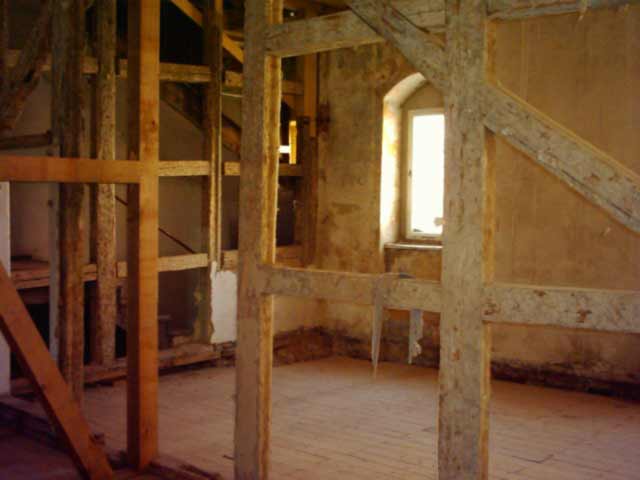
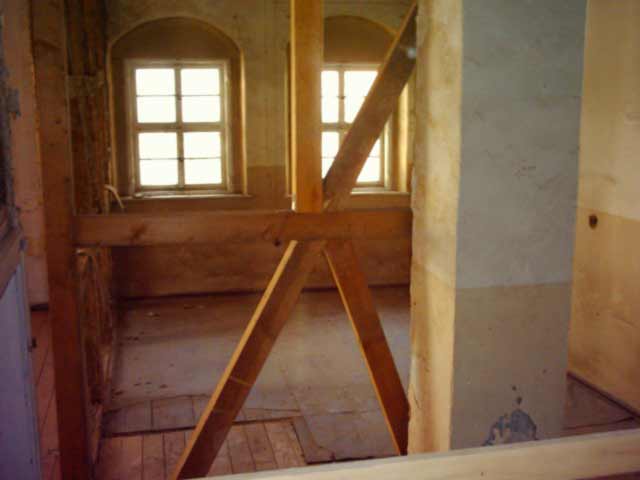
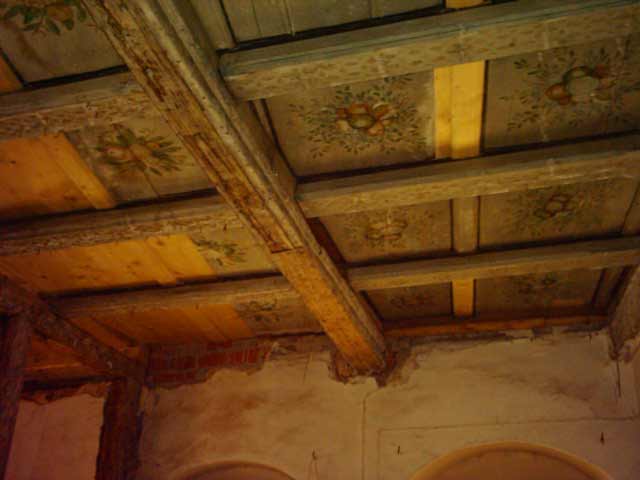
While I was still in London in July, Kenneth Lockwood asked me to go and investigate how the rooms look like today and take some photographs. Renate Lipmann took us to those rooms which are normally out of bounds for the public. They must be about the only rooms left in the castle that are still in their ´original´state. Here are the photos: