by
Audrey Doyle
Situation
A
tight deadline is not unusual in the visual effects business. Every facility
has, at some point, had to complete an effects sequence in less time than
what generally would be considered optimal. But agreeing to complete in
just nine weeks a total of nine complex virtual environments, each comprising
hundreds of frames and millions of polygons, could be, in the words of
Charles Darby, "semi-suicidal."
Darby
is visual-effects supervisor and co-owner of Digital Firepower, a Hollywood,
California-based facility that specializes in creating elaborate digital
worlds through the medium of 2D and 3D digital matte paintings. In early
fall, the facility created six such hybrid environments for the much anticipated
film Dungeons & Dragons, which hit theaters December 8. About
a month after Digital Firepower completed the job, Darby got an urgent
call from the film's director, Courtney Solomon, explaining that he was
having trouble getting the look he wanted in shots he had awarded to another
facility months before.
"They
were the opening and closing shots in the film; they were important shots
but very complicated and dramatic, and Courtney wasn't pleased with the
way they were coming out," Darby recalls. "He liked what we had already
done for him so much that he asked me if we could take over and complete
this new batch of shots."
Darby
admits he was cautious about accepting the project. He adds, however, that
he knew the 3D modeling and animation software his artists would be using
to help create the environments would enable them to not only meet the
extremely tight deadline under which they would be working, but also exceed
the director's expectations. That software is Discreet's award-winning
3ds
max™.
Problems/Challenges
When
Solomon approached Digital Firepower to create additional Dungeons &
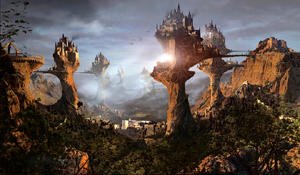
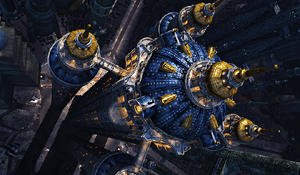
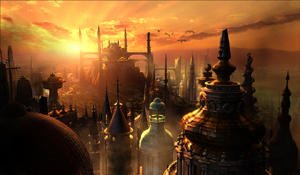
Dragons environments, the request was for six 2D and 3D digital matte
paintings of the fantastical city in which the film takes place — a task
that Darby and his team of 10 were given nine weeks to complete. That six-shot
order quickly grew to nine shots three weeks into the project, but the
deadline remained the same. According to Darby, the studios that were working
on the shots prior to Digital Firepower were about half finished with them
when the director asked them to stop.
"Their
camera moves were way too fast, so there was no sense of scale," Darby
says. "This is supposed to be a very large city. The fact that the camera
was moving too fast around the buildings in the environments made the city
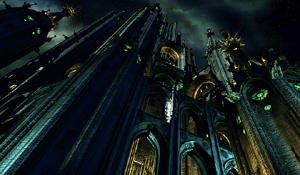
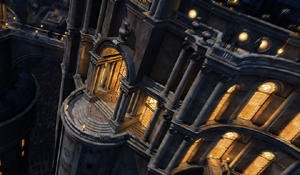
look small." In addition, he adds, the textures on the buildings were rudimentary,
and Solomon wanted the architecture to be detailed and ornamental.
Darby
says he knew up front that completing these shots would be challenging
for the team. "We were being asked to create elaborate 2D and 3D matte
paintings and complex camera moves for shots that were very important in
terms of the film," he says. "They're the hero shots that help sell the
concept that this is a massive city. Viewers had to believe that they were
looking at a huge city, so it was important that the environments we were
being asked to create have the right look."
What's
more, the team would have to create all the 3D geometry from scratch. "Although
we were offered the other studios' existing geometry, I didn't want it
because we wanted to conceptually rethink every camera move and angle for
the shots, and then design the looks ourselves," Darby says.
Solution/Benefits
Rather
than turn down Solomon's request, however, Darby accepted the challenge,
in part because he had such confidence in his 3D toolset. "We had used
3ds max for the 3D work in the first batch of shots we were awarded originally,
and those were done under a pretty tight deadline, too — only eight weeks,"
he says. "I don't think we would have accepted this new work if we didn't
have 3ds max."
According
to Darby, the team began by creating watercolors of the environments they
needed to build. Those were translated into animatics, and the animatics
were approved. Then the artists created the bulk of the 2D matte paintings
using Adobe Photoshop, and created the 3D environments in 3ds max
using hand-painted textures. Some shots even include 3D people created
Discreet's character studio®.
Although
Darby says all nine shots were elaborate in terms of detail and complexity,
he says perhaps the most difficult of the nine is the very first shot in
the film, created by Darby, 2D/3D artist Jamie Baxter, and animator Simon
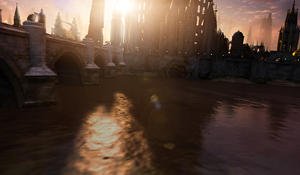
Yuen. "You're moving across a river, and it's kind of abstract; you're
not entirely sure what you're looking at. Then a bridge goes hurtling past
you and underneath you. The camera tilts up, and you see that the sun's
going down and a beautiful, warm light is hitting the water. You sweep
past a large, ornate bridge, and you pass people walking on the bridge.
The sun's setting and silhouetting the buildings, which you are now facing.
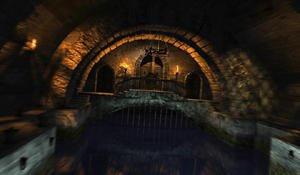
You head toward an archway on the other side of the river and go through
the archway and into a tunnel, past beams of light and then through a doorway.
The screen turns black and then the shot cuts to a live-action interior,
which is on the other side of the door. It's really a beautiful shot. You
can't tell where the 2D ends and the 3D begins."
According
to Darby, the speed of working in 3ds max is one of the benefits
that helped Digital Firepower complete this and the remaining eight shots
on time. "We find it very fast to use, especially when it comes to kicking
out renders," he says. "This was really a cruel deadline, and 3ds max's
speed helped us to meet it."
Another
benefit was the fact that 3ds max is so artist-friendly, which was
important for this job because some of the artists on the team were new
to working in 3D. "We're all traditional artists here," Darby says. "An
artist can understand 3ds max because although it can be used for
complex things, it's not such a complex package. If it were, we wouldn't
have been able to make our deadline.
"Our
shots are considered some of the most beautiful and memorable in terms
of effects in this film," Darby concludes. "And thanks to 3ds max,
we were able to complete in nine weeks shots that other facilities had
a year to do."
Images
Courtesy of Digital Firepower and New Line Cinema. |