URBAN LEADERSHIP FOUNDATION
Global Cities Leadership
Networks,
Catalysing City Leadership Teams,
Birthing Urban Poor Churchplanting Movements,
and Training in Transformation of Postmodern Cities.
Through Thinktanks &
Leadership Networks,
Creating Urban Theology,
and Prophetic and Apostolic Leadership.
THE NEED: POST-MODERN CITIES
URBAN LEADERSHIP DEVELOPMENT PROCESSES
Urban Leadership Foundation
P.O. Box 20-524 Glen Eden,
Auckland, New Zealand
Ph/fax [64](9)813-1440
email: adcity@nznet.gen.nz
U.S. Funding/ Sales Contact:
711 E Walnut Ave, #406
Pasadena, CA 91101, USA
Phone/fax (818) 584-3863
Correspondence:
627 N.Mentor #201
Pasadena, CA91106, USA
email: vivgrigg@earthlink.net
The mission of Urban Leadership Foundation is
to facilitate the emergence of leadership infrastructures with
strategies for evangelism and for the transformation of the soul
of cities and nations.
GOALS
Our aim is to catalyze missions partnerships
and indigenous leadership teams in 300 mega-cities and 1000
least evangelized cities.
We seek to build teams, of Christian
leaders in both the church and secular society by inspiring them
with a vision, and enabling them to develop strategies for the
evangelisation and transformation of their cities.
We build networks of these leaders
globally, across continents and within countries to enable cross-fertilization
of ideas, multiplication of models and peer group development.
Urban Leadership is an organisation and base team for the
prophetic ministry of Viv
Grigg, and expository
Bible teaching ministry of Ieda Grigg. It is a series of
think-tanks, and catalysing of networks for urban missions, city
leadership teams, and Christian leaders in secular public roles.
It has been uniquely positioned to call the global church into
partnerships to the least evangelized and poorest cities of the
world.
Phase 1: Urban Church-planting ('69-'81). When he
entered Manila's squatter settlements in the 1970's, New
Zealander Viv Grigg had to forge new patterns in evangelical
theology and pioneer new urban missions strategies. The challenge
was to find a way that met people's spiritual needs in context of
dealing with their poverty. This was one of several urban
fellowships that Viv had pioneered among students, professionals,
and then the urban poor.
Phase 2: Urban Poor Missions ('81-'91). In the 1980's,
he catalyzed four mission societies of people living among the
mega-city poor, bringing religious and socio-economic change.
These now number over 300 workers. He helped catalyze a Brazilian mission which
has workers in the slums of 11 cities in South America, North
Africa, and Asia. Ieda and he personally pioneered a team of
workers into Calcutta which initiated slum fellowships in that
city.
Urban Leadership was structured around Viv as a small
prophetic nucleus of workers, a "virtual reality corporation"
(now you see it, now you don't) that generates vision and
networks to serve these missions and other partnerships into the
mega-cities. It does not seek to integrate these into a mega-structure
under its control. As churches and missions have been pioneered,
vision imparted and leadership established, they have been spun
off from Urban Leadership Foundation to develop their own
indigenous patterns.
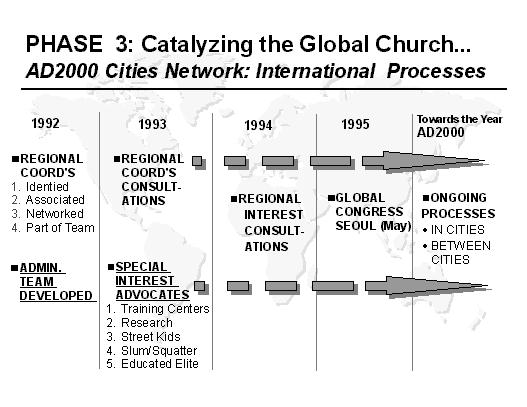
Phase 3a: Catalyzing the Global Church ('91-2000).
Since 1991, Urban Leadership has been catalyzing and empowering
teams of city leaders, based on models developed in Calcutta,
North India and New Zealand. As coordinator of the AD2000 cities
network globally he has lead consultations for numbers of city
leaderships around the world, seeking to mobilize partnerships
into the 1700 least evangelized cities.
Phase 3b: Modelling City-State Leadership Development for
Transformation (96-2000): With Viv back in his home base of
New Zealand, Urban Leadership has been facilitating the N.Z. city
leaders' network, Vision for
Auckland, encouraging an ethnic leadership network,
and a national network of evangelicals involved in transformation
of society.
In the last thirty years the greatest
migration in human history has occurred.
One billion people have moved from rural poverty to the mega-city
slums, squatter areas, favelas and bustees. These
migrant poor now make up 40% of the world's cities and their
numbers will double in the next ten years. Existing missions
strategies have largely ignored both these burgeoning cities and
the urban poor.
In the year 2000 A.D. there were:
- 40 mega-cities of over five million
- 460 mega-cities over a million.
- 6600 cities that have populations in excess of 100,000.
Of these, we have classified 1734 as "least evangelized"
(without movements of churches sufficient to reach them). Most
fall within the "10/40 Window" a geographical region
between Morocco and Japan, covering North Africa, the Middle East,
Northern India and China. History shows that the key to reaching
a city is to begin with the poor. Beyond the poor of these cities,
one finds the political and social elite who determine the nature
and structure of the cities. For real and long lasting
transformation to occur, we must challenge the leadership
structures of these cities. Inspiring and resourcing indigenous
leadership is a central element in evangelizing and transforming
these cities. Enlightened leadership brought together from
different cities or within cities, encouraged to define a vision,
and equipped with knowledge, networks and resources can rapidly
accelerate the process of bringing the Kingdom of God. "
If we reach the cities ,we reach the
nation. But if we fail in the cities , they become a cesspool
that will infect the entire country." D.L. Moody
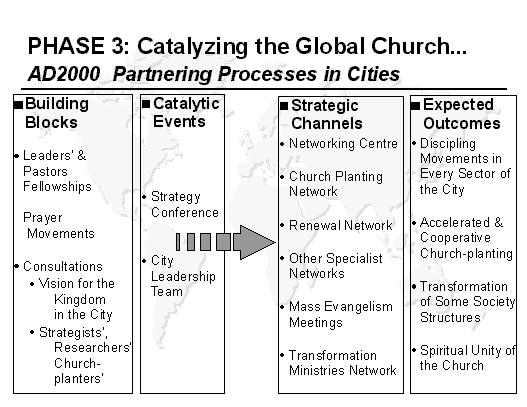
1. Raising Vision
* Urban Research
* Writings and Publications
* Think-tanks and Strategy Consultations
Working Groups
Best Way to Develop Leaders
2. City Leadership Team Formation
of Pastors and Leaders in Society
for Evangelisation and Transformation
Leadership Networks and Partnerships
3. Urban Poor Strategies and Mobilization
1. Rebuild a New Zealand Resource Base
- Develop a manpower and financial resource base in
Auckland, with appropriate partnership links to existing
New Zealand teaching and vision-setting institutions.
- Build the Auckland city leadership team (1997-2001),
facilitate its coordinating office
- Teach
Urban Missions in two main
Bible Schools (1996-2001).
- Bring together thinktanks and strategy
working groups of ethnic, business and leadership groups
in societal sectors (1998)
- Work with others in the development of a national
leadership infrastructure for the transformation of
the soul of the nation, linking core teams of leaders in
12 societal sectors (as opportunity permits).
2. International: Urban Leadership /
Cities Network Partnership
- Strategy Consultations: Generate in-city
leadership processes through in-city and inter-city
strategy consultations for city leadership teams.
- Adopt-a-City Program and Global Urban Research
Consortium: Expand the research consortium on the web,
connecting two page profiles cities. Mobilize churches to
adopt, pray and send workers to serve national leaders.
3. International: Expand Existing Urban
Poor Missions Models
- Urban Poor Ministry Training: Expand
Urban Poor Awareness Seminars for churches, and
seminary courses on Church-planting Among the
Urban Poor, Theology of Urban Poor Ministry and
Citywide Leadership Strategies
- Sustain Linkage to Existing Movements:
Continue to advise and influence Servants to Asia's Urban
Poor, the U.S. Servant-Partners, facilitate Brazilian missionaries into
Asia from Kairos,
and work with the leadership team of the AD2000 Urban
Poor Network.
- New Zealand - Calcutta Linkage: Sustain the
momentum in the intercessory battle for Calcutta
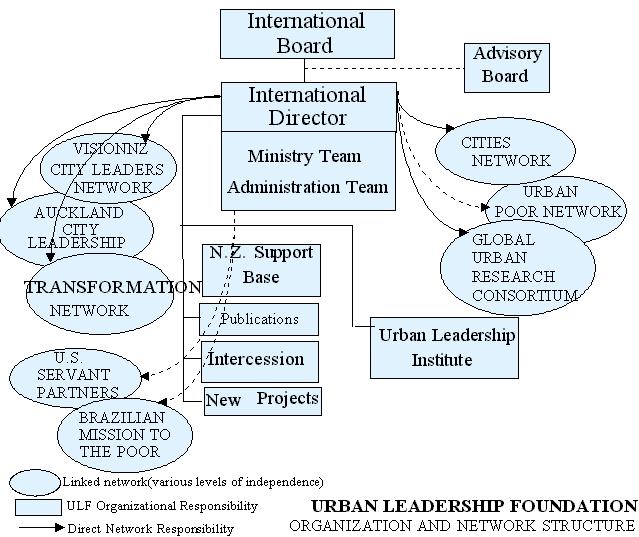
Virtual Reality: The organizational structure of
the mission is deliberately limited. The international office has
traditionally been lean, in keeping with the ethos of a mission
committed to the poor. It expands and contracts as it builds and
spins off each movement.
Internal Structure: The International Board
oversees the ministry, setting policies. The NZ admin. committee
on the board is responsible for legal and financial issues. There
is an advisory board consisting of key national leaders and
specialist advisors. The operational side of the mission is the
responsibility of the international director. The Cities Network
is a separate ministry that has been catalyzed, administered and
funded by Urban Leadership Foundation.
Networks: In this chart the various parts of the
organization are designated as being either an essential part of
the Urban Leadership Organization or as being a network link,
even if in some cases ongoing organizational support is sustained.
Volunteer support staff are needed for managing
the website, computer development, secretarial support,
bookkeeping. City leaders are invited to join in developing the
city leaders networks.