SAN VINCENZO ABBEY
Since that spring's day when three saints arrived at Volturno's springs more than 1300 years have passed; after a time of great prosperity, for San Vincenzo Abbey, one of great sadness and of slow agony came, until centuries of forgetfulness fell on the stones of its ruins. By then, not much has changed in the place's nature; today, those who arrive at the high Volturno's valley, stay admiring and attratting by the same setting, on which there are the signs of the old Benedictine power.  Of the old San Vincenzo abbey only S.Epifanio's crypt has remained untouched. But the excavations made by the archeologists have offered for the first time, the possibility to see a big center of the Carolingian dinasty, one of the most important in 9th century in Europe. The first English man who has left a description of a visit at San Vincenzo was Keppel Graven. But he does not mention the frescoed crypt discovered only the previous year. About San Vincenzo abbey's history, during the high Middle Ages, the crypt has an important role. The perfectly preserved paintings have been and still are being studied by many art historians. The crypt was deviced by Epifanio as funerary chapel for himself. About the archeological outline, until 1980, only the crypt gave the reality of the old account. Thanks to the latest ten years of work, today we can state that the human presence in this place dates back to the old "Iron Age". There's no dubt that San Vincenzo abbey was made in an important center. Opposite the crypt, in fact, the rests of a small sanctuary datable around the 5th century B.C. have been found. It was situated near Volturno and knew great flourishing in the course of the 15th century a.C. When the first monks arrived at San Vincenzo, the late Roman villa covered an hectar and half surface. The graveyard church was transformed in the first abbey church. So San Vincenzo "The Minor" was built. The nearest church had a different fate, in fact it was used for a short time. The first big transformation intervention was the demolition and the rebuilting of the northern church. The just-built structure consisted in a little nave poorly constructed connected to the abse of the previous late Roman church. Subsequently in San Vincenzo "The Minor" a new deambulatory was made, which was more perfect then the previous one. It was under abbot Giosuč (792-817), San Vincenzo became one of the most important places in western Europe. It is thought that over 1000 people lived in San Vincenzo in that period. Under abbot Epifanio the monastery was furtherly enlarged; but on 10/10/881 a troop of Saracens put on end to that incredibly magnificent period which had been the 9th century for San Vincenzo al Volturno. It was necessary to wait till 1055 to find a new impulse to the realization of important works in the Abbey with abbot John 5. What remained of the old site disappeared under the farmer's terracings and the memory of its history and of its exsistence vanished; until 1980, when the excavations started.
The 7th of April, the classes 2nd and 3rd of the side D went to the abbey of Castel San Vincenzo.
Below there are some photographs of the visit.
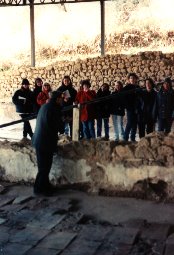 |
Architect Di Turi is illustrating the history of the excavations; in the photo you can notice the flooring in the diving-hall which has partly disappeared. |
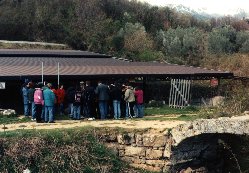 |
Before the actual visit to the ruins Mr Di Turi is summarizing the historical and geographical situation of the abbey site. |
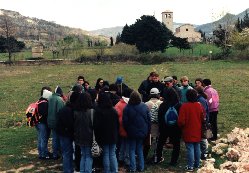 |
At short distance from the abbey ruins we are intent on listening to our guide. |
 Back
Back