| About this page in Armenian |
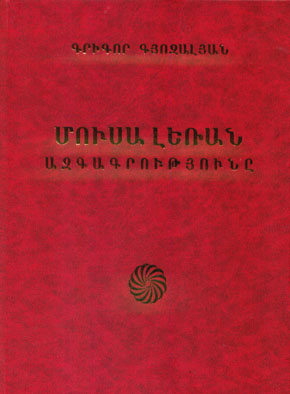
I made the acquaintance of the repatriate intellectual Grikor Gyozalian (Geghuni), a native of Moussa Dagh, specialized in engineering in Paris, in 1976, at the time when I was preparing my folklore collection "Moussa Dagh" for publication (V. Svazlian. Moussa Dagh. "Armenian Ethnography and Folklore." Vol. 16, Publishing House AS ASSR, Yerevan, 1984). Grikor Gyozalian became for me not only a talented narrator from whom I have written down folklore materials already doomed to oblivion, but also, with his compassionate behaviour and patriotic fervency, he assisted in the dialectal corrections of the original texts of my collection, for which I am grateful to him.
Formerly, Grikor Gyozalian had assisted also the academicians Ararat Gharibian and Gevork Jahukian in studying the difficult dialect of Moussa Dagh.
Appreciating Grikor Gyozalian's rich experience and knowledge of his native land, I requested him to compile the ethnography of Moussa Dagh, putting at his disposal the "Ethnographic Questionnaire" of the famous ethnographer Stepan Lissitsian, in order that, using these scientific principles as a starting point, he might present the life and customs of this section of the Armenian nation, the lack of which is notable up to the present day.
Inspired with the dream of his native land and endowed with poetic style, Grikor Gyozalian realized this work with love and enthusiasm; however, it was left unpublished up till now for various reasons at the archives of the Institute of Archaeology and Ethnography of the National Academy of Sciences of the Republic of Armenia.
The present work summarizes the period extending till the heroic battle organized by the denizens of Moussa Dagh during the days of the Armenian Genocide in 1915. Based upon the general characteristic of the seven villages of Moussa Dagh, it depicts the geographical environment they have lived in, the old and new historical events, the popular rites and beliefs embracing all the spheres of the human life from birth till future life.
The section "Economic Life" includes detailed descriptions concerning land-cultivation, horticulture, vegetable-growing, cattle-breeding, sericulture, apiculture, hunting, widespread occupations in handicraft and manual skill, barter, trade, transport, etc.
The section "Material Life" describes the villages, the churches, nearly all the variants of the external aspect and internal furnishing of houses and adjacent constructions, of costumes, of adornments, of food and beverages.
Of special interest are the materials included in the section "Social Relations" of the inhabitants of Moussa Dagh dealing with the customary right and various forms of thinking of the generation, the family, the class layers, the beliefs, the holidays and the rites.
Grikor Gyozalian has succeeded, as an eye-witness survivor, in presenting what he has seen and heard in the past in a popular language and in an expressive and vivid style, imparting to the material a truthful and trustworthy character.
The work is supplied with drawings made by the author himself, which render this valuable ethnographic ancient material more obvious and more comprehensible.
Grikor Gyozalian's present work is a colourful panorama saved from a total loss of the former life, customs and outlook of the heroic denizens of Moussa Dagh, which, we are sure, will occupy its befitting place in the century-old history of the Armenian people.