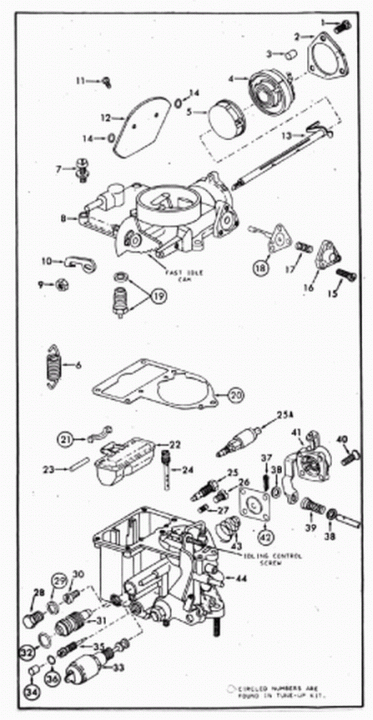
A general exploded view of the 34PICT/3 Carburetor is shown in the following diagram, and a listing of the parts, giving nomenclature and part number (referring to the exploded view) is given in the following table.
~~~
Carburetor Parts Listing and Nomenclature
Ref. No.
Part
Ref. No.
Part
1.
Retaining ring screw (3)
23.
Float lever pin
2.
Retaining ring cover
24.
Air correction jet
3.
Retaining ring spacer bush
25.
Auxiliary idle speed fuel jet
4.
Cover, /w spring & heater element
26.
Auxiliary fuel jet plug
5.
Plastic cap
27.
Auxiliary fuel jet
6.
Throttle return spring
28.
Main jet plug
7.
Screw & washer-upper body (5)
29.*
Plug gasket
8.
Upper body assembly
30.
Main jet
9.
Choke shaft nut
31.
Bypass air screw
10.
Operating lever--fast idle cam
32.*
Volume control screw O-ring
11.
Choke valve screw (2)
33.
Bypass air cut-off screw
12.
Choke valve
34.*
Volume control screw plug
13.
Choke shaft
35.
Volume control screw
14.
Choke valve spacer washer (2)
36.*
Volume control screw O-ring
15.
Cover screw (3)
37.
Cotter pin
16.
Vacuum diaphragm cover
38.
Washer (2)
17.
Vacuum diaphragm spring
39.
Connector rod spring
18.*
Vacuum diaphragm - choke
40.
Cover screw (4)
19.*
Needle, seat & gasket assembly
41.
Cover - with lever & pin
20.*
Gasket, carburetor body
42.*
Pump diaphragm
21.*
Float pin lug
43.
Diaphragm spring
22.
Float
44.
Carburetor main body assembly
*Included in the tune-up kit.
REMOVAL:
Remove air cleaner.
Detach fuel hose from the carburetor and quickly plug it (a pencil works great).
Detach vacuum hoses if you have them; remove the caps from the vacuum ports on the carburetor if you have no vacuum hoses.
Disconnect the wire from the automatic choke heating element.
Disconnect the wire from the electromagnetic cutoff valve.
Loosen the clamp screw in the accelerator cable pivot pin, then pull the cable out of the pin. Stow the cable pivot pin and clamp screw in a safe place so you can find them later.
Remove the distributor cap to provide access, then remove the two nuts (13mm) from the studs on the carburetor flange. Remove the carburetor and gasket; stow the two nuts.
Stuff a rag into the intake manifold to keep foreign material out.
DISASSEMBLY:
Use the exploded view as a guide. The numerical sequence may generally be followed to disassemble the unit far enough to permit cleaning and inspection.
CAUTION: Brass tube type jets are not removable.
Remove the five screws that hold the carburetor upper part to the body and remove the upper part. Remove the gasket; your carburetor kit should have a new one.
Remove the float valve from the upper part; there should be a new one in your kit.
Note the arrangement of the float pin lug and the float lever pin relative to the float; remove the float assembly and store away carefully. There will be a new pin lug in your kit; be sure to note which way it goes.
Remove the idle solenoid valve from the left side of the carburetor.
Remove the bypass screw and the volume control screw from the left side of the carburetor.
NOTE:The manuals say not to remove the volume control screw, as it is set at the factory. Go ahead and remove it -- after 30 years it will have been moved several times already, and "leaving it alone" is fine for a newish engine but silly when the engines are all at least 30 years old and in different states of health - same with the carbies, so adjustments become essential. Adjustment directions are given below.
Inspect the O-rings on the bypass screw and the volume control screw for wear.
Remove the main jet plug on the left side of the carburetor. Reach through the plug hole with a screwdriver and remove the main jet. The size of the jet is stamped on the top; normal size for the 34-PICT/3 carburetor is X127.5 (1.275mm diameter). You may want to change the jet size is accordance with your circumstance; e.g., smaller jet size at high altitude (X125 at 4000 ft.).
Remove the air correction jet (it just screws out).
Remove the various other jets and adjustment screws from the carburetor body and store them away carefully. You will clean these and replace them. Inspect all jets, adjustment screws, and the holes they came from for wear.
Disassemble the accelerator pump and linkage.
Disassemble the throttle valve shaft assembly (actually, you don't really need to do this. BUT -- do check for lateral movement (side-to-side) in the throttle shaft. If you find such movement, the shaft hole is out-of-round and you will be getting air in-leakage. This is very serious; my thinking is that if the throttle shaft hole is out of round, it is likely that the rest of the carburetor isn't in very good shape, either. I just bought a new carburetor.)
Disassemble the automatic choke assembly.
CLEANING:
Cleaning must be done with carburetor disassembled.
Soak parts all metal parts long enough to soften and remove all foreign material. Use a carburetor cleaning solvent and an old toothbrush on the carburetor body.
Make certain the throttle body is free of all hard carbon deposits. Wash off in suitable solvent.
Blow out all passages in castings with compressed air (if available -- it's best if you have it; I usually don't, but I find that "canned air" (like Ultra Jet or similar) works pretty well). Check carefully to ensure thorough cleaning of obscure areas.
CAUTION: Do not soak choke heating element, pump diaphragm, float, vacuum diaphragm, or any rubber parts in solvent.
REASSEMBLY:
Reassemble the carburetor in essentially the reverse order of disassembly, giving special attention to the following special instructions.
SPECIAL INSTRUCTIONS:
Make sure all jet orifices are clean and open. Clean with compressed air (or "canned air"). Do not use wires to check for clogged orifices.
Check the float valve for binding and leakage. It should not be possible to blow air through the valve while the needle is pressed lightly onto its seat.
Check the float for leaks by immersing it in hot water. If bubbles appear, replace the float.
Check for a worn spot (depression) on the float lever where it makes contact with the fuel inlet needle valve. Replace float assembly, if necessary. Float assembly may be purchased at local VW dealer, P/N 113-129-391 rectangular shaped float (22).
The proper needle seat gasket must be used for specific carburetor. The 34 PICT-3 uses the 0.5 mm (.020") gasket.
When installing the pump diaphragm and spring, make sure the larger end of spring is properly seated in the carburetor body cavity. Be sure to install the diaphragm with plunger toward pump cover. (See the exploded view.)
Be sure to use the correct body joint gasket; there will probably be several in the kit. Compare to the old one.
Check the thermostatic spring in the automatic choke housing for damage. If it is distorted or "kinked", replace the assembly.
Make sure the electrical heating element is not broken. This can be checked with an ohmmeter or connected to a correct voltage battery for a few minutes to see if it warms up. (Be sure to ground the inside metal part of the housing in order to complete the circuit.)
When installing assembly with spring and heater element, carefully rotate assembly counterclockwise, being sure the hook on coil end engages with the lever on choke shaft. Continue rotating approximately 1/8 turn more until index marks align. Then tighten screws securely.
Turn the volume control screw in until it seats lightly, then back it out 2-1/2 to 3 turns. The bypass screw will have to be adjusted to give the proper idle with the engine running.
INSTALLATION:
Install in reverse order of removal.
Lightly lubricate the choke valve shaft and throttle valve shaft with engine oil and the external linkage with molybdenum grease.
Using a new gasket, install the carburetor on the intake manifold; torque the retaining nuts to 14 ft-lb (just snug them up tight with your 13mm box-end wrench).
Secure the fuel hose with a new hose clip.
Pass the end of the accelerator cable through the cable pivot pin installed in the throttle lever. Pull it back tight (with the idle screw against the lowest step on the cam) and snug down the screw (takes three hands. I use my channel lock pliers and hold the end of the cable to the throttle lever while I tighten the screw with the other hand).
Perform the Idle Adjustment and Timing procedures.
Disclaimer stuff: Rob and Dave have prepared this information from their own experiences. We have not assumed any specialised mechanical knowledge, but we DO assume that anyone using this information has at least some basic mechanical ability.
We hope you find this information useful, but we don't take any responsibility for anything which happens to you, other people, your VW or any other property or goods resulting from your use of this material.
Feel free to print off any of this information for your own use. If you intend to link this material to another site, reprint it, or in any other way redistribute it, please leave the information complete, including this disclaimer section, and provide a link to this Web site.