As we all know, the babies we all love so much are cooled by air. Adequate cooling of the VW engine, and the flip-side, overheating, are concerns. In any system in which work is being done, the Second Law of Thermodynamics dictates that some of the energy produced is wasted in the sense that it cannot be utilized for work. This waste energy, in the form of heat, must be transferred to a “heat sink.” In a water-cooled car, the water circulating through the engine block and heads carries the waste heat to a radiator, where the waste heat is dumped to the atmosphere. The atmosphere is also the “heat sink” in the aircooled VW engine, but in Volkswagens the waste heat is removed from the engine by flowing air rather than water. Finning on the heads and cylinders facilitates the heat removal, and a cooler is provided in the system to remove heat from the engine oil; heat is also carried from the oil cooler by flowing air. We are often asked, “What is the best way to keep my Bug cool?” And being the stock enthusiasts that we are, we respond, “You already have (or perhaps, had) everything you need.” Volkswagen engineers recognized from the outset the importance of keeping the engine cool, and they came up with a very efficient design, consisting of a blower (fan), a set of air vanes, thermostatically controlled flaps, air dams and deflector plates. This system is designed to efficiently direct the flow of cooling air toward the cylinders and heads, paying particular attention to the exhaust valve areas of the heads. The smart VW owner will watch carefully for the tell-tale signs of overheating. In his technical manual(1), Gene Berg states that the safe upper oil temperature is on the order of 235F (113C) so. If the temperature is higher than 235F, the heat can cause case studs to pull out, head and case sealing surfaces to warp, cases to be internally distorted, permanent case metal fatigue and engine bearings to wear prematurely. Sounds like a horror story, but it is easily prevented if a few precautions are taken and followed religiously.
How Do You Know If Your Engine Is Running Too Hot?
There are several of ways -
With the engine completely warmed up, grab the dip stick and pull it out. If you can JUST hold it without it burning your fingers, the engine temperature is OK. If it burns your fingers (and the engine will usually smell hot too), then the temperature is too high -- possibly as high as 285F (140C) -- VERY hot!
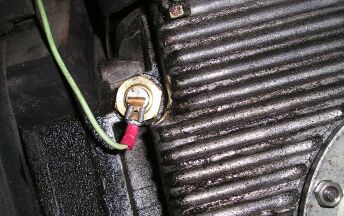
An oil temperature gauge requires an oil temperature sensor/sender. There are two types of oil temperature sensors -


Wiring instructions come with the gauge (e.g., VDO). Generally speaking, you run a wire from the sensor up to where you install the gauge in the cabin. You will need to drill a small hole in the floor pan behind the rear seat so you can route the wire into the area under the rear seat, then forward from there). To wire the gauge you simply connect the gauge to power (we used the #11 fuse) and to ground, and you’re all set. In our Superbug we found a nice place in the dash to install the gauge, just to the left of the steering column.

A word of caution from Gene Berg: “Practically all (temperature gauges) read low in the 212 to 260 degree range by 40 to 50 degrees ...” So far we haven’t experienced this, but we’ve installed a Gene Berg temperature-sensing dipstick as a back-up -
This sensor is sold by Gene Berg Enterprises. It installs in the dipstick hole and connects with a wire the oil pressure switch. When the temperature reaches about 225F, the spring inside of the dipstick turns to make electrical contact, and the oil light in the instrument cluster begins to flicker. As the temperature increases, the oil light will flicker more rapidly until it remains on continuously -- which means your oil temperature is dangerously high.


With the temperature-sensing dipstick, you don’t get any indication that the temperature is rising until the oil light flickers, telling you the oil is becoming too hot; but at least you can do something before any damage occurs. The dipstick is very easy to install in the car, since it uses the existing dash oil pressure light as an indicator.
How Do You Keep the Operating Temperature Within Safe Limits?
Below are some things that you can do (short of pulling the heads and fussing with the compression ratio. Rob Boardman: “Dropping the compression ratio is counterproductive; more compression means a more efficient engine.")

The original style thermostat is no longer made and is becoming more and more difficult to find. A very good option is to use the new-style thermostat pictured below. This thermostat is the original replacement style for Mexican fuel-injected Beetles made from 1975 to 1979 and is a suitable replacement for the old bellows-style thermostat. The thermostat provides enough upward movement of the connecting rod to fully open the flaps on both Type 1 and Type 4 applications.
Note: The fan associated with the "doghouse" oil cooler provides plenty enough air to cool up to about 80hp (a warmed up Type 4 engine in a Bug for example), but to get best effects you have to ensure every bit of cooling air goes where it's most needed. That means you must have the cooling flaps above the cylinders -- with these fully open more air is directed to the hotter heads and less to the cooler cylinders. The cooling flaps also work with the thermostat to provide a fast, even warm-up on those cold mornings. The importance of cooling flaps used to be misunderstood and many have been removed by engine builders as “not needed”, but they are essential in getting more air where it’s needed most – the cylinder heads.


Note: Be careful not to over-torque the nuts on the oil cooler studs – you might squash the small rubber seals too much and reduce the oil flow through them.


Note: Dave installed a fiberglass rear apron on his '73 SB. This apron does not have the slot for the stock rubber engine compartment seal, so the stock seal would not stay in place but kept falling down onto the muffler. Dave discussed this situation with John Connolly of Aircooled.Netand decided to go with an alternate seal that John recommended, shown in the picture above. This seal is used in the 1972 and newer Type 2's and the Type 4 VW. The seal is pressed down into the space between the engine tin and the body of the car.

You have to remove the engine to install the cool tin, and to fit them to the Type 1 Beetle tinware they might need to do a little cutting and bending. They are not really needed for a stock Beetle engine, but if you have a higher performance engine or are experiencing cooling problems, they might help.
There you have it. Use all the stock parts of the cooling system, properly fitted and without any exposed holes in the tinware, use the right fuel, set the carburettor mixture right, drive sensibly, and your engine will run in its preferred heat range in summer or winter.
Credits and references -
Disclaimer stuff: Rob and Dave have prepared this information from their own experiences. We have not assumed any specialised mechanical knowledge, but we DO assume that anyone using this information has at least some basic mechanical ability.
We hope you find this information useful, but we don't take any responsibility for anything which happens to you, other people, your VW or any other property or goods resulting from your use of this material.
Feel free to print off any of this information for your own use. If you intend to link this material to another site, reprint it, or in any other way redistribute it, please leave the information complete, including this disclaimer section, and provide a link to this Web site.
Last revised 23 June 2004.