
CULTURAL RELATIVISM

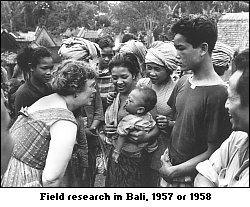
Margaret Mead

theory
basic component of theory
impact on adolescent development
positive effects of divorce
negative effects of divorce
how to create positve outcome


THEORY


Culture, environment, and socialization are the primary determinants of human personality and behaviour.


BASIC COMPONENTS OF THEORY

The "Storm and Stress" of adolescence is a product of culture.

According to Mead, the USA is a PRECONVENTIONAL culture, where survival and success rely on technology much rather than industrial or agricultural resources.  The nuclear family is no longer the norm and children DO NOT model themselves after their parents, but rather their peers.

Mead believed that a "tolerant family system", in which Mom and Dad could disagree without quarrel and a child could challenge without loss of love, self-respect, or increase in emotional tentions, fosters a "wholesome individual".

Benedict and Le Francois point out that the abrupt, confusing, and unclear transition from child to adult in American culture causes adolescents stress.


IMPACT ON ADOLESCENT DEVELOPMENT

Adolescence in America is characterized by stress,  insecurity, jarring changes and children require a "tolerant" atmosphere in order to thrive.  Therefore, any further significant changes may ultimately add further stress to already anxious times.  Degree of impact to adolescent development is relative to the emotionality and tone of the parent separation (i.e. mutually agreeable versus hostile).

However, depending on the beliefs in individual American subcultures (e.g., ethnic and religious),  single-parenting and divorce is much more accepted than previous generations; thus, negative feelings from society has lessened and there may even be support, in the form of other parents/relatives, support groups, and school/religious group assistance, for the single-parent situation.  Today, community reaction could very well be supportive, considering the family's circumstances.


POSITIVE EFFECTS OF DIVORCE


Adolescent may welcome divorce/separation, if it eliviates tension in the environment/home.

If social/community reaction is supportive, then additional stress to adolescent will be minimized.

Since parents are not the models for American adolescents, kids will less likely internalize any negative patterns of parental behavior during strife.


NEGATIVE EFFECTS OF DIVORCE


If social/community reaction is negative (e.g., religiously wrong), adolescent stress will increase, causing adolescence to be even more of a "storm". Added stress of divorce may push adolescent into negative activities to escape family tensions and sudden transitions in the home.

If transition (2 parents --> 1 parent) and explanation of the causation and terms (i.e. custody) of separation/divorce are understood and handled poorly, further stress will result.


HOW TO CREATE POSITIVE OUTCOME


- explain clearly and in such a way that the child will understand why is divorce happening, what is expected of the child (i.e. relationship with each parent), and how this decision will ultimately be better for everyone.

- eliminate harmful influences:  negative peer group, substance/alcohol abuse

- surround the family with a supportive atmosphere.


*Note:  The U.S. is composed of many subcultures; thus, effects and outcome of divorce may be difficult to predict and generalize.

last updated 1999 August 12