GENERALITIES
 |
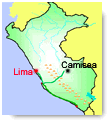
Camisea
recoverable contents: |
|
Gas: 11 TCF |
|
Liquid: 600
MMBls |
|
Camisea is a
field located in jungle with two main areas: San Martin and Cashiriari |
|
An old project
well known by Shell and Perupetro with 8 well drilled |
|
It exists good
documentation about it |
|
There are
several possibilities about its development |
|
Despite Shell
rupture, Shell showed interest and it participated in Camisea previous information round.
Mobil participated too. There were 29 companies interested |
MARKET
ASPECTS
|
Two main
potential market are power generation and industry |
|
Petrochemical is
a market for medium term |
|
Residential/commercial
market is the market for long term period |
|
The market
grouth is supported by an average interesting PBI (6% average in last 6 years) and
sustained historical electricity consumption (4,5%) despite country situation |
INDUSTRIAL
MARKET
|
The industry is
little but concentrated in Lima and La Oroya |
|
All first 40
companies consumption could be 60-80 MMscfd for 2003 with out considering refineries but
with cement industry |
|
Cement industry
is a doubtful client because coal support. It means 30 MMcfd for 2003 |
|
Fuels industry
demand is higher but it is needed the penetration period |
POWER
GENERATION
|
Despite
competitors supply it is expected 70-100 MMscfd demand for 2003 at least |
|
It already
exists two power plants in Lima capable to burn 150 MMscfd of natural gas |
|
The existing
grid let electricity supply from Lima to places located far away |
|
Perú
Electricity intensity is low, about 700 Kwh/inhabitant. Government is constructing new
transmission lines to facilitate the widest electricity arrival |
REGULATORY
|
There are a New
Hidrocarbon Law (august 1993) |
|
By License
contracts contractors have the extracted hidrocarbon property |
|
Free money
dispose of 100% |
|
It lets short
depreciation period |
|
Electricity Law
(june 1992) |
|
Generation,
transmission and distribution activities are separated businesses |
|
Free prices for
client consumption more than 1 Mw |
|
COES for System
operation |
|
CTE for
Regulated market Tariff |
|
Marginal costs
foundations |
Some
regulatory problems
|
Electricity |
|
Tariff
doesn’t consider gas transportation cost. This cost will be low because of some
guarantees for transporter. |
|
Distribution |
|
City Gate is far
away from clients. It is expected changes |
|
Tariff formula
sounds good, but some before assets electrical distributors valuation problem are not a
good precedent |
|
Transportation |
|
Tariff
generators privileges could push to hydro-thermal companies not to suscribe gas sales
contracts |
Fields
|
Size of project
associated to liquid recovery strategy because gas production depends on liquid recovery
strategy |
|
Liquid recovery
depends of reservoir conditions, market and possibilities of a big investment |
|
Camisea is
located 500 kms from coast |
|
There are two
main fields: San Martin and Cashiriari |
Investment
Referential numbers for small and big Project (MMUS$)
| Part |
Small |
Big |
| Drilling |
42 |
250 |
| Infrastructure |
43 |
100 |
| Processing Plant |
85 |
600 |
| Transportation |
560 |
525 |
| Liquid line |
|
245 |
| Fractionation/storing/dispatch |
|
150 |
| Distribution |
60 |
60 |
| Total |
790 |
1,930 |
In all cases, the investment is phased.
These numbers are cummulated investment.
On summary
(MMUS$):
| Phase |
Small |
Big |
| Field |
170 |
1,100 |
| Transportation |
560 |
770 |
| Distribution |
60 |
60 |
| Total |
790 |
1,930 |
transportation and distribution will be
presented as only one package
Something else:
|
It can be
presented different choices: |
|
Minor project.
In 1988 Shell expoused a smaller project: US$ 1,200 millions. The level of liquid were
lower and gas extraction and reinjection too |
|
Cost effective
can be improved with new designer and constructors |
Transportation
|
Any route has to
cross jungle (250 km), Andes (between 1200 as 4800 m altitude and cold climate - 300 kms)
and Coast (50 kms) |
|
In 1988, it was
elected "northern route" (Bechtel) to Lima. It pass near two central country
companies (mining and cement) with 20 MMscfd potential gas consumption |
|
In 1997, Shell
chose "southern route" (Bechtel) with "aggregate value" to Pisco-Pampa
Clarita (200 kms from Lima). This route is called the route for future expansion. This
route is considered in current Bid |
CURRENT
SITUATION (after Shell discontinuing decision)
|
Energy Minister
indicates Camisea will be given in separated business |
|
Cepri Comision |
|
After ten months
preliminary studies |
|
Separated business is going on to bid |
|
Schedule |
|
Calls by may 31, 1999 |
|
Transportation and distribution next four months. |
|
Production fields : six month. Contract on december 1999 |
EXPECTATION
|
Regulation
changes because of country importance project |
|
Some
improvements related Shell environment negotiation |
|
Term for
execution: 2000-2003 |
Why Shell
abandoned the project?
|
The regulated market tariff price doesn’t push for high internal rate
return |
|
Regulations changes were not enough. Shell wanted more for more market
securities. |
|
Prices oil scenario was not good on july 1998 |
|
Other Shell priorities |
 W. Raúl Cornejo (51-1) 965-4903 W. Raúl Cornejo (51-1) 965-4903
|
