99.11.12 Austria Tales and Legends: The Discovery of the Erzberg
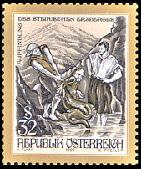
On Nov. 12, Austria Post issued a 32 ATS definitive stamp in its Standard series - Austria Tales and Legends: The Discovery of the Erzberg,
Styria's Erzberg Mountain - the centuries' old place of work for countless
settlers to this area - plays a significant role in legend (there are around
a dozen tales). No matter how one regards the accuracy of these legends:
the wrath of the thunder god, the wisdom of the Styrians in choosing a
gift, and the promise kept by the water sprite, today the Erzberg has become
a veritable "bread loaf". Iron occurs throughout the Styrian uplands. Indeed
the most famous quarries are located in the Erzberg Mountain (1,466 m),
the "Styrian Pyramid" of iron ore. Iron ore has been mined here for more
than a thousand years. The Murz-Murtal line has grown historically. It's
tectonic origin dates back 70 million years. Geologically the Erzberg belongs
to the Grauwacken Zone, whose lime and slate strata from the Paleozoic
Era extend from Lower Austria to Tyrol. Central Europe's largest open-cast
mines are located here due to extensive siderite (FeCO) deposits
which happen to be the largest in the world. For centuries the Erzberg
has served as the backbone of Austria's iron and steel industry and has
rightfully bore the name "bread loaf of Styria": it is the loaf from which
each generation cuts a slice.