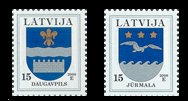
Latvia Post revealed two more 0.15Ls definitive stamps added to its Coats of Arms definitive series on July 6. The two stamps, featuring the Coats of Arms of Daugavpils and Jurmala, are designed by E. Viliama, printed by Joh. Encshede, the Netherlands in the quantities of 3 million respectively.
Daugavpils is the second largest city in Latvia. It is the center of Latgale region. 1275 is the first time when Daugavpils is mentioned in historical sources. In 2000 the city is going to celebrate its 725th anniversary. In 1582 Daugavpils gained the status of town. The main and the largest part of the city lies on the Right Bank of the Daugava, located in a low plane between the river and Lielo Stopu lake. There is a dam on the bank of the Daugava, which protects the city from spring floods. 17 districts have developed historically. The oldest part of the city is northwestern district, called Old Forstate and neighborhood of the former fortress - Cietoksnis. Image of the city looks highly different from other oldest Latvian towns, because of lack of ancient buildings. The old part of Daugavpils was placed where nowadays is located the fortress built in 19th century. Daugavpils is an important traffic joint of Eastern Latvia. Railways connect Daugavpils with Riga, towns of Russia and Lithuania, but motorways - with other places in Latvia, Lithuania, Byelorussia and Russia.
Jurmala town is placed on the Riga gulf shore at the length of 24 kilometers.
In the South Jurmala is marked off by the second largest navigable river
of Latvia - the Lielupe at the length of 30 kilometers. In the West part
of Jurmala between Sloka and Kemeri there lie lakes, marshes and wet forests,
where are situated the main curing resources of Jurmala. Behind the border
of Jurmala, to the South from Ventspils motorway there is located restricted
nature area - heath of Kemeri and Smarde with many small lakes and pools.
In the midst of the restricted, area there is situated a nature reservation.
Essential elements of the health resort town and its neighborhood are forests,
parks and plants covering 4 thousand hectares in total. The content of
Jurmala population is made of highly different societies - permanent inhabitants,
health resort visitors and guests at a rest for a short while. The number
of permanent inhabitants in Jurmala has significantly started to increase
since 19th century and has reached as many as 58 975. Jurmala gained status
of town in 1959.
Original information and image from Latvia Post