2000.11.15 South Africa 7th Definitive Series
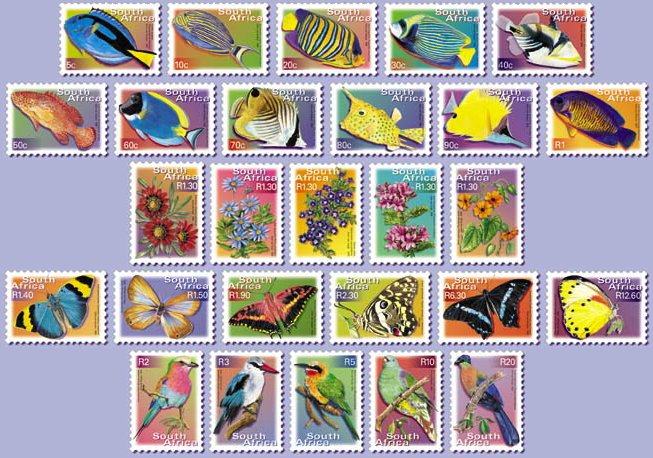
The South African Post Office announced its Seventh Definitive set of postage stamps on 1 November 2000, seven years after the Sixth Definitive. The new set consists of 27 different designs and 23 values, each belongs to one of the four series - flowers, butterflies, fish and birds, respectively. The values range from 5c, which is the lowest value, through to standard postage rates and up to R20, which is the highest value. Chris van Rooyen was responsible for artwork of the stamps featuring birds, butterflies and fish, while Joan van Gogh was responsible for the artwork of the flowers. The House of Questa is selected through tender as printer for this series, and Joh-Enschedé will be responsible for the printing of the self adhesive stamps. The lower values below R10 are printed in sheet of 50, and for R10, R12.6 and R20, they are in sheet of 10.
It is also decided for the reprinting policy of this set that there will only one reprint per year, using the same printer, the same artwork, the same paper and the same printing technique and gum as used for the original printing so that to avoid many different varieties when stamps are reprinted.
Fishes:
5c Palette Surgeon (Paracanthurus hepatus) - Belongs to the family Acanthuridae and to the subfamily of surgeonfish. Widely distributed in tropical and subtropical seas, they occur from KwaZulu-Natal to the central Pacific and are generally found on reefs in clear water. They reach a length of up to 26 cm.
10c Blue-banded surgeon (Acanthurus lineatus) - Belongs to the family Acanthuridae and to the subfamily of surgeonfish. Occurs in the Indo-Pacific Ocean, south to Durban in KwaZulu-Natal. They are territorial and very aggressive and live at the outer edge of reefs exposed to wave action. Their long caudal spine is venomous. They grow to a length of 38 cm.
20c Royal angelfish (Pygoplites diacanthus) - The royal angelfish belongs to the family Pomacanthidae and to the subspecies of angelfish. This vividly coloured species is widespread in the tropical Indo-West Pacific Ocean, south to Sodwana Bay in KwaZulu-Natal. They are usually seen swimming from one coral crevice to another. Grow to about 25 cm.
30c Emperor angelfish (Pomacanthus imperator) - Belongs to the family Pomacanthidae and the subfamily of angelfish. They occur in the outer reefs of live coral in the Indo-West Pacific, south to KwaZulu-Natal. Juveniles occasionally reach East London. They grow to about 40 cm.
40c Blackbar triggerfish (Rhinecanthus aculeatus) - Belongs to the family Balistidae and the subfamily of triggerfish. Common in the tropical Indo-West Pacific Ocean, south to Algoa Bay, they are usually found in quiet waters of lagoon sandy areas and parts of seaward reefs. They grow to a length of about 30 cm.
50c Coral rock cod (Cephalopholis miniata) - Belongs to the family Serrandidae and the subfamily of rock cods and sea basses. This is a coral reef species which range from the Red Sea to KwaZulu-Natal, and east to the western Pacific. They attain a length of about 40 cm.
60c Powder blue surgeonfish (Acanthurus leucosternon) - Belongs to the family Achanthudiae and the subfamily of surgeonfish. Occurs from Sodwana Bay on the eastern KwaZulu-Natal coast to Indonesia. An in-shore species sometimes seen in large aggregations. They grow to about 23 cm.
70c Threadfin butterfly fish (Chaetodon auriga) - Belongs to the family Chaetodontiodae and the subfamily of butterfly fish. Occurs in the tropical Indo-Pacific seas from South Africa and the Red Sea to the Hawaiian Islands and Australia; its habitat extends south on the South African coast to Mossel Bay.
80c Longhorn cowfish (Lactoria cornuta) - Belongs to the family Ostraciidae and to the subfamily of "boxfish". A beautiful fish with colours varying from green and olive to orange with blue spots. Occurs in the Indo-West Pacific Ocean, frequently thrown ashore westward to beyond Mossel Bay. They grow to about 46 cm.
90c Longnose butterfly fish (Forcipiger flavissimus) - Belongs to the family Chaetoddontidae and to the subfamily of butterfly fish. Most widely distributed species of butterfly fish, extending from Durban in KwaZulu-Natal to the Red Sea, across the Indian and tropical Pacific Oceans to Easter Island and Baja, California. They reach a length of about 16 cm
R1 Coral beauty (Centropyge bispinosus) - Belongs to the family Serrandiae and the subfamily of rock cods and sea bass. They occur in the tropical Indo-West Pacific Ocean, south to Sodwana Bay along the eastern KwaZulu-Natal coast, but are rare in Southern African waters.
Flowers:
R1.30 Botterblom (Gazania krebsiana) - This sun-loving, fast growing flower occurs in a variety of bright warm colours mainly in the red, orange and yellow range. It is hardy and drought resistant, which makes it a popular garden flower. The botterblom occurs naturally in the Karoo, Namaqualand, KwaZulu-Natal, the Free State and the northern regions of the country, as well as in Lesotho, Swaziland and Botswana.
R1.30 Blue marguerite (Felicia amelloides) - This delightful indigenous flower, also known as the blue daisy or bush felicia, bears sky-blue daisy-like flowers with prominent yellow centres. They are happy in almost any setting and the name felicia is aptly derived from the Latin word "felix" meaning "happy". They occur naturally and abundantly from Namaqualand to Caledon in the Northern and Western.
R1.30 Karoo violet (Aptosimum procumbens) - A densely tufted perennial found mainly in dry areas, especially the Karoo and Namaqualand. The plant is an excellent ground cover and because it is so well-adapted to dry conditions, the deep blue flowers often adorn the bare veld during periods of drought.
R1.30 Tree pelargonium (Pelargonium cucullatum) - This attractive indigenous pelargonium with its brightly coloured pinkish-purple flowers, is well-suited to coastal gardens. They occur naturally along the south-western Cape coast, from Gordon's Bay in the west to Gans Bay in the east, with a few isolated populations on the Cape Peninsula
R1.30 Black-eyed Suzy (or Susan) (Thunbergia alata) - Described as a "cheerful, happy-go-lucky indigenous climber", the black-eyed susy with its small bright flowers and distinctive black "eye", is a very popular garden flower. They occur naturally in the Eastern Cape, KwaZulu-Natal, Mpumalanga and Swaziland.
Butterflies:
R1.40 Gold-banded forester (Euphaedra neophron neophron) - This spectacular butterfly occurs in the dense bush of the coastal forests of Zululand, occasionally settling in patches of sunlight. It is essentially a shade- loving species and seldom ventures out into the open.
R1.50 Brenton blue (Orachrysops niobe) - The Brenton blue butterfly is a threatened species due to habitat destruction as a result of residential development. Its natural habitat is limited to Brenton-on-Sea near Knysna, a popular holiday resort some 490 km east of Cape Town. Negotiations are underway to establish a reserve where this species will be protected.
R1.90 Silver-barred charaxes (Charaxes druceanus) - This elegant butterfly occurs mainly in rain and riverine forests, Males often glide rapidly around favoured perches on the tops of trees and occasionally specimens of both sexes fly low along forest roads to settle on damp patches or low vegetation.
R2.30 Citrus swallowtail (Papilio democus Esper) - This butterfly is widely spread throughout southern Africa. It has been recorded in most habitats from montane forests to the edges of the Namib desert, and is a familiar sight in most gardens. The females lay their eggs on citrus trees, hence the name.
R6.30 Green-banded swallowtail (Papilio nireus Linnaeus) - This is the only Southern African representative of the large, diverse and complex nireus species group. Locally this graceful butterfly with its dramatic black and blue colouring occur from the eastern areas of the Western Cape to the Eastern Cape, KwaZulu-Natal, Gauteng, the Northern Province, Mpumalanga and the North-West Province.
R12.60 False dotted border (Belenois thysa thysa) - This large forest white occurs in the coastal and rain forests of the Eastern Cape Province from around the Bashee River north-eastwards to KwaZulu-Natal and along the coastal areas of KwaZulu-Natal.
Birds:
R2 Lilac-breasted roller (Coracias caudata) - A beautiful, vibrantly coloured bird that occurs in the northern parts of South Africa and further north from Angola to Ethiopia. They prefer savanna or open woodland and are often seen in the Kruger National Park, where they are always a welcome sight.
R3 Woodland kingfisher (Halcyon senegalensis) - This medium-sized kingfisher with its vivid blue and white plumage, occurs in Africa south of the Sahara. In Southern Africa they are found from KwaZulu-Natal and South Africa's Northern Province to Zimbabwe and the northern parts of Namibia. They prefer woodland, denser savanna and riverine forest.
R5 White-fronted bee-eater (Merops bullockoides) - This attractive medium-sized bird with its distinctive white breast, occurs in the central Free State, Zululand, Gauteng, and the Northern and Northwest Provinces. Also found in Mozambique, Zimbabwe, Botswana, Zaire and Kenya. They prefer woodland, especially along rivers and lakes.
R10 African green pigeon (Treron calca) - The African green pigeon, dressed in subtle shades of green, purple and yellow, occurs in Africa south of the Sahara. In South Africa it is confined to the eastern, north-eastern and northern regions. It prefers woodland and especially riverine fig trees as it feeds mainly on figs and other fruit
R20 Purple-crested lourie (Tauraco porphyreolophus) - This spectacular
bird with its brightly coloured plumage and distinctive mettalic purple
crest, occurs in the southern and eastern parts of Africa. In South Africa
it is confined to the extreme eastern regions, preferring riverine forest,
evergreen thickets, woodland, dense thornveld, savanna, parks and gardens.
Original information from South Africa Post