
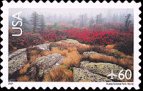
 The 60c denomination exactly satisfies the international rate for a 1-ounce letter to Canada and Mexico. Acadia National Park, located along the Maine coast and a haven for all forms of terrestrial and aquatic wildlife, had its genesis in 1913, when President Woodrow Wilson designated 6,000 acres (within the present park) as the Sieur de Monts National Monument. More land was acquired during the next six years, and President Wilson established Lafayette National Park in 1919. The park was renamed Acadia National Park in 1929. During the past 15 years, the park has purchased numerous easements and small parcels of land to secure its boundaries and preserve scenic integrity According to the National Park Service, this park is unusual because
the efforts of private citizens, not public funds or lands, led to its
creation. George B. Dorr, Charles W. Eliot (a former president of Harvard
University) and John D. Rockefeller contributed heavily to the park's development.
Rockefeller gave more than 11,000 acres of land to the park, and he directed
and financed the construction of a network of more than 50 miles of carriage
roads. Today, some 45 miles of these broad, graveled roads wind through
the park. They are closed to vehicular traffic, allowing hikers, bicyclists,
horseback riders and carriages to enjoy the park's scenery. Visitors in
cars also may take in the park's beauty along a 27-mile scenic drive, Park
Loop Road. More than 120 miles of hiking trails are available to challenge
all levels of ability..
Technical Details
Original information and image from USPS
News and Linn's Stamp News
|