


Analysis
Vision
The Test
Retail Channel Strategy
Results
Maxxum. It’s a Single Lens Reflex Camera with Automatic Focusing. This
brilliantly engineered and designed camera instantly excites the retail
industry. Technically hip and conservative retail sales associates can’t
seem to get enough of pointing the new camera and watching the lens dial
quickly into focus.
For Pentax, and all the other major camera brands, the fascination at
retail of this new competitor creates a nearly impossible problem: To
remain credible national brands each company must maintain an
advertising presence to keep its name front and center. However
customers drawn to retail stores by any brand of Single Lens Retail
Advertising will be enthusiastically shown the new technology of Minolta.
The problem is finding a way to keep advertising without helping the
Minolta competition.
For companies such as Canon, Olympus and others, the immediate option
is to focus advertising on compact camera models the so-called, "lens-
shutter" models. Pentax, however, at that time was a Single Lens Reflex
specialist, with no other consumer product lines.
Making matters worse, Pentax had launched an earlier attempt at an auto-
focus Single Lens Reflex Camera which failed to excite consumer interest,
due to pre-mature technology and a very bulky lens system. Pentax
engineers determined that there was no consumer interest in this category
and suspended research and development.
The prognosis was that Pentax would need at least 2 years to develop and
bring a competing product to market.
Lens Reflex Camera sales had more to do with style and fashion than it had
to do with taking good pictures. I had timed the sudden interest in and start
of the sales boom in this category to the appearance of a popular film,. Blow UP.
Most people who bought Single Lens Reflex cameras used them for family
snapshots and few ever used the interchangeable lens feature, taking
virtually all photographs with the standard lens supplied at purchase.
Pentax had a medium format Single Lens Reflex Camera (using 120 or 220
size film to product 6cm x 4.5cm negatives instead of the 2.4 by 3.6cm
negatives of 35mm cameras). This model, the 645 had virtually the same
weight and handling characteristics of a 35mm model, but with a larger
negative, was capable of much more resolution.
This particular model never quite captured the attention of professional
photographers. They complained of the lack of interchangeable and
Polaroid backs.
What the model had was classy looks.
wedding with a state of the art 35mm Nikon, which looks very much like
the hundreds of Canon AE-1’s, Pentax Spotmatics, and many other generic
35mm Single Lens Reflex cameras. Along comes the rich uncle with a
Pentax 645; it’s a sleek looking as a Hassleblad, and with it uncle steals the
thunder and the attention of the guests.
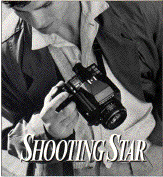
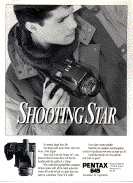
I worked with our Canadian Agency, Mc Kim to develop
an advertising campaign based on selling the Pentax 645
as a fashion accessory. This was a major departure from
previous advertising where advertising highlighted
technical features. We produced print advertising in black
and white to keep costs down and ran a test in an issue of
Time Canada that was planned to be Starched.
The result was that the Pentax ad starched in the top 10 of
all advertisements for both "notice" and "recall." This is
unusual for a black and white advertisement; color ads
usually earn the top awareness results.
against the Minolta Maxxum. During the boom days of Single Lens Reflex
camera sales, many big discount retailers and department stores added this
category to build traffic. Usually within weeks of a new product launch, a
model would be sold at or near cost due to price war competition for
traffic. For the specialty camera store, this was a model to sell and still
earn a reasonable margin since the mass merchants were late in getting on
the bandwagon.
year development Period before the introduction of the Pentax Auto-Focus
SF-1. Pentax quickly developed over a 50% market share of medium
format cameras in Canada and became one of the largest markets for this
model worldwide.
An added benefit was that only Pentax made the accessories and lenses for
the 645. For the more popular Single Lens Reflex models, many other
companies manufactured accessory lenses and sold them in competition
with the major OEM brand lenses.