
Triboelectric BBD screens were developed using these ranges, and the probe A-2 screen is illustrated in Figure 1-2.
Figure 1-2
Operating & Alarm Ranges for Triboelectric BBD Signals

Refinement of BBD Alarm Levels
As result of continuing refinement to the BBD system, IPSCO made these changes in 2001 to the programming of the system’s Alarm Record File:
- The Caution and Alarm Levels: The percent of scale ranges previously established remained unchanged, however the time period for the signal for an alarm to be generated and recorded was changed to a one (1) minute rolling time period.
- The Alarm Notification Level (analogous to exceeding 3% opacity): This alarm level remained the same, however the time period for generating an alarm was modified to a six (6) minute rolling average.
- Cleaning Spike Alarm: In addition to the operating and alarm ranges established by the initial evaluation of the surrogate dust testing, a third alarm level was developed by evaluation of amplitude of the normal cleaning spikes associated with the return of recently cleaned bag to online service. During the initial return to service on the dust laden off gas, there is a brief interval of small particle passage (invisible to the COM or human eye) while the filtering cake layer is reestablished on the surface of the bag. By tracking the duration and amplitude of this spike, it was observed that weakened or partially penetrated bags could be detected well in advance of visible emission problems. This cleaning spike alarm level was created in the software, and was set at 80% of scale for greater than one minute. This refinement has been very helpful in maintaining a proactive program for early identification of broken bags.
Requirement to Verify COM to BBD Correlation
As noted in the introduction section of this paper, USEPA Region 7 was presented with the requested comparison data developed over the 45 day period beginning in September 2000. Upon review of this data, and the associated comparison curves, Region 7 required a "correlation" of the BBD to the COM for opacity at and below the EAF standard of 3% before approving alternative monitoring. The motivation for this change in position can be supposed, however the requested correlation presented the previously identified scientific problem of attempting to establish a correlation using the least reliable instrument as the basis for correlation. The additional correlation requirement was raised by Region 7 in August 2001.
Given the experience gained during nearly a year of operating the BBD and the COM, IPSCO agreed to verify a correlation as requested by Region 7, provided that the protocol for the correlation was agreed upon before any statistical work was begun. After several exchanges of information, a protocol was established. The correlation protocol included the following parameters:
- The period of correlation would include five (5) days of normal EAF operations in which the COM was performing within its specifications. The days of August 6, 7, 10, 11 and 12 were selected.
- The data points for statistical analysis would use an average of the continuous trend data recorded for the BBD and the COM.
- The COM instantaneous reading (rather than 6 minute average reading) trend data would be used to develop two (2) minute average data points, based upon the continuous trend record. There would be three (3) discrete data points for each instrument during every six (6) minutes of operations.
- The BBD data would use the continuous trend data for the A-1 and A-2 probes combined, since the contribution of the two plenums are physically combined before entering the stack where the COM is located.
- The real time clock of the computer used for trending the data would be used to identify the 3 data points for each 6 minutes of operation.
- The data base created from the trend line evaluations would include 7200 points (5 days, 24 hours/day) for correlation, a clearly significant data base for statistical evaluation.
- The USEPA’s previously identified 4% margin for the 45 day comparison would also be applied to the data evaluation now being used for the correlation of the instruments. A standard deviation of less than 4% for the correlation function would be acceptable.
Refined Evaluation of Surrogate Dust Data
Based upon experience gained during use of the COM and the BBD at Montpelier Works, and similar comparison work done at the IPSCO Mobile Works in 2001, several factors were identified that impact the correlation of COM opacity to Triboelectric BBD signals. These are:
1. The imprecision of the COM at opacities below 5% is recognized, and therefore the data used for regression curve evaluation should focus on the area requested for correlation (± 3% opacity) while including data measured in the area where reliability is higher, yet below the area of logarithmic relationship. The range of opacities below 20% was selected for regression analysis.
2. The use of 6 minute averaged data is the basis for the present opacity standard, and this averaging period appeared to moderate the poor sensitivity of the COM at the lower opacity levels (< 5% opacity).
3. The use of the 6 minute averaging period also moderated the effect of the BBD signal associated with the particles invisible to the COM.
The surrogate dust testing data collected on 11/16/00 for the COM and BBD was reduced to the data below 20% opacity, and a regression of this data produced a linear relationship with an R2 factor of 0.87, indicating a very good correlation. A plot of this regression curve is illustrated in Chart 1.3. The regression formula is:
y = 3.0222x + 1.9073
y = Triboelectric BBD Signal, % of scale
x = COM Opacity, %
Chart 1.3
Regression of 6 Minute Averaged COM and Triboelectric Measurements
Opacities < 20%, All Probe Data
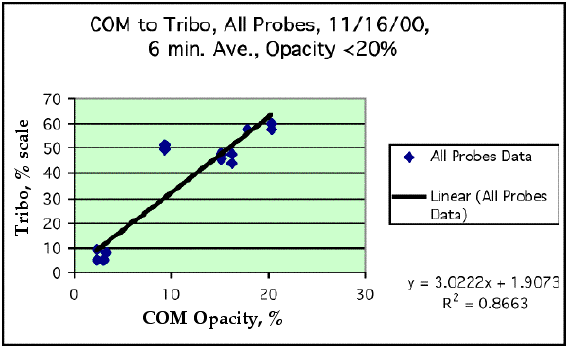
The regression formula was produced from the data collected in November 2000, and submitted at the end of the " 45 day comparison" originally requested by Region 7. The data period for normal operations in August 2001 was selected as a period close to the most recent recalibration of the COM to conform with PS-1, following a lightening strike in late July 2001. Therefore, the 7200 data points created from the normal operating period in August 2001 were independent of the data used to create the regression formula.
Discussion of Data Organization and Evaluation
The data for the 5 day correlation period (August 6, 7, 10, 11 and 12) was organized in spread sheet format for analysis as illustrated in Table 1.2 The 2 minute average data points were developed from the trend record for the COM and the BBD.
Table 1.2
Example of Data Evaluation Format
| |
START |
END |
COM |
COM |
A-1 PROBE |
A-1 PROBE |
A-2 PROBE |
A-2 PROBE |
| DATE |
TIME |
TIME |
2 min AVE |
6 min AVE |
2 min AVE |
6 min AVE |
2 min AVE |
6 min AVE |
| 8/6/01 |
0:00 |
0:02 |
0.5% |
|
1.0% |
|
3.0% |
|
|
0:02 |
0:04 |
1.0% |
|
1.0% |
|
3.0% |
|
|
0:04 |
0:06 |
0.0% |
0.5% |
1.0% |
1.0% |
3.0% |
3.0% |
|
0:06 |
0:08 |
0.0% |
|
1.0% |
|
3.0% |
|
|
0:08 |
0:10 |
0.5% |
|
1.0% |
|
1.0% |
|
|
0:10 |
0:12 |
0.0% |
0.2% |
1.0% |
1.0% |
1.0% |
1.7% |
|
0:12 |
0:14 |
0.0% |
|
3.0% |
|
1.0% |
|
|
0:14 |
0:16 |
0.5% |
|
3.0% |
|
3.0% |
|
|
0:16 |
0:18 |
0.5% |
0.3% |
2.0% |
2.7% |
3.0% |
2.3% |
|
0:18 |
0:20 |
1.0% |
|
2.0% |
|
3.0% |
|
|
0:20 |
0:22 |
0.3% |
|
3.0% |
|
3.0% |
|
|
0:22 |
0:24 |
0.5% |
0.6% |
2.0% |
2.3% |
1.0% |
2.3% |
The data for each of the five days was organized in this format. Once the data was organized, the 6 minute average data calculated for the respective time periods was reorganized for statistical evaluation. An example of the reorganization is illustrated in Table 1.3
Table 1.3
COM & BBD Data Reorganized of 6-minute Averages
| COM |
A-1 PROBE |
A-2 PROBE |
END |
COM |
A-1 |
A-2 |
SUM |
PREDICTED |
| 6 min AVE |
6 min AVE |
6 min AVE |
TIME |
% 6 min |
% 6 min |
% 6 min |
A-1,2 |
TRIBO |
| 0.4% |
2.7% |
2.5% |
6:06 |
0.4 |
2.7 |
2.5 |
5.2 |
3.0 |
| 0.0% |
1.0% |
2.3% |
6:12 |
0.0 |
1.0 |
2.3 |
3.3 |
1.9 |
| 0.1% |
1.3% |
1.5% |
6:18 |
0.1 |
1.3 |
1.5 |
2.8 |
2.2 |
| 0.3% |
1.3% |
1.5% |
6:24 |
0.3 |
1.3 |
1.5 |
2.8 |
2.7 |
| 0.3% |
1.8% |
1.5% |
6:30 |
0.3 |
1.8 |
1.5 |
3.3 |
2.7 |
| 0.3% |
1.8% |
1.5% |
6:36 |
0.3 |
1.8 |
1.5 |
3.3 |
2.7 |
| 0.0% |
1.0% |
1.0% |
6:42 |
0.0 |
1.0 |
1.0 |
2.0 |
1.9 |
For ease in review by Region 7 personnel the 6 minute average data was identified by the real clock end time for each averaging period (column 4). The original COM and BBD data was listed as a percent opacity (column 1) and percent of scale (columns 2 & 3), respectively. The data was then converted from % to a decimal equivalent (columns 5, 6 & 7) for correlation calculations. The combined signal for BBD probes A-1 and A-2 is summed (column 8) for correlation to the COM signal. The result of using the measured 6 minute average of the COM signals in the formula y = 3.0222x + 1.9073 gives a calculated triboelectric BBD signal. This calculated triboelectric BBD signal is listed in Table 1.3 as "Predicted Tribo" (column 9). A standard deviation was then calculated for the measured data of the sum for A-1 and A-2 signals compared to the predicted values over each 6 hour period during a respective day. A plot of the comparison of the measured to predicted values illustrates the close correlation between these values. The period of 6:06 AM to 12:00 PM is illustrated in Chart 1.4.
Chart 1.4
Comparison of Measured BBD signals to Predicted signals
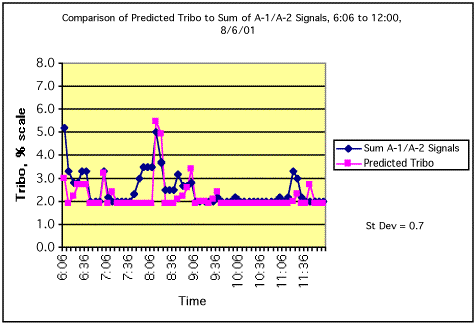
The standard deviation for the illustrated period is 0.7%. The standard deviations for 6 hour correlation periods over the 5 day study period ranged from 0.5 % to 1.1%, well less than the 4.0% considered as an acceptable correlation under the protocol. In addition, the sum A-1 & A-2 data was compared to the predicted values on a daily basis, including all of the 6 minute average data for the 24 hour period. However, two time intervals on 8/7/01 were excluded from the data base because the COM was providing erroneous data associated with moisture in the air.
Correlation of Daily Data
The daily data correlation was reorganized slightly for standard deviation calculation to provide a second method for correlation verification. In addition to calculation of the standard deviation between the sum A-1 & A-2 signal data and the predicted data, the calculated difference between the sum A-1 & A-2 signal data and the predicted signal was also evaluated for standard deviation. The organization of the data for the daily standard deviation calculations is illustrated in Table 1.4. The illustration shows only a portion of the daily data.
In the illustration of Table 1.4 (8/10/01), the standard deviation between the sum A-1 & A-2 signals and the predicted signal is shown above the "Predicted Tribo" column, and is 0.6% for this respective day. The standard deviation for the calculated difference between the sum A-1 & A-2 signals and the predicted signal is shown above the "Sum-Pred Difference" column, and is 0.7%. In this case, for the 8/10/01 data, the standard deviation for the data, using both methods of correlation are well below the 4.0% considered appropriate by Region 7.
Table 1.4
Daily COM and BBD data Organization
|
|
Stand. Dev. |
0.6 |
0.7 |
|
END |
SUM |
PREDICTED |
Sum-Pred |
| Date |
TIME |
A-1,2 |
TRIBO |
Difference |
| 8/10/01 |
0:06 |
4.0 |
5.9 |
-1.9 |
|
0:12 |
2.3 |
3.4 |
-1.1 |
|
0:18 |
2.0 |
1.9 |
0.1 |
|
0:24 |
2.0 |
1.9 |
0.1 |
|
0:30 |
2.0 |
3.4 |
-1.4 |
|
0:36 |
3.0 |
2.9 |
0.1 |
|
0:42 |
2.0 |
1.9 |
0.1 |
|
0:48 |
2.0 |
2.4 |
-0.4 |
|
0:54 |
2.0 |
2.7 |
-0.7 |
|
1:00 |
2.0 |
2.4 |
-0.4 |
For each day, the daily standard deviations for the respective correlation are summarized in Table 1.5. The daily standard deviations are all well below the 4.0% for both methods, and the comparison between the methods of calculating the standard deviations for each day are very close.
Table 1.5
Standard Deviations of Predicted to Measured BBD Signals
Daily Data Evaluated by Two Methods
|
|
Stand Dev. |
|
Stand. Dev. Predicted to |
Sum A1/A2 - Predicted |
| Date |
Sum A1/A2 |
Difference |
| 8/6/02 |
0.8 |
0.8 |
| 8/7/02 |
1.1 |
1.6 |
| 8/10/02 |
0.6 |
0.7 |
| 8/11/02 |
0.6 |
0.6 |
| 8/12/02 |
0.5 |
0.4 |
Findings & Conclusions
Recognizing the factors already listed that negatively impact the potential for identifying a mathematical correlation between the COM and Triboelectric BBD signals, a clear correlation was established between the two instruments. This correlation was done using surrogate dust testing data previously accepted by Region 7, and the evaluation used normal operating data according to the protocol established before the data was collected. The standard deviations for the correlation was well below the 4.0% established by Region 7, and included 7200 points of measured data in the data base.
The following general conclusions can be made from this study.
1. A clear correlation exists between COM opacity and Triboelectric BBD signals below 20% opacity where emissions associated with normal EAF operations occur.
2. The correlation is based upon a linear regression of data collected during surrogate dust introduction testing.
3. A surrogate dust test is necessary to establish a correlation function. The poor precision of the COM at opacities below 7% to 10% prevents collection of sufficiently variable and reliable data to perform a statistically valid regression. Tracking of normal EAF operations, where opacities are below 3%, cannot produce COM data that will allow for development of a correlation.
4. The BBD can be used to prevent opacity violations exceeding the 3% (6 minute average) standard, as well as identify periods when the standard has been exceeded.
5. The BBD is a reliable tool for predictive and proactive maintenance on the EAF baghouse. The COM, on the other hand, is virtually useless for predictive, compartment specific maintenance, and cannot be used as a basis for proactive maintenance.
End of Document

