
Tourism Authority of Thailand
Le Concorde Building, 202 Ratchadapisek Road, Bangkok 10310, Thailand
Tel: (2) 694 1222. Fax: (2) 694 1220/1.
E-mail: info1@tat.or.th (information section)
Website: www.tat.or.th or www.tourismthailand.org
Royal Thai Embassy
29-30 Queens Gate, London SW7 5JB, UK
Tel: (020) 7589 2944 (ext.115) or (09001) 600 (recorded visa information; calls cost 60p per minute). Fax: (020) 7823 7492 or (020) 7823 9695 (visa).
E-mail: thaiduto@btinternet.com
Opening hours: Mon-Fri 0930-1230 (consular section).
Honorary Consulates in: Birmingham, Cardiff, Dublin, Glasgow, Hull and Liverpool.
Office of Commercial Affairs (Royal Thai Embassy)
11 Hertford Street, London W1J 7RN, UK
Tel: (020) 7493 5749. Fax: (020) 7493 7416.
E-mail: thaicomuk@dial.pipex.com
Website: www.thaicomuk.dial.pipex.com
Tourism Authority of Thailand
49 Albemarle Street, London W1S 4JR, UK
Tel: (09063) 640 666 (consumer enquiries; calls cost 60p per minute) or (0870) 900 2007 (brochure request line) or (020) 7499 7679 (trade only). Fax: (020) 7 629 5519.
E-mail: info@tat-uk.demon.co.uk
Website: www.thaismile.co.uk
Opening hours: Mon-Fri 0930-1700.
British Embassy
1031 Wireless Road, Lumpini, Pathumwan, Bangkok 10330, Thailand
Tel: (2) 305 8333. Fax: (2) 255 8619 (commercial section) or 255 6051 (consular section).
E-mail: Visa.bangkok@fco.gov.uk
Website: www.britishemb.or.th
Consulate in: Chiang Mai (tel: (53) 263 015; fax: (53) 263 016; e-mail: ukconsul@loxinfo.co.th).
Royal Thai Embassy
1024 Wisconsin Avenue, Suite 401, NW, Washington, DC 20007, USA
Tel: (202) 944 3600. Fax: (202) 944 3611.
E-mail: thai.wsn@thaiembdc.org
Website: www.thaiembdc.org
Consulates in: Chicago, Los Angeles, New York (tel: (212) 754 1770).
Honorary Consulates in: Boston, Dallas, Denver, Florida, Georgia, Honolulu, Houston, Kansas, Montgomery, New Orleans, Oklahoma, Oregon and Puerto Rico.
Tourism Authority of Thailand
c/o Royal Thai Consulate-General, 351 East 52nd Street, New York, NY 10222, USA
Tel: (212) 754 1770 or 754 2536-8. Fax: (212) 754 1907.
E-mail: tatny@aol.com
Website: www.tourismthailand.org or www.experiencethailand.com
Also deals with enquiries from Canada.
Office also in: Los Angeles (tel: (323) 461 9814) and Toronto (tel: (416) 614 2625).
Embassy of the United States of America
95 Wireless Road, Pathumwan District, Lumpini Sub-district, Bangkok 10330, Thailand
Tel: (2) 205 4000. Fax: (2) 205 4131. Website: www.usa.or.th
Consulate in: Chiang Mai (tel: (53) 252 629; fax: (53) 252 633).
Royal Thai Embassy
180 Island Park Drive, Ottawa, Ontario, K1Y 0A2, Canada
Tel: (613) 722 4444. Fax: (613) 722 6624.
E-mail: thaiott@magma.ca
Website: www.magma.ca/~thaiott/mainpage.htm
Consulate in: Vancouver.
Honorary Consulates in: Edmonton, Montréal and Toronto and Calgary.
Canadian Embassy
Street address: 15th Floor, Abdulrahim Place, 990 Rama IV Road, Bangkok 10500, Thailand
Postal address: PO Box 2090, Bangkok 10501, Thailand
Tel: (2) 636 0540. Fax: (2) 636 0565 (general enquiries) or 636 0555 (consular section) or 636 0568 (trade section).
E-mail: bngkk@dfait-maeci.gc.ca
Website: www.dfait-maeci.gc.ca/bangkok
Consulate in: Chiang Mai.
Country dialling code: 66
Copyright © 2002 Columbus Publishing.
Business profile
Economy
The Thai economy grew very rapidly during the 1980s and early 1990s. Nevertheless, certain aspects of its economic performance during this period gave cause for concern, notably the foreign debt, shortcomings in the taxation system and the weakness of the country's financial institutions. The economy was already slowing down - annual growth had fallen to five per cent in 1996 from its five-year annual average of ten per cent - when the Asian currency crisis struck in the late summer of 1997. After a strong initial recovery, the Thai economy has since fallen back and GDP growth in 2001 was under two per cent.
Before Thailand assumed its position as one of the Asian 'tiger' economies, agriculture had been the main economic activity: this has declined in relative importance as the industrial and service base expanded and developed. The sector remains important nonetheless: the main crops are rice - of which Thailand is one of the world's leading exporters - sugar, cassava, maize, rubber, cotton and tobacco. Fishing is also significant, especially for prawns which have become one of the country's largest exports. Another important natural resource, timber, was highly lucrative until, under international pressure, a logging ban was introduced in 1989. However, illegal logging continues - especially on the Thai-Myanmar border where much of the best quality timber may be found. The country's other principal natural resources are minerals: gemstones are the most lucrative (again, there is much illegal activity in this industry) but there are also major deposits of tin and lead, plus copper, gold, zinc and iron, and rare metal ores containing antimony, manganese and tungsten. Natural gas and oil fields have been located offshore and are now being developed. In the industrial sector, Thailand manufactures cement, electronics, jewellery and sugar; there is also an important oil refinery.
In the service sector, Thailand has a large tourism industry catering for over eight million arrivals annually and worth about $7 billion to the economy. Thai companies are also highly active in transport, telecommunications, finance and the media. Thailand is a member of the Association of South East Asian Nations (and as such will participate in the planned Free Trade Area), as well as the Asian Development Bank and the Colombo Plan (a co-operative trading body covering South Asia). Thailand's main trading partners are Japan, Singapore, the USA, Germany and Hong Kong.
Business
Most people in senior management speak English but in very small companies, or those situated outside the industrial belt of Bangkok, English is less well-known. Most businesses of substantial size prefer visitors to make appointments. Visiting cards are essential. Office hours: Mon-Fri 0900-1700. Government office hours: Mon-Fri 0830-1200 and 1300-1630.
Commercial Information
The following organisation can offer advice: Department of Export Promotion, 22/77 Rachadapisek Road, Chatuchak, Bangkok 10900 (tel: (2) 511 5066; fax: (2) 512 2670; e-mail: tidep@depthai.go.th; website: www.thaitrade.com).
Conferences/Conventions
The Thailand Incentive and Convention Association has 191 members representing all sectors of business interested in conventions and incentives. Members include hotels, airlines, publishing houses, advertising agencies, cruise operators, travel agents, lawyers, equipment suppliers and banks. The aim of the association is to provide help with every possible query that an organiser may have as well as providing practical assistance. It publishes a quarterly newsletter, an annual guide, a gift-ideas catalogue and a social programme. The Bangkok Convention Centre is the largest venue in the country, but there are many other venues (including hotels) in Bangkok and elsewhere. The largest markets for delegates in 1988 were Malaysia, Japan, the USA, Taiwan and Australia, though interest from Canada and Germany showed a considerable increase. In October 1991, Thailand hosted the annual meeting of the World Bank and International Monetary Fund attended by 15,000 delegates. Further information can be obtained from the Thailand Incentive and Convention Association (TICA), 99/7 Ladprao Soi 8, Ladyao, Chatuchak, Bangkok 10900 (tel: (2) 938 6590; fax: (2) 938 6594; website: www.tica.or.th).
Copyright © 2002 Columbus Publishing.
Climate
Generally hot, particularly between March and May. The monsoon season runs from June to October, when the climate is still hot with torrential rains. The best time for travelling is November to February (cool season).
Required clothing: Lightweights and rainwear are advised.
Bangkok Today
37°C / 98 F
partly cloudy
Chiang Mai Today
38°C / 100 F
mostly clear
Phuket Today
28 oC / 82 oF
Mostly Cloudy
Copyright © 2002 Columbus Publishing.
Duty Free
The following goods may be imported into Thailand without incurring customs duty by passengers irrespective of age:
200 cigarettes or 250g of tobacco or equal weight of cigars; one litre of wine or spirits; one still camera with five rolls of film or one movie camera with three rolls of 8mm or 16mm film.
Restricted exports: There are restrictions on the export of items of archaeological interest or historical value without a certificate of authorisation from the Department of Fine Arts in Thailand. The export of images of the Buddha and other religious artefacts is also subject to this ruling.
Prohibited items: The import of non-prescribed drugs and all firearms and ammunition is prohibited. Gold bullion must be declared on arrival and can be left at the airport of entry to be retrieved on departure. The import of meat from any country affected by Bovine Spongiform Encephalopathy (BSE) or mad cow and foot and mouth diseases. The measure covers meat from all 15 EU countries and any other infected country.
Warning: Any drug-related offences are severely punished and may result in life imprisonment or even the death penalty.
Copyright © 2002 Columbus Publishing.
Excursions and sightseeing
BANGKOK BEACHES CENTRAL PLAINS CHIANG MAI KANCHANABURI NORTH EAST
BANGKOK
Overview | Statistics | Cost of Living | Getting around | Sightseeing | Key Attractions
Tours | Excursions | Nightlife | Sport | Shopping | Culture
Overview
Love it or hate it, buzzing, sweaty, exotic Bangkok is a city that really is larger than life. For some, the frenetic pace, heat, traffic and lack of personal space can be overpowering and good reasons to pass through the city as quickly as possible, but for many others, the sheer dynamism is intoxicating.
A curious blend of the traditional East with the modern West, every street in Bangkok holds a surprise. Ramshackle buildings crouch next to exotic temples surrounded by delightful gardens, which are in turn overlooked by modern hotels and offices. Bangkok has emerged as a major world city with the traffic jams to match, as well as the all-pervasive mobile phones and designer clothes a prominent feature on the streets. The chaos on the roads is mirrored by the busy traffic on the Chao Phraya River, which dissects the city and is regularly crisscrossed by long-tailed boats, river taxis and small rowing boats, all miraculously missing each other.
But traditional Thai life is never very far away. Weaving among the nose-to-tail traffic in the morning rush hour, saffron-robed monks can still be seen collecting alms, while just moments from the city centre whole communities live in stilt houses by the river, eking out a living using skills that have not changed in centuries.
Bangkok became the capital of what was then Siam in 1782, following the destruction of the previous capital, Ayutthaya. Bangkok is not the name used by the Thais - they call it Krung Thep, which is actually a very shortened version of its full title. The absolute rule of the monarchy ended in 1932 when it was replaced by a system of constitutional monarchy. To this day, the monarchy is regarded with almost religious reverence and it is an offence, punishable by imprisonment, to insult the royal family. His Majesty King Bhumibol is the longest reigning monarch in the world, having come to power in 1946. Following the end of absolute monarchy, Thailand moved towards democracy but this has been thwarted by the military, which has often staged coups in protest at government policies. The role of the military in domestic politics has now been curtailed but the 1990s saw governments come and go although there has been some stability since the government took on the job of tackling the economic crisis.
Thailand is staunchly anti-Communist, as seen during the Vietnam War when it was a strategic ally for the USA. Latterly, it has softened its stance and relations have improved with its Communist neighbours who have now become members of the Association of South East Asian Nations (ASEAN), of which Thailand is an influential member. Thailand's main industries are tourism, textiles and electronics. Despite over half of Thai citizens working in agriculture, the industry only accounts for 15% of the GDP, although Thailand is still the world's largest exporter of rice. The difference in growth between industry and agriculture during the past few decades has resulted in enormous inequality between the city and countryside.
Thailand is a tropical country so it is hot throughout the year, but the best time to visit is between November and March, during the dry season. During the rainy season, humidity is very high and the downpours are short but violent and the streets of Bangkok often flood.
Top
Statistics
Location: Central Plain, Thailand.
Population: 5.5 million (city); 9.2 million (metropolitan area).
Religion: 95% Buddhist, 4% Muslim with the remainder being a mix of Christians, Hindus and Sikhs.
Time zone: GMT + 7 (GMT + 6 from last Sunday in March to Saturday before last Sunday in October).
Electricity: 220 volts AC, 50Hz; two-pin plugs are standard.
Average January temp: 26° C (79° F).
Average July temp: 29° C (84° F).
Annual rainfall: 1500mm (58.5 inches).
Top
Cost of Living
One-litre bottle of mineral water: B30
33cl bottle of beer: B200 (local beer B40)
Financial Times newspaper: B200+
36-exposure colour film: B120
City-centre bus ticket: B3.50-30
Adult football ticket: B50-100
Three-course meal with wine/beer: B800+
1 Thai Baht (B) = £0.02; US$0.02; C$0.03; A$0.04
Top
Getting Around
The public transport system within Bangkok is plentiful and cheap, although most visitors use the taxis or the three-wheeled taxis called tuk tuks. An elevated monorail, the Bangkok Transit System (tel: (02) 617 7300; fax: (02) 617 7135; e-mail: nuduan@bts.co.th; website: www.bts.co.th) or Skytrain, operates on two lines across the city. The Sukhumvit Line runs from On Nut along Sukhumvit Road to Siam Square, Phaya Thai Road, Victory Monument and Mo Chit. The Silom Line starts at Saphon Taksin and runs through Silom's business area, Siam Square, ending at the National Stadium. The Skytrain only opened at the end of 1999 and has vastly improved the time it takes to move around the city. Trains operate 0600-2400, running every 3-5 minutes during the rush hour and every 10-15 minutes off peak. Tickets should be purchased from automatic ticket machines, with prices costing B10-40 across seven zones. Passes can be bought for 10, 15 and 30 journeys, costing B250, B300 and B540 respectively.
The Bangkok Mass Transit Authority (tel: (02) 246 0973; e-mail: cnai.bmta@motc.go.th; website: www.bmta.motc.go.th) runs a comprehensive and highly complex bus system. This operates across the city 0500-2300, with fares on regular buses ranging from B3.50 to B5 and on air-conditioned buses from B6 to B16. The air-conditioned red and grey microbuses (operated by private operators) cost B30 for a single journey with a guaranteed seat. The yellow and orange Euro II air-conditioned buses fares range from B8 to B18 and they use fuel-efficient engines to belatedly attempt to reduce air pollution in the city. There is also a limited night service operating 2300-0500 with a fare of B5. Bus route maps are widely available in hotels and bookshops.
Work is underway on a 20km (12-mile) subway system, which is scheduled for completion in 2003. The traffic jams in Bangkok are legendary and pollution extreme and this is aggravated by the roadworks preparing the tunnels and stations for the new subway.
Taxis: can be hailed on the streets. If they are metered taxis, they will have a taxi meter sign on the roof. Visitors should check that the meter is turned on. The meter rate starts at B35 for the first three kilometres with B5 for each subsequent kilometre. There are also unmetered taxis where the fare must be agreed upon before leaving. Note that the passenger has to pay for any road tolls incurred. Visitors should always ensure they have plenty of small change to pay the taxi fare. Many people arrange a taxi through the concierge at their hotel where the rate is fixed and paid to the hotel before departure. It is also possible to rent a taxi for longer trips. In this cases, a fare should always be agreed in advance, even with metered taxis. There is a taxi hotline (tel: 1661) for calling a taxi and there is an additional charge of B20 for this service on top of the meter fare.
Tuk Tuk: these three-wheeled taxis ply the streets and are ideal for short journeys. Fares must be negotiated before getting in and range from B40 to B150. The number of tuk tuks in the city is decreasing but they can still be found around hotels and visitor attractions.
River Taxis: numerous river taxis, operated by Chao Phraya Express River Taxi (tel: (02) 222 5330), travel upstream and downstream on the Chao Phraya River, acting more like buses than taxis. Fares range between B5 and B15 and the hours of operation are 0600-1840 daily. Other smaller boats just shuttle from one side of the river to the other.
Motorcycle Taxis: as a result of the gridlock experienced during the rush hour, motorcycle taxis are now available as they can manoeuvre between the cars to reach their destination. Fares range from B15 to B100 depending on distance. The wearing of helmets is compulsory and they are supplied by the driver. Drivers wear coloured tabards for identification and wait at road intersections.
Limousines: These can be provided by the main car hire companies (see Car Hire below) or at the airport (tel: (02) 535 2801, terminal one, counter 7 or 535 5155, terminal two, counter 5). Limousines to the city from the airport cost B500-650.
Driving in the City: driving in Bangkok requires a great deal of patience and a certain stubbornness. Few visitors attempt to hire a car, as good knowledge of the city is required to be able to drive around. The density of the traffic and the number of lanes means that drivers always need to know which lane to be in. There are a number of expressways crossing the city with clearly signposted exits but, during the rush hours (0700-0900 and 1600-1800), the traffic is often gridlocked. Traffic direction and entry/exit locations change during the day without warning. Bangkok drivers, in particular taxis, buses and motorbikes, are very aggressive and unlikely to give way. Many of the large shopping complexes and hotels have a car park attached and a convenient location is the Siam Centre on Rama I Road, which is open 24 hours. Car parks cost in the region of B20 for up to three hours and B10 for each subsequent hour.
Car Hire: many visitors to Thailand now choose to hire a car but few hire one within Bangkok because of the difficulties of moving through the constantly heavy traffic. Drivers must be at least 23 years old and have held a driving licence for two years. A national licence and International Driving Permit are required. It is compulsory to purchase Collision Damage Waiver and Theft Protection and these are generally included in the hire price. Payment must be made by credit card. Avis have an office at 2-12 Wireless Road (tel: (02) 255 5300; website: www.avisthailand.com ), and Budget at New Petchburi Road (tel: (02) 203 0225; website: www.budget.co.th ). Hire of a standard saloon car costs from B2000 per day or B12,000 per week.
Top
Sightseeing
Overview
The sprawling city of Bangkok is full of interesting attractions for tourists, however, the heavily congested traffic means that it is difficult to cover a lot of ground in a single day. Sightseeing should be selective or restricted to one area unless staying in the city for any length of time. The new Skytrain does help visitors travel across town quicker. An excellent way to appreciate the layout of the city is to go to the observation deck on the 77th floor of the Baiyoke Sky Hotel, the second tallest hotel in the world, after the Grand Hyatt in Shanghai.
Apart from the major sights, which are all 'must-see', there are numerous other attractions, including over 400 temples. To the north of the Royal Grand Palace is Sanam Luang, which is a huge public area, surrounded by old tamarind trees, used for many ceremonies throughout the year, such as the Ploughing Ceremony, as well as a popular place for kite-flying and for passing time. The nineteenth-century Wat Suthat on Bamrung Muang Road is renowned for its murals depicting the lives of Buddha. In front of the temple is Sao Ching Cha (Giant Swing), which was the site of a Brahmin ceremony until the 1920s. Only the posts of the swing remain.
Chinatown is a lively area located between the river and Hualampong railway station. The area is fascinating for its maze of narrow lanes and open-fronted shops selling a cornucopia of items. On Yaowarat Road, Wat Trai Mit houses a gleaming solid gold Buddha, three metres high and weighing over five tons. Close to Chinatown is Phahurat, the main Indian area, crammed with colourful fabric shops and excellent Indian restaurants.
On Sri Ayutthaya Road, in an elegant area full of government buildings and the current royal residence, is Wat Benjamabopit, mainly built with Italian marble and a mix of European and Thai architecture. Lumphini Park is a haven of tranquillity in the heart of the city, dotted with pavilions and two small lakes. For visitors who do not have time to travel in the rest of Thailand, the Ancient City is an open-air museum with full-size and scaled-down replicas of famous buildings, monuments and temples from all over the country. It covers an area of 112 hectares (280 acres) and is 33km (20 miles) southeast of the city centre.
Well worth a visit is Bang Pa In, 60km (37 miles) north of Bangkok, the former summer residence of the royal family in the seventeenth century, which is a collection of buildings reflecting oriental and European influences. Whether visiting palaces or temples, it is important to dress respectfully. Entry can and will be refused if this rule is not followed.
Tourist Information
Tourism Authority of Thailand (TAT)
Le Concorde Building, 10th floor, 202 Ratchadaphisek Road
Tel: (02) 694 1222. Fax: (02) 694 1220.
E-mail: center@tat.or.th
Website: www.tat.or.th
Opening hours: Mon-Fri 0830-1630.
There is another office at 4 Ratchadamnoen Nok Avenue, Pomprab. The Tourist Service Centre on Khao San Road (in front of Chana Songkram Police Station) is open 24 hours a day, manned by a tourist officer from the Tourist Police (tel: 1115) between 1630 and 0830.
Top
key Attractions
Royal Grand Palace
The Royal Grand Palace is a glittering walled complex that houses several palaces, all highly decorated with tiles and ceramics. Building was begun in 1782 when Bangkok was founded as the capital of Thailand. The complex houses Wat Phra Kaeo, the holiest of all Thai temples, where the sacred Emerald Buddha rests, not covered in emeralds but jade. There is even a scale model of Angkor Wat. There is a strict dress code and visitors wearing shorts, sleeveless shirts and flip-flops will be refused entry, although it is possible to hire trousers and plastic shoes.
Na Phra Lan Road
Tel: (02) 222 6889.
Transport: Served by numerous buses.
Opening hours: Daily 0830-1530.
Admission: B200.
Vimanmek Palace
Vimanmek Palace is the world's largest building made entirely of golden teak. It used to be a royal summer retreat and was dismantled and rebuilt in Bangkok in 1900. The 81-room mansion stands in carefully manicured lawns and houses Thailand's first indoor bathroom and the oldest typewriter with Thai characters. It is located close to the current royal residence. Visitors are not free to wander but must take a guided tour, which take place every 30 minutes.
Ratchawithi Road
Tel: (02) 281 8166.
Transport: Served by numerous buses.
Opening hours: Daily 0900-1600 (last tour at 1515).
Admission: B50. Free once a ticket to the Royal Grand Palace has been purchased (ticket valid for 30 days).
Wat Pho (Temple of the Reclining Buddha)
Wat Pho is the oldest and largest temple in Bangkok and houses an enormous gold-plated Reclining Buddha 46m (150ft) long and 15m (49ft) high. Today, it is also renowned for its teaching of herbal medicine and traditional massage.
Thai Wang Rd
Tel: (02) 222 0933.
Transport: Served by numerous buses.
Opening hours: Daily 0800-1700.
Admission: B20.
National Museum
One of the largest and most comprehensive museums in the region, the National Museum houses a vast collection of artefacts from the neolithic period through to more recent periods. The building, begun in 1782, is fascinating in its own right, having been built in traditional Thai style. The museum is so large that it needs more than one visit, but if time is short it must be spent in the lovely teak pavilion, housing personal royal belongings. Free guided tours are given by volunteers at 0930 on Wednesdays and Thursdays and come highly recommended.
Na Phrathat Road
Tel: (02) 224 1396.
Transport: Served by numerous buses.
Opening hours: Wed-Sun 0900-1600.
Admission: B40.
Wat Arun (Temple of Dawn)
Located on the west bank of the Chao Phraya River, the seventeenth-century Wat Arun has a 79m-high (259ft) tower decorated with multicoloured ceramic tiles, which makes it a landmark along the river. The effect of the tiles is best observed at a distance. It was the first home of the Emerald Buddha before it was transferred to Wat Phra Kaeo in 1785.
Arun Amarin Road
Tel: (02) 465 5640.
Transport: Boat from Tha Tien Pier.
Opening hours: Daily 0700-1700.
Admission: B10.
Jim Thompson Thai House
Jim Thompson was an American who came to Bangkok after World War II and the Jim Thompson Thai House was his home until he mysteriously disappeared in Malaysia in 1967. He completely revived the Thai silk industry and his house, traditionally Thai in style, is now a museum showing his collection of Asian artefacts. The house is a complex of six traditional Thai teak structures brought to Bangkok from various parts of Thailand and its construction was completed in 1955. The house can only be visited on a guided tour.
6 Soi Kasemsan 2, Rama I Road
Tel: (02) 216 7368. Fax: (02) 612 3744.
E-mail: info@jimthompsonhouse.com
Website: www.jimthompsonhouse.com
Transport: Skytrain National Stadium station.
Opening hours: Daily 0900-1700 (last tour at 1630).
Admission: B100.
Royal Barge National Museum
The royal barges are rarely used by the royal family because of their age and a few of them are now preserved in the Royal Barge National Museum on the Thonburi side of the river. The eight long, narrow boats on display are intricately gilded and each require between 50 and 60 rowers to take their oars. The figure on the bow of each boat signifies whether it carries the King and Queen or other members of the royal family.
Khlong Bangkok Noi
Tel: (02) 424 0004.
Transport: River taxi.
Opening hours: Daily 0900-1700.
Admission: B30.
Suan Pakkard Palace Museum
Suan Pakkard Palace used to be the residence of Princess Chumphot, one of Thailand's leading art collectors. Five traditional wooden Thai houses, brought to Bangkok from around the country, are set in one of the loveliest gardens in the city. The museum houses an important collection of antiques.
Sri Ayutthaya Road
Tel: (02) 245 4934.
Transport: Skytrain Victory Monument station.
Opening hours: Daily 0900-1600.
Admission: B100.
Ban Kham Thieng
Ban Kham Thieng is a 200-year-old classic northern-style teak house, brought from Chiang Mai and reconstructed in Bangkok. The house was owned by a worker and shows the simplicity of rural life in the north during the last century. It contains a collection of traditional implements used by farmers and ricefield fishermen.
131 Soi Asoke (Soi 21), Sukhumvit Road
Tel: (02) 260 2830 or 661 6470.
Transport: Skytrain Asoke station.
Opening hours: Tues-Sat 0900-1700.
Admission: B100.
Ko Kret
Beyond the airport, 20km (12 miles) to the north of the city, Ko Kret is a tiny island community virtually untouched by the nearby metropolis. There are no roads on the island and many of its residents rely on its potteries for employment, as well as fruit and flowers from its many plantations. The island can be reached via Highways 31 and 35, then ferry from Pak Kret Pier.
Top
Tours
Walking Tours: Although Bangkok is not really the best city for much exploration on foot, World Travel Service (tel: (02) 233 5900; website: www.wts.co.th ) does offer a guided walking tour of Chinatown and Wat Suthat.
Diethelm Travel (tel: (02) 255 9150; website: www.diethelm-travel.com) also offers a walking tour of Chinatown, called 'Bangkok Way of Life', which lasts 3 hours 30 minutes and costs US$16.60 in a group.
Bus Tours: World Travel Service (tel: (02) 233 5900; website: www.wts.co.th) runs small group tours with free pick-ups from numerous hotels throughout Bangkok. Tours can be booked direct or through the tour desk in the hotel. Half-day city tours include the 'Royal Grand Palace Tour' (including Wat Phra Kaeo) and the 'Temples Tour' (covering Wat Pho, Wat Trai Mit and Wat Benjamabopit). Both last 3 hours 30 minutes; the 'Royal Grand Palace Tour' costs US$18.40, while the 'Temples Tour' costs US$14.20. Diethelm Travel (tel: (02) 255 9150; website: www.diethelm-travel.com) offers similar tours.
Bicycle Tours: every Saturday at 1800 there is a three-and-a-half-hour bicycle trip around the historical heart of Bangkok, operated by the Bangkok Tourist Bureau (tel: (02) 225 7612; e-mail: kong149@hotmail.com). The tour departs from their offices at 17/1 Phra Arthit Road, Phra Nakhon and passes Sanam Luang, Wat Pho, the Democracy Monument and the Khao San Road backpacker area. The charge is B290 per person including the hire of a bicycle, snacks and drinks.
Boat Tours: Bangkok is laced with khlongs (canals) and life alongside the khlongs is far removed from the hustle and bustle of downtown Bangkok. An ideal way to see this side of Bangkok is a boat trip, passing tiny temples, orchards, orchid farms and typical houses on stilts. These are organised by World Travel Service and Diethelm Travel (see Bus Tours above). WTS offers a five-hour boat trip costing US$13.20.
Alternatively, there is a full-day cruise on The Oriental Queen, to Ayutthaya, the ruins of the former capital. The boat departs from the Oriental Hotel (tel: (02) 659 9000, ask for Oriental River Cruise counter) every day at 0800, returning by coach. The cost is B1900.
Top
Excursions
For a Half Day
Rose Garden: This is a popular tourist attraction (tel: (034) 322 544; fax: (034) 322 775; website: www.rose-garden.com), 32km (20 miles) to the west of Bangkok. It features daily cultural shows at 1445 including dancing, Thai boxing, cock fighting and an elephant show. The resort is set in well-kept gardens and is open 0800-1800 and admission to the show is B330.
Damnoan Saduak Floating Market: Although this market is 80km (50 miles) west of Bangkok, it is far more interesting than the floating market in Bangkok, as it has not been turned into a tourist attraction. In the early morning, the narrow canals are full of small boats carrying fruit and vegetables sold by local women. The market is very colourful and atmospheric, but is all over by 1100, necessitating an early start from Bangkok. Although it is possible to take a bus from the Southern Bus Terminal to within a mile of the market, it is probably easier to join an organised tour from a hotel (see the Tours of the City section).
For a Whole Day
Kanchanaburi: Located 122km (76 miles) from Bangkok is the site of the infamous Bridge over the River Kwai. Built by allied PoWs during World War II, this is an area of exceptional natural beauty, with forested mountains and wooded valleys. Two immaculately maintained allied war cemeteries are located just outside of the town. Kanchanaburi can be reached by either bus, train or by tour bus from Bangkok. The local Tourist Authority of Thailand office (tel: (034) 511 200; website: www.tat.or.th) can provide further information.
Ayutthaya: This was the Thai capital for over 400 years until its destruction in 1767. Ruins of numerous temples and palace buildings cover a vast area. The beauty of the place is such that it was declared a World Heritage Site by UNESCO. It is located 76km (47 miles) north of Bangkok and can be reached by bus or train or on a boat trip. The local Tourist Authority of Thailand office (tel: (035) 246 076/7; website: www.tat.or.th) can provide further information.
Top
Nightlife
Much of Bangkok's nightlife is concentrated in the two red light districts of Bangkok - Patpong (between Silom and Surawong Roads) and Soi Cowboy (Sukhumvit), named after the first bar that opened here called the Cowboy Bar. Bangkok's sex industry is as blatant and booming as ever. However, in addition to the numerous sex clubs and massage parlours, there are many excellent cocktail bars and restaurants and at night the area is always thronging with people. There are no regulations concerning licensing hours and most venues are open all day and late into the night. The dress code is very relaxed, although a few of the nightclubs do enforce smarter dress.
As in any city, nightlife venues come and go and news of the latest hotspots can be found in the city's listings magazine, Bangkok Metro.
Bars: The Bull's Head, Sukhumvit 33/1, is popular with many ex-pat residents of Bangkok. It is a British-style pub and even has a weekly quiz night. Bangkok's oldest wine bar is the Wine Bridge at Langsuan Balcony, Soi Lang Suan, offering quality wine at reasonable prices. Irish pubs are popular in most cities in the world and the busy Dubliner Irish Pub on Sukhumvit (Washington Square) is no exception. A stylish watering hole is The Barbican on Soi Thaniya, Silom Road, with a good selection of drinks and good food. The Silver Dollar on Sukhumvit Soi 22 (Washington Square) is a laid-back middle-American-style bar popular with ex-pats.
Casinos: Gambling is illegal in Thailand.
Clubs: Concept CM2 is a huge, rather expensive place, incorporating a disco, bar and restaurant in the basement of the Novotel Hotel on Siam Square, which continues to be very popular. Devotees of techno regularly pack Lucifer at Radio City on Patpong Soi 1. The amazing light and sound system and ostentatious Art Deco-style interior of Narcissus, 112 Sukhumvit Soi 23, attracts the smart set keen on house and techno. A trendy new club on 71/8 Sukhumvit Soi 31, DV8, opened in 2001 catering to fans of acid jazz and 70s soul and funk at the weekends.
Live music: Ad-Makers, 51 Soi Lang Suan (off Ploenchit), has live bands that play to international standards and the crowd often sing along. Saxophone Pub, 3/8 Victory Monument, Phayathai Road, remains a popular music venue with a variety of live music including funk, jazz, blues and ska. The best Latin-Caribbean music can be found at The Salsa Club in the Pathumwan Princess Hotel located at the MBK Centre on Phayathai Road. Country lovers will enjoy the ranch-like Montana Saloon on Sukhumvit Soi 63.
Top
Sport
Bangkok and Thailand are synonymous with Thai Boxing, the traditional sport of kick-boxing, where feet, knees and elbows can be used as well as fists. Its popularity means that fights are held every night of the week around the city, particularly at Ratchadamnoen Stadium (tel: (02) 281 4205), on Ratchadamnoen Nok Road (Monday, Wednesday, Thursday and Sunday nights), and Lumphini Stadium (tel: (02) 251 4303), on Rama IV Road (Tuesday, Friday and Saturday nights).
Two other sports are also popular in Thailand. Kite fighting takes place in the hot season where opposing teams fly male Chula and female Pakpao kites in a surrogate battle of the sexes. Visitors can witness spectacular events most weekends at Sanam Luang. Takraw is played using a woven rattan ball where a circle of men use feet, knees, thighs, chests and shoulders to acrobatically pass the ball to each other, endeavouring to keep it airborne and to kick it into a suspended basket. Tournaments are periodically held at Sanam Luang. The local press will have details.
The Thailand football league has two divisions, the premier and the first and the teams have names such as Air Force, Bangkok Bank, Army and Telephone Association of Thailand. However, the long-term future of football in Thailand is in doubt because of a lack of sponsorship for the league. Tickets for all sporting events can be bought at the venue up to an hour before the match starts.
Golf: Thailand has many excellent golf courses and some are open to visitors. The Royal Golf & Country Club, southeast of Bangkok (tel: (02) 738 0133), has a beautiful 18-hole course, with green fees for visitors of B1000 during the week and B1500 at the weekend. The Royal Dusit Golf Course, on Pitsanuloke Road (tel: (02) 281 4320), also provides an 18-hole course, with green fees for visitors of B330 weekdays and B550 at the weekend.
Fitness centres: Many of the centres throughout the city are attached to hotels and are for members only. However, the National Stadium Hua Mark, on Ramkhamhaeng Road (tel: (02) 314 4678), has a training centre and aerobics classes.
Swimming pools: Siam Water Park to the north of the city, on Sukhaphiban 2 Road (tel: (02) 517 0075), has waterslides and artificial surf. The Grand Tower Guest House, on Sukhumvit Soi 55 (tel: (02) 259 0380), welcomes non-guests to its pool.
Tennis: Tennis clubs that open to the public include Asoke Sport Club, 302/81 Mooban Tawaamit, Asoke-Din Daeng (tel: (02) 246 2260), Sawadee Soi, 35/5 Sukhumvit Soi 31 (tel: (02) 258 4502), and Central Tennis Court, 13/1 Soi Attakarn Prasit Sathorn Tai Road (tel: (02) 213 1909).
Top
Shopping
Bangkok is arguably the best place in Asia for shopping and visitors will be spoilt for choice with the extensive shopping malls, department stores, small shops and markets. The city is also a bargain hunter's paradise and haggling with street vendors is to be expected and all part of the fun enjoyed by both buyer and seller. The Silom Road area is one of the main shopping centres, which boasts numerous department stores including Robinsons, several shopping plazas and a wide range of silk and antique shops, as well as many tailors. The River City Shopping Complex, adjacent to the Royal Orchid Sheraton Hotel, has two floors devoted to antiques. Prices are fixed in most department stores but they do frequently offer discounts to interested buyers. The ultimate shopping experience is to be had at The Emporium on Sukhumvit with brand-name clothing and accessories, as well as cinemas, supermarkets and restaurants.
However, most visitors will head to the many street markets for their colourful atmosphere and lower prices. The Sukhumvit Road area has a street market that runs most of the day but is busiest at night. Dozens of stalls sell clothes, bags, silk items and gifts. Apart from the colourful nightlife in Patpong, the area also has a bustling night market where clothes and souvenirs are a real bargain. The weekend market at Chatuchak Park, on Phaholyothin Road, sells virtually everything that Thailand makes or grows, such as furniture, carpets, ceramics, watches, clothes, food and flowers. Chinatown is full of gold shops and the nearby cloth market at Phahurat has a huge range of superb fabrics. Woeng Nakhon Kasem, better known as the 'Thieves' Market', located between Yaowarat Road and New Road, sells antique porcelain, copperware and furniture. Good buys to be found throughout the city include silk items, silver and gold, gems (rubies and sapphires are indigenous to Thailand), pearls, painted umbrellas and fans, ceramics, wickerwork, woodcarvings and leather goods. It is also an ideal place to have clothes made and the quality is of a high standard.
Many stores are open 12 hours a day, seven days a week and the street markets have even longer hours, although some are busier in the mornings and others in the evenings. A Thailand Duty Free Shop is located in the World Trade Centre on Ratchadamri Road. Tourists can pay for their purchases here and collect them at the airport immediately prior to departure from the country. Value Added Tax (7%) can be refunded on goods bought in shops labelled 'VAT refund for tourists'. Cash refunds can be obtained in the airport departure hall and application forms can be found in the shops.
Top
Culture
Bangkok has many traditional dance and theatre groups, which perform around the city, although nowadays they are more popular with tourists than locals, who have generally embraced Western imports. The city does have its own orchestra, the Bangkok Symphony Orchestra (website: www.bkso.org). Western plays, with famous actors from Britain and America, are often put on for short seasons at some of the international hotels.
Both Thai and international cultural performances, including classical music, dance, ballet and pop concerts, are frequently held in the Thailand Cultural Centre on Ratchadaphisek Road (tel: (02) 247 0028), the National Theatre, Na Phra That Road (tel: (02) 224 1342), and Queen Sirikit National Convention Centre on New Ratchadaphisek Road (tel: (02) 299 3000; website: www.qsncc.co.th). Tickets can be obtained in advance from the venues.
Music and dance: Sala Rim Nam (tel: (02) 437 2918 or 6211) is owned by the Oriental Hotel and is located on the opposite bank of the Chao Phraya River, next to the Peninsula Hotel. The nightly traditional music and dance show starts at 2030, preceded by dinner at 1900. Although there are numerous traditional shows daily throughout the city, this one - reputed to be the best in Thailand and beautifully located in a traditional teak pavilion-style restaurant - is unmissable. Baan Thai (tel: (02) 258 5403), on Sukhumvit Soi 32, has a similar nightly music and dance show set in an old Thai house. Another venue is the Sawasdee (tel: (02) 237 6310) on Soi Phiphat, Sathorn Road.
Theatre: Classical dramas are very colourful and expressive and these are held on the last Friday and Saturday of each month at the National Theatre (see above). The Bangkok Playhouse, on Phetchaburi Road (tel: (02) 319 7641), puts on modern plays each week on Friday, Saturday and Sunday nights. The Chalerm Krung Royal Theatre, on Charoen Krung (New Road) (tel: (02) 222 0434), has regular performances of plays and musical dance dramas. For those fascinated by the infamous 'Ladyboys' or katoeys of Bangkok, there are two performances each night at the Calypso Cabaret in the Asia Hotel on Phayathai Road (tel: (02) 215 0808), which are always packed out.
Film: Bangkok has a large number of cinemas but not all show English-language films. Some show movies with English soundtracks but many will have been dubbed into Thai. Cinemas that show films in English or with English subtitles include: EGV Multiplexes and Major Cineplexes (website: www.majorcineplex.com ), both with various venues throughout the city; Lido Multiplex, Rama I Road (tel: (02) 252 6498), and United Artists (website: www.ua-siam.co.th ), at Sukhumvit Soi 24 (tel: (02) 664 8711) and Ratchadaphisek Road (tel: (02) 673 6060).
Nineteenth-century Bangkok was featured in the spectacular Anna and the King (directed by Andy Tennant in 1999). The filming did not take place there as the Thais banned the book on which it was based (see Literary Notes below) and the earlier film, starring Yul Brynner, claiming they were historically inaccurate. The James Bond movie, The Man with the Golden Gun (1974; directed by Guy Hamilton) uses Bangkok as a backdrop as well as stunning Phang Nha Bay.
Cultural events: The birthdays of the King and Queen of Thailand are widely celebrated throughout Bangkok and preceding the King's birthday in December is the annual Trooping of the Colour ceremony. The Royal Guards renew their allegiance to the monarch in a colourful ceremony at the Royal Plaza. The Royal Barge Procession takes place only occasionally now because of the age of the barges, although there is a small display on the King's birthday. The last major procession was in November 1999 to mark the 72nd birthday of the King and prior to that it was in 1996 to celebrate the King's 50th year on the throne. The processions are incredibly spectacular and the 1999 outing saw 52 of the elegantly carved barges rowed by thousands of costumed oarsmen.
Literary Notes: very few novels have been written focusing on Bangkok, although the city would make an excellent backdrop for any storyline, although Jake Needham's novel, The Big Mango (1999), depicts the story of an ex-GI returning to Bangkok in search of money stolen from a Vietnamese bank.
Perhaps the most famous film about Bangkok and the royal court in particular is The King and I (1956). This is based on the book Anna and the King of Siam (1944) by Margaret Landon, which is a novel adapted from The English Governess at the Siamese Court, the memoirs of Anna Leonowens, recounting her period as a governess in the court of King Mongkut. A more historically accurate account of the time can be found in The Kingdom and the People of Siam (1857) by Sir John Bowring who was responsible for negotiating the treaty with King Mongkut.
Still based around the royal family, The Bangkok Secret (1990) by Anthony Grey investigates the mystery surrounding the murder of King Ananda in Bangkok in 1946 - an event that is often glossed over and the identity of the assailant is still unknown. One of the best-known residents of Bangkok was Jim Thompson, who was responsible for building a major industry - silk - and whose home is a Bangkok landmark. He mysteriously disappeared in Malaysia in 1967 and William Warren wrote a book about his life and disappearance called Jim Thompson: The Legendary American of Thailand (1976).
Top
BEACHES AND COASTAL AREA
GULF OF BANGKOK: Situated in the Eastern Gulf, Pattaya, one of South-East Asia's most infamous beach resorts, is blighted by excessive development. The quieter nearby resort of Bang Saen is a more salubrious choice. A little further away is Ko Samet, an idyllic island about half an hour's boat ride from Rayong. Two to three hours south of Bangkok are Cha'am and Hua Hin. The latter was a royal watering place and is currently enjoying a renaissance.
PHUKET: The island of Phuket (attached by a causeway to the mainland) in the southwest corner of the country is one of several resorts on the Indian Ocean. Phuket is now threatening to outstrip Pattaya as the number one beach resort in Thailand. The main town of Patong has a reputation for sex and sleaze, but many of the resort hotels that are dotted around the bountiful beaches of the island are superb. The island is also large enough to accommodate backpacker beach-hut developments alongside the slick luxury hotels. Diving is popular, though visibility can be a problem.
PHANG NGA BAY: Easily reached from Phuket, this bay boasts one of the world's most stunning seascapes; the area was featured in the James Bond film, 'The Man with the Golden Gun'. Approximately 3500 islands (koh) are scattered in the bay. Though forbidding and seemingly impenetrable from the outside, they harbour a wealth of untouched fauna and flora in their hollow interior. Until recently they were believed inaccessible from the surrounding sea. There are now canoe trips through tunnels and cracks in the rock, although this is dependent on the prevailing tide.
KOH PHI PHI ISLANDS: These idyllic twin islands lie an easy boat trip away from either Phuket or the mainland at Krabi. The largest, Ko Phi Phi Don, is a dumbbell shaped slice of paradise, its coastline fringed with white beaches all around, and its interior clad with tropical rainforest. The only town, Ton Sai, has been largely ruined by uncontrolled tourist development, but much of the rest of the island is still untouched and a number of upscale hotels and resorts inhibit these better preserved areas. Neighbouring Ko Phi Phi Leh's main claim to fame was that it was controversially used as the setting for the Hollywood blockbuster, 'The Beach', in 2000. There are no accommodations on this limestone outcrop, but it makes a perfect day trip from its larger sibling.
KOH SAMUI: Over the last decade or so Koh Samui, once a backpacker's haven, has developed into a more sophisticated beach resort, complete with an airport that offers regular flights to and from Bangkok and Krabi. Koh Samui is Thailand's third largest island, and although tourism is now the main industry, its lingering rustic charm is summed up by the fact that coconut farming is still a major industry. Chaweng Beach is the island's largest beach and has a number of good hotels as well as groups of bungalows and bars that are ideal for the budget traveller.
KOH PHANGAN: Koh Phangan is still relatively undeveloped and is mainly visited by the more adventurous traveller looking to get away from fast food outlets and chain hotels. Each month it hosts all-night full moon beach parties at Hat Rin with up to 10,000 revellers frolicking in the moonlit surf in a nefarious festival that attracts everyone from backpackers to the Bangkok young professional set. There are no luxury hotels on the island, but there are plenty of beach hut style accommodations dotted in small communities around the island, offering a real escape or the chance to party with other travellers. The only access to Koh Phangan is by boat from Koh Samui or Surat Thani on the mainland.
KOH TAO: Koh Tao, which translates as 'Turtle Island', is another less developed island, but it is becoming increasingly popular as a scuba diving destination. Ban Mae Hat is the only real town, and it is given over to cheap hotels and dive operators. The diving around Koh Tao is excellent with clean water and good visibility.
Top
CENTRAL PLAINS
The Central Plains, located between Bangkok and Chiang Mai, form the prosperous heart of the country, a rich environment that has seen the rise and fall of great cities and kingdoms. Phitsanulok makes a convenient base for excursions into the area. The town is also the site of the Wat Phra Si Rattana Mahathat. This important monastery houses the well-known Phra Buddha Chinnarat, reputedly one of the most beautiful Buddha images of Thailand. From Phitsanulok one can visit the ancient city kingdoms of Sukhothai and Kamphaeng Phet. UNESCO included Sukhothai and its environs on its list of World Heritage Sites. It covers a huge area and includes palaces, temples and pavilions as well as lakes, ponds and canals.
Top
CHIANG MAI
In the far north is Thailand's second-largest city and a centre for excursions to the region's ancient and beautiful temples, the teak forests and their working elephants, caves and waterfalls, and journeys to visit the northern hill tribes. The Doi Suthep temple here is one of the most famous temples in northern Thailand. Perched high on a hilltop, it offers fine views over the city on clear days. The trip up can either be made via a funicular (price per person Bt5) or via a grand staircase with 400 steps. The banisters alone are worth a visit: a giant green-and-red glazed serpent winds its way down to end in a magnificent dragon's head.
Excursions: There are many small villages in the area surrounding the city where local handicrafts are produced. In the Mae Sa Valley there is an elephant training school and, nearby, an orchid farm; longer trips can be made to the Doi Inthanon National Park and to Chiang Rai, from which the Mekong River and the Golden Triangle can be reached. Another interesting route to take is the road to Mae-Hong-Son near the border with Myanmar. It is a good base from which to go trekking or motorcycle touring. On the way round the Mae-Hong-Son loop, it is possible to stop at the small town of Pai, a relaxed and friendly place.
Top
KANCHANABURI
The province of Kanchanaburi now has modern hotels from which trips around this beautiful part of Thailand can be made. Kanchanaburi is the site of the famous Bridge Over The River Kwai, a place where thousands of Thai forced labourers and Allied prisoners of war died at the hands of the Japanese. It is an area that also boasts several beautiful waterfalls and limestone caves.
Top
NORTH EAST
In the northeast, about three hours by road from Bangkok, is the Khao Yai National Park & Wildlife Reserve. The most popular of the country's national parks, it has been developed into a modest resort. As well as the attractions of the wildlife and jungle, the park can be used as a base to visit the many ancient and historical sites in the northeast of Thailand. There are also some excellent Khmer sites in the northeast, including Pimai, Lopburi and Phanom Rung. The northeast also provides its own special festival celebrations, the most exciting being the elephant roundup at Surin each November.
Copyright © 2002 Columbus Publishing.
Top
General information
Area: 513,115 sq km (198,115 sq miles).
Population: 60,816,227 (1997).
Population Density: 118.5 per sq km.
Capital: Bangkok. Population: 7,753,000, including Thon Buri (1995).
Geography: Thailand is bounded to the west by Myanmar and the Indian Ocean, to the south and east by Malaysia and the Gulf of Thailand, to the east by Cambodia, and to the north and east by Laos. Central Thailand is dominated by the Chao Phraya River.
Government: Constitutional monarchy since 1973. Head of State: HM King Bhumibol Adulyadej (Rama IX) since 1946. Head of Government: Prime Minister Thaksin Shinawatri since 2001.
Language: Thai is the official language. English is widely spoken, especially in establishments catering for tourists.
Religion: The vast majority adhere to Buddhism (Theravada), with Muslim and Christian minorities.
Time: GMT + 7.
Electricity: 220 volts AC, 50Hz. American- and European-style 2-pin plugs are in use.
Communications:
Telephone: IDD is available. Country code: 66. Outgoing international code: 001.
Mobile telephone: GSM 900/1800 networks. Network operators include Advanced Info Service (web site: http://www.ais900.com and Total Access Communications Co., Ltd. (web site: http://www.dtac.co.th).
Fax: Facilities are widely available.
Internet/E-mail: Cybercafés provide public access to Internet and email services. ISPs include Internet Thailand (web site: http://www.inet.co.th) and Asia Infonet (web site: http://www.asianet.co.th)
Post: Airmail to Europe takes up to one week. The General Post Office in Bangkok is open 0800-2000 Monday to Friday and 0800-1300 weekends and holidays. Post offices up-country are open 0830-1530.
Press: English-language dailies are the Bangkok Post and The Nation.
BBC World Service and Voice of America frequencies: From time to time these change.
BBC (website: www.bbc.co.uk/worldservice):
MHz
15.36
9.740
6.195
3.915
Voice of America (website: www.voa.gov):
MHz
17.74
15.19
9.760
1.143
Copyright © 2002 Columbus Publishing.
Getting around - internal
AIR
Thai Airways International (TG) (website: www.thaiair.com) runs services to all major towns, using a total of 22 airports. Bangkok Airways (PG) (website: www.bkkair.com) flies seven additional routes. Discounts are available in off-peak seasons and during special promotional periods.
Departure tax: Bt30 for all domestic flights, Bt400 for domestic flights from Samui Airport. Children under two years are exempt.
RIVER
Thailand has, depending on the season, up to 1600km (1000 miles) of navigable inland waterway. Services operate between Thanon Tok and Nonthaburi, and luxury cruises are available on the Oriental Queen. Long-tailed motorboats and taxi-boat ferries also operate.
RAIL
The railway network extends over 4600km (2860 miles), linking all major towns with the exception of Phuket. It has recently been extended to serve centres on the east coast. There are four main trunk routes to the northern, eastern, southern and northeastern regions, and also a line serving Thon Buri, River Kwai Bridge and Nam Tok. There are several daily services on each route, with air-conditioned, sleeping and restaurant cars on the principal trains. The journeys are leisurely but comfortable, and travelling by train is certainly one of the best ways to get around the country. The Southern Line Express stops at Surat Thani for those who wish to continue by bus and ferry to the offshore island of Ko Samui. Some railway timetables are published in English.
ROAD
There is a reasonable road network comprising many highways and 52,000km (32,300 miles) of national and provincial roads. All major roads are paved. Traffic drives on the left. Bus: There are inter-urban routes to all provinces. Fares are very cheap, and the buses very crowded. Privately owned air-conditioned buses (seats bookable) are comfortable and moderately priced. Taxi: There are plenty of taxis, which operate day and night. There are three types: taxi-meter, taxis which are unmetered and 3-wheeled, open-air tuk-tuks. Where there is no meter, fares should be agreed before departure. It is sometimes possible to agree fares for longer trips even in taxi-meters. Tipping is not expected. It is also possible to take a motorbike taxi. These are especially useful in Bangkok's horrendous rush-hour traffic. Taxi drivers do not always carry change, so it is important to have the correct amount. Passengers are also expected to pay for any motorway tolls. Car hire: Available in all main cities. Motorcycle hire is also available. Documentation: International Driving Permit required. IDPs are valid for three months, after which a Thai driving licence is required.
URBAN
Conventional bus services in Bangkok are operated by the Government Mass Transit Authority, but there are also extensive private minibus operations and passenger-carrying trucks. Premium fares are charged for air-conditioned and express buses. Fares are generally low and are collected by conductors. Ferries and long-tailed motorboats operate on the Chao Phraya River which are a quick and cheap way to get about. Bus maps of the city are available, on arrival, from the tourist office at Don Muang Airport.
JOURNEY TIMES
The following chart gives approximate journey times (in hours and minutes) from Bangkok to other major cities/towns in Thailand.
Journey time from Bangkok to:
Air
Road
Rail
Chiang Rai
1.15
12.00
-
Chiang Mai
1.00
10.00
14.00
Hat Yai
1.15
15.00
17.00
Hua Hin
0.40
3.00
4.00
Pattaya
-
3.00
-
Phitsanulok
0.55
5.30
6.00
Phuket
1.20
10.45
-
Samui
1.20
13.00
14.00
Surat Thani
1.00
11.00
12.00
Ubon Ratchathani
1.45
10.00
11.00
Udon Thani
1.00
9.00
10.15
Copyright © 2002 Columbus Publishing.
Getting there - international
AIR
Thailand's national airline is Thai Airways International (TG).Bangkok is the main entry point into Thailand as well as being a major access point for travel to Cambodia, Laos, Myanmar, Nepal and Vietnam.
Approximate flight times: From Bangkok to London is 11 hours; to Manila is 3 hours 10 minutes; to Singapore is 2 hours 15 minutes and to Sydney is 9 hours 30 minutes.
Departure tax: Bt500 for all international departures. Transit passengers and children under two years of age are exempt.
Bangkok International Airport - Don Muang (BKK)
Address: Bangkok International Airport, 171 Vibhavadi Rangsit Road, Bangkok 10210, Thailand
Location: The airport is located 24km (15 miles) north of Bangkok
Country code: 66
Airport code: BKK
Number of terminals: 3
Telephone: (0)2 535 1254 (Departures) or 535 1310 (Arrivals)
Fax: (0)2 535 1065 or 531 5559 or 535 1654
E-mail: aatpr@airportthai.th.org
Website: www.airportthai.or.th
Time zone: GMT + 7
Transfer between terminals: Free shuttle buses on two routes connect the Domestic Passenger Terminal and International Passenger Terminals 1 and 2 every 15 minutes 0615-2330.
Information and help desks: Airport information counters are located in the arrivals and departures halls within the international and domestic terminals. The Tourist Authority of Thailand counter is located in the shared arrivals hall of both International Passenger Terminals 1 and 2.
Airport facilities: Money and communications: Bureaux de change and ATMs can be found throughout the terminals; there is a bank on the second floor of the northern part of International Passenger Terminal 2. A postal service is also available at the airport. Eating and drinking: Various restaurants and fast food outlets offer a wide variety of international cuisine. Shopping: There are several gift and souvenir shops, as well as a duty-free shop. Other facilities: There are smoking rooms and two VAT refund counters available in International Passenger Terminal 1. There is a 24-hour medical emergency clinic on the ground floor of International Passenger Terminal 1, near Arrivals; two other medical rooms exist in International Passenger Terminal 2 and in the Domestic Passenger Terminal, open until 1500.
Disabled facilities: Facilities for disabled travellers include lifts, accessible toilets and an electric car for transport around the terminals. Car parking for disabled travellers is also available in the airport car parks.
Conference and business facilities: The airport has a business centre providing telephone, fax, computers and meeting rooms in the transit/transfer centre of International Passenger Terminal 1. There are telecommunications centres in International Passenger Terminal 2 and in the International Passenger Terminal 1 post office. Internet services are provided in International Passenger Terminal 1 and in the business passenger lounge.
Car hire: Avis is located in the first Floor Meeting Hall in Arrivals, between International Passenger Terminals 1 and 2. Other car hire companies, including Budget, have desks in the Arrivals area in the Domestic Passenger Terminal.
Car parking: A car park is located in the basement of International Passenger Terminal 1; in addition, there is a seven-storey car park next to International Passenger Terminal 2 and a three-storey car park in front of the Domestic Passenger Terminal.
Driving directions: The main road linking the airport to central Bangkok is the Vibhavadi Rangsit Road; it is also possible to travel into Bangkok via faster toll-motorways.
Public Transport: Rail: Train: Trains run to Bangkok, 0606-2007, from Don Muang Station which is opposite the airport and connected to the terminals by a walkway bridge. Road: Taxi: Pre-paid airport taxi vouchers can be purchased from the Thai Airways counter; alternatively licensed and metered city taxis (with black and yellow, not black and white, plates) can be flagged down outside Departures (journey time to central Bangkok: approximately 30-90 minutes). Limousine: A limousine service counter is available in the Arrivals hall of International Passenger Terminals 1 and 2. Bus: Air-conditioned airport buses operate on four routes and leave regularly from the front of the airport, 0500-2400, to many hotels. There is also a Thai Airways bus which serves the Asia Hotel. Regular public buses, some air-conditioned, operating on various routes can also be caught from the road in front of the airport.
Chiang Mai International Airport (CNX)
Located 15km (9 miles) from the city (travel time - 20 minutes). For further information see the separate section below.eTaxi service is available to the city centre. Airport facilities include car hire, banks/bureaux de change (0830-1530), restaurant (0800-2200) and bar (2100-0200).
Phuket International Airport (HKT)
Located 35km (22 miles) northwest of Phuket town. Buses and taxis are available to the city centre. Airport facilities include left luggage, duty-free shops (0700-2100), first aid (0800-2200), banks, post office (0830-2000), restaurant and snack bars (0700-2100), car hire and tourist information.
Hat Yai International (HDY)
This airport has recently been opened; so far it is only used for flights to Asian destinations and domestic flights. The nearest town is Songkhla (approximately 20km/12.5 miles away). Taxis, bus and train services are available.
SEA
The main international port is Bangkok. Limited passenger services are available. Cargo/passenger lines: Ben Shipping, Glen, Hansa, Polish Ocean, Royal Inter-Ocean and States Steamship. There are passenger crossings between Thailand and Laos at several points along the Mekong river.
RAIL
Through trains operate to Kuala Lumpur, with daily connections to Singapore and to the borders with Cambodia (at Aranyaprathet) and Laos (at Nong Khai). The journey to Singapore takes 48 hours.
ROAD
There are international roads from Malaysia, Myanmar and Laos. Roads into Cambodia are not officially open to tourist traffic.
Copyright © 2002 Columbus Publishing.
Health
Special Precautions Certificate Required
Yellow Fever No 1
Cholera 2 No
Typhoid & Polio Yes N/A
Malaria 3 N/A
Food & Drink 4 N/A
1: A yellow fever vaccination certificate is required from travellers over one year of age arriving from infected areas. Countries and areas included in endemic zones are considered to be infected areas.
2: Following WHO guidelines issued in 1973, a cholera vaccination certificate is not a condition of entry to Thailand. However, cholera is a serious risk in this country and precautions are essential. Up-to-date advice should be sought before deciding whether these precautions should include vaccination, as medical opinion is divided over its effectiveness. See the Health appendix.
3: Malaria risk exists throughout the year in rural areas throughout the country, especially in forested and hilly areas and around the international borders. There is no risk in cities and the main tourist resorts, eg Bangkok, Chiang Mai, Pattaya, Phuket and Samui. The malignant falciparum form is present and is reported to be highly resistant to chloroquine and resistant to sulfadoxine-pyrimethamine. Resistance to mefloquine and to quinine has been reported from areas near the borders with Myanmar and Cambodia.
4: Food and water-borne diseases are common. Use only bottled or otherwise sterilised (eg boiled) water for drinking, brushing teeth or making ice. Unpasteurised milk should also be boiled, although pasteurised or homogenised milk is available from some dairies. Tinned or powdered milk is safe as long as it is reconstituted with sterile water. Beware of dairy products that may have been made with unboiled milk. Stick to meat and fish that have been well cooked, preferably served hot, but not reheated. Avoid raw vegetables and unpeeled fruit.
Other risks: Amoebic and bacillary dysentery and hepatitis A and E may occur. Hepatitis B is highly endemic and trachoma is also reported. Japanese encephalitis may occur, particularly in rural areas. A vaccine is available, and travellers are advised to consult their doctor prior to departure. Precautions should be taken to guard against mosquito bites due to the risk of this disease and dengue fever. HIV infection is rife in Thailand, especially among prostitutes in Bangkok and Chiang Mai.
Rare cases of Bengal Cholera have been reported and an outbreak of leptospiros in the northeast of the country, following flooding in 1999 caused a number of deaths. Rabies is present. For those at high risk, vaccination before arrival should be considered. If you are bitten, seek medical advice without delay. For more information, consult the Health appendix.
Note: Those suspected or confirmed of carrying aids will be refused entry.
Health Care: Health insurance is recommended. Medical facilities are good in main centres. All major hotels have doctors on call.
Copyright © 2002 Columbus Publishing.
History and Goverment
HISTORY
The Kingdom of Thailand, known as Siam until 1939, was ruled by the Khmers, based in what is now neighbouring Cambodia, during the 11th and 12th centuries. In 1238 two Thai chieftains rebelled against Khmer domination and established the first independent Thai kingdom. Ayutthaya, to the north of Bangkok, was the capital of the kingdom from the early 1300s until its destruction by Burmese invaders in 1767. The Burmese were quickly forced out and the monarchy re-established. The absolute rule of the monarchy lasted until 1932 when it was replaced by a system of constitutional monarchy.
Since the end of absolute monarchy, Thailand has made slow progress towards a democratic, pluralistic system of government. The principal reason has been the attitude of the military which has exercised a strong though rarely beneficial influence: only recently have Thai politicians seriously addressed the issue of excluding them. But during the Cold War, this was a minor consideration: democratic governments were a rarity in the region and Thailand's chief strategic ally, the USA, was more concerned with Thailand's role as a bulwark against encroaching communism from elsewhere in South-East Asia. In this respect, Thailand was and continues to be an influential member of the Association of South-East Asian Nations (ASEAN): with the Cold War at an end, Thailand has been prominent in proposing the reformation of ASEAN into a regional trading bloc (see Business Profile).
Thailand's uniformly hostile attitude towards its communist neighbours was dropped after a reappraisal of Thai foreign policy in 1988/89; since then, relations with Cambodia, Laos and Vietnam have improved dramatically. This switch was one of the successes of the Government led by Chatichai Choonhaven, who governed the country from his election in 1988 until his overthrow in a military coup in February 1991. This uprising, the 17th since 1932, was led by army chief General Suchinda Kraprayoon, who emerged at the head of a new ruling body entitled the National Peacekeeping Council (NPKC).
The NPKC appointed a former diplomat and businessman, Anand Panyarachun, as Premier. Anand led a group of technocratic ministers - there was no government as such - which gained many international plaudits for its competent management and comparative honesty in a country where corruption is commonplace. Elections were held in March 1992. Eleven parties won seats in the new National Assembly, led by the country's main centre-right party Chart Thai (Thai Nation), which allied with five other parties to form a government in which General Suchinda took the premiership. The public reaction to Suchinda's assumption of the post, given that no-one had elected him to anything, was immediate and furious.
Massive demonstrations demanding his resignation were met by fierce measures from the military. The decisive intervention in the crisis was then made by King Bhumibol, who normally strictly refrains from involvement in politics. The King is revered as a semi-deity by Thais, and seen both inside and outside the country as a stabilising political influence. The King asked Anand to form a government, pending alterations to the constitution - crucially, limitations on the role of the armed forces in domestic politics - and the holding of a new round of elections. These took place in September 1992, returning the liberal Pak Prachatipat (PP, Democratic Party) which had consistently opposed the military government, as the largest party.
The PP was able to form a government with the support of four smaller parties, and party leader Chuan Leekpai assumed the premiership. This administration lasted two and a half years until deposed by one of a string of no-confidence motions. The July 1995 general election which followed brought Chart Thai back to power, with party secretary-general Banharn Silpa-Archa as prime minister, at the head of a coalition also involving the country's third major party, the Pak Kwam Wang Mai (PKWM, New Aspiration Party), and five others. Internal disputes, mostly related to the growing problem of corruption in the business world, toppled the Government 18 months later.
Another round of elections was called and held in November 1996. The PKWM, scoring heavily in rural areas, won 125 seats; the PP, with stronger urban support, 123 seats. PKWM leader Chavalit Yongchaiyudh, a former army general and veteran politician, assumed the premiership. In 1997, a new constitution was adopted (see GOVERNMENT below). In November that year, General Chavalit resigned from the premiership, largely as a result of his government's inept handling financial crisis which had hit the country in the summer (see Business Profile). The coalition which Chavalit led quickly followed. A new coalition, comprising the PP with six other parties and Chuan Leekpai as premier, took office.
The Chuan government has had reasonable success in tackling the country's economic crisis and has won plaudits from abroad. Domestically, the going has been less smooth. Large-scale corruption, in particular, has proved difficult to root out. Holding together the coalition is a massive task in itself, although he has been helped by the incompetence of the Chavalit-led opposition in exploiting the Chuan government's weaknesses. Senate elections held in March 2000 were the first under the new constitution, involving proportional representation for the first time. However, the new Electoral Commission, a genuinely independent body, received so many complaints about malpractice that the results were suspended.
A second attempt to elect a Senate appears likely, as of May 2000, to suffer the same fate. Despite the instability which this has caused, it is widely viewed as a signal of the growing strength of Thai democracy. The acid test will come with elections for the lower, more powerful House of Representatives scheduled for November 2000.
GOVERNMENT
Under the most recent version of the constitution, dating from October 1997 promulgated in December 1991, the legislature is the bicameral Ratha Sapha (National Assembly). The 393-member Sapha Pootan Rassadorn (House of Representatives) is elected for a four- year term. Executive power is vested in the Prime Minister and cabinet of ministers, with the former drawn from the ranks of the Ratha Sapha - normally the leader of the largest party (or largest party in the governing coalition).
Copyright © 2002 Columbus Publishing.
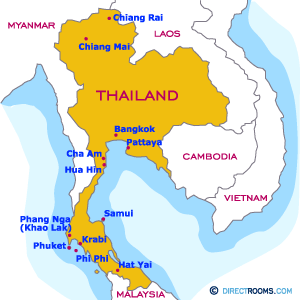
Map
Click on any of the regions to obtain a more detailed area map.
Money
Currency: Baht (Bt) = 100 satang. Notes are in denominations of Bt1000, 500, 100, 50 and 20. Coins are in denominations of Bt10, 5 and 1, and 50 and 25 satangs. In addition, there are a vast number of commemorative coins which are also legal tender.
Currency exchange: Foreign currencies can be exchanged at banks (which have the best rates), hotels (which charge high commissions) and, in larger towns, bureaux de change (generally open from 0800-2000). Outside large towns and tourist areas notes higher than Bt100 may be difficult to exchange and visitors are advised to carry small change.
Credit & debit cards: American Express, MasterCard and Visa are widely accepted, while Diners Club has more limited use. Check with your credit card company for details of merchant acceptability and other facilities which may be available.
Travellers cheques: Accepted by all banks and large hotels and shops. To avoid additional exchange rate charges, travellers are advised to take travellers cheques in US Dollars or Pounds Sterling.
Exchange rate indicators
The following figures are included as a guide to the movements of the Baht against Sterling and the US Dollar:
Date
Feb'01 May'01 Aug'01 Nov'01 Latest Exchange Rates
1 USD = 43.33 THB
1 EUR = 38.24 THB
£1.00=
61.89 64.60 64.19 62.17
$1.00=
42.38 45.50 44.38 44.15
Currency restrictions: The import and export of local currency is limited to Bt50,000. The import and export of foreign currency is unlimited.
Banking hours: 0930-1530 Monday to Friday (Bangkok); 0830-1530 in the rest of the country.
Copyright © 2002 Columbus Publishing.
Passport and Visa
PASSPORT
Passport Required? Visa Required? Return Ticket Required?
Full British
Yes No Yes
Australian
Yes No Yes
Canadian
Yes No Yes
USA
Yes No Yes
Other EU
Yes No Yes
Japanese
Yes No Yes
Note: Owing to frequent changes to passport and visa regulations, travellers are advised to check current regulations with the relevant Consulate (or Consular section at Embassy) prior to travel.
Restricted entry: Entry may be refused to people with long, untidy-looking hair who are dressed in an manner considered by the authorities to be ?hippyish' or offensive. Passports issued by the Palestinian Government are not recognised by the Thai authorities.
Passports must be valid for 6 months beyond intended length of stay required by all except: holders of a Hong Kong certificate of identity bearing a Thai visa issued in Hong Kong, and holders of a Singapore certificate of identity issued in Singapore with a visa.
VISAS
Required by all except the following nationals for stays of up to 30 days, provided they are bona fide tourists with valid passports, hold a confirmed date return ticket and are entering by air, sea or by any other means of transport via the Thai/Malaysian border:
(a) nationals of the countries referred to in the chart above;
(b) nationals of Argentina, Bahrain, Brunei, Chile, Cyprus, Djibouti, Egypt, Fiji, Iceland, Indonesia, Israel, Kenya, Kuwait, Malaysia, Mauritania, Mexico, Morocco, Myanmar, Norway, Oman, Papua New Guinea, Philippines, Qatar, Samoa, Saudi Arabia, Senegal, Singapore, Slovenia, South Africa, Switzerland, Tunisia, Turkey, United Arab Emirates, Vanuatu and Yemen;
(c) nationals of Brazil, Korea (Rep. Of), New Zealand and Peru for touristic stays of up to 3 months;
(d) transit passengers continuing their journey within 12 hours, provided holding confirmed tickets and other documents for an onward journey and do not leave the transit lounge.
Note: (a) The following nationals can obtain an entry visa on arrival at the immigration checkpoints at Don Muang (Bangkok), Chiang Mai, Phuket, Samui International, Hat Yai and Utapao airports, provided holding a confirmed ticket to leave within 15 days, a valid passport, 2 passport-size photos and that their visit is for tourist purposes only: Albania, Andorra, Antigua & Barbuda, Bahamas, Barbados, Belize, Bhutan, Bolivia, Botswana, Bulgaria, Burkina Faso, Burundi, Cameroon, Cape Verde, Central African Republic, Chad, China, CIS, Colombia, Comoros, Congo (Dem. Rep.), Costa Rica, Côte d'Ivoire, Croatia, Czech Republic, Dominica, Dominican Republic, Ecuador, Equatorial Guinea, Estonia, Ethiopia, Gabon, Gambia, Grenada, Guatemala, Guinea-Bissau, Guinea, Haiti, Honduras, Hungary, India, Jamaica, Kiribati, Latvia, Lesotho, Liberia, Liechtenstein, Lithuania, Malawi, Maldives, Mali, Malta, Mauritius, Monaco, Nauru, Niger, Panama, Paraguay, Poland, Romania, Rwanda, St Kitts and Nevis, St Lucia, St Vincent & the Grenadines, San Marino, São Tomé & Príncipe, Seychelles, Sierra Leone, Slovak Republic, Solomon Islands, Somalia, Surinam, Swaziland, Tanzania, Togo, Tonga, Trinidad & Tobago, Tuvalu, Uganda, Uruguay, Vatican City, Venezuela, Zambia and Zimbabwe.
The fee for this service is approximately US$15, which has to be paid in US Dollars or the Thai Baht equivalent. Travellers should note that there are normally long queues at the immigration checkpoints.
(b) Anyone intending to stay longer than 30 days must obtain a visa prior to arrival.
Types of visa and cost: Tourist: £8 per entry. Non-immigrant (including business visits): £15. The length of stay is determined by Immigration Officers on arrival. It is possible to get a multiple-entry visa. When applying it is necessary to specify the number of entries required. The standard fee is multiplied by the number of entries and is payable in cash or by postal order only. Transit: £5.
Validity: All visas are valid for 3 months from the date of issue.
Application to: Consulate (or Consular section at Embassy); see address section.
Application requirements: (a) Passport (valid for at least 6 months after intended stay). (b) 1 completed application form. (c) 2 recent passport-size photographs. (d) Fee (cash or postal order only). (e) Registered, stamped, self-addressed envelope for postal enquiries. (f) If requesting a non-immigrant visa for a business visit, a letter from the employer in country of origin and from the business partner in Thailand explaining the purpose of the visit is required. Visa extensions: (a)-(e), and (f) Copy of passport and additional fee.
Nationals of Bangladesh, China, Cambodia, India, Laos, Myanmar, Nepal, Nigeria, Pakistan, Sri Lanka, Vietnam, Middle East countries and socialist countries must provide additional information. Contact Consulate for details. Yellow fever vaccination certificates are required for applicants who have visited or come from an affected area.
Working days required: At least 2 days.
Note: (a) The Royal Thai Embassy in London does not accept visa applications by post. (b) Visa application procedures vary depending on nationality.
Copyright © 2002 Columbus Publishing.
Public Holidays
Jan 1 2002 New Year's Day. Feb Makha Bucha. Apr Songkran and Family Day (Thai New Year). Apr 6 Chakri Day. May Visakha Bucha*; Royal Ploughing Day. May 1 Labour Day. May 5 Coronation Day. Jul Asahala Bucha. Jul 24 Khao Phansa Day (Buddhist Lent Day). Aug 12 HM The Queen's Birthday. Oct 23 Chulalongkorn Day. Dec 5 HM The King's Birthday. Dec 10 Constitution Day. Dec 31 New Year's Eve. Jan 1 2003 New Year's Day. Feb* Magha Bucha Day. Apr 6 Chakri Day. Apr Songkran and Family Day (Thai New Year). May 1 Labour Day. May Royal Ploughing Day. May 5 Coronation Day. May 7* Visakha Bucha. Jul 5* Asahala Bucha. Jul Khao Phansa Day (Buddhist Lent Day). Aug 12 HM The Queen's Birthday. Oct 23 Chulalongkorn Day. Dec 5 HM The King's Birthday. Dec 10 Constitution Day. Dec 31 New Year's Eve.
Note*: The religious festivals are determined by the Buddhist lunar calendar and are therefore variable.
Special Events
Asarnha Puja Day/Khao Phansa Day (commemorates Buddha's first sermon and the beginning of Buddhist Lent), 5/6 Jul 2001, at temples.
Queen's Birthday Celebrations (public holiday with display of lights decorating public buildings), 13 Aug.
Chulalongkorn Day (public holiday in memory of Rama V), 23 Oct
King's Birthday Celebrations (public holiday with display of lights decorating public buildings), 5 Dec.
Constitution Day (marks the start of the constitutional monarchy), 10 Dec.
New Year's Eve, 31 Dec.
New Year's Day (celebrations traditionally begin with merit-making in the mornings, when Buddhists take gifts of flowers, incense or donations to the temples, followed by parties and entertainment. In particular, around Sanam Luang in Bangkok for the rest of the day), 1 Jan 2002, Sanam Luang areaof Bangkok.
Makha Puja (Buddhist Holy day featuring various day and night candlelit ceremonies), Feb, at temples.
Bangkok Fringe Festival (innovative theatre productions), Feb, Patravadi Theatre
International Kite Festival (kite fighting and demonstrations), Mar/Apr, Sanam Luang, Bangkok.
23rd International Bangkok Motor Show, Mar/Apr, Bangkok International Trade & Exhibition Centre in Bangkok.
Songkran (Thai New Year), religious ceremonies and public festivities involving lots of water, Apr
Coronation Day (public holiday), 5 May
Royal Ploughing Ceremony (celebration of the start of the rice-growing season), May
Copyright © 2002 Columbus Publishing.
Social profile
Food & Drink: There are many European and Asian restaurants. Thai food is hot and spicy, but most tourist restaurants tone down the food. Pri-kee-noo, a tiny red or green pepper, is one of the hot ingredients that might best be avoided. These are generally served on a side plate in a vinaigrette with the main course. Thai dishes include tom yam (a coconut-milk soup prepared with makroot leaves, ginger, lemon grass, prawns or chicken); gang pet (hot ?red' curry with coconut milk, herbs, garlic, chillies, shrimp paste, coriander and seasoning) served with rice; kaeng khiaw (?green' curry with baby aubergines, beef or chicken) served with rice and gai yang (barbecued chicken); and kao pat (fried rice with pieces of crab meat, chicken, pork, onion, egg and saffron) served with onions, cucumber, soy sauce and chillies. Desserts include salim (sweet noodles in coconut milk) and songkaya (pudding of coconut milk, eggs and sugar often served in a coconut shell). Well worth trying is sticky rice and mangoes (rice cooked in coconut milk served with slices of mango), a favourite breakfast dish in the mango harvest season (March-May). Other popular fruits are papaya, jackfruit, mangosteens, rambutans, pomelos (similar to grapefruits) and, above all, durians, which farangs (foreigners) either love or hate. Owing to the strong smell of durians, the majority of hotels do not allow them onto the premises. Drink: Local whisky, either Mekhong or Sangthip is worth sampling. The local beer comes in varying strengths. Fruit juices are also worth trying. Coconut milk straight from the shell is available during the harvest season. Bars have counter or table service. There are no licensing laws.
Nightlife: Bangkok offers a wide range of entertainment venues, from nightclubs, pubs, bars, cinemas and restaurants (many of which are open-air), to massage parlors, pool halls and cocktail lounges. Performances of traditional religious and court dances can be seen at the Thai Cultural Centre. Phnom Penh has some good bars, including the fabled Heart of Darkness. Elsewhere on the mainland nightlife takes the form of traditional dances. The islands are renowned for their nightlife, attendence is almost exclusively foreigners. The full moon parties are notorious and continue well into the following morning.
Shopping: Good buys include Thai silks and cottons, batiks, silver, pottery with celadon green glaze, precious and semiprecious stones, dolls, masks, lacquerware, pewterware, bamboo artefacts and bronzeware. The weekend market at Chatuchak Park in Bangkok is a regular cornucopia with items ranging from genuine antiques to fighting fish. Tailor-made clothes are also good value and can be made in a matter of days. Shopping hours: Mon-Sun 1000-2100; department stores 1000-2200.
Special Events: A remarkable number of festivities take place in Thailand throughout the year. Some of these, like Songkran, the old Thai New Year (in April), Visaka Puja, a Buddhist holy day in March and Loi Krathong (in November) are celebrated all over the country, while others are more local in nature. For a detailed list of festivals taking place around the country in 2001, contact the Tourism Authority of Thailand (see address section).
Social Conventions: Present-day Thai society is the result of centuries of cultural interchange, particularly with China and India, but more recently with the West. Western visitors will generally receive a handshake on meeting someone. A Thai will be greeted with the traditional closed hands and a slight bow of the head, the wai. Buddhist monks are always greeted in this way. The Thai Royal Family are regarded with an almost religious reverence. Visitors should respect this. It is very bad manners to make public displays of anger. Thais regard such behaviour as boorish and a loss of ?face'. Public displays of affection between men and women are also frowned upon, and it is considered rude to touch anyone on the head or to point one's feet at someone. Shoes should be removed before entering someone's home or a temple. Informal dress is widely acceptable and men are seldom, if ever, expected to wear suits. A traditional Thai shirt is the most suitable attire for men at any official function. Beachwear should be confined to the beach and topless sunbathing is frowned upon. Smoking is widely acceptable. Tipping: Most hotels will add 10% service charge and 11% government tax to the bill. Taxi drivers are not tipped.
Copyright © 2002 Columbus Publishing.
Sport and Activities
Watersports: Thailand's 2710km (1694 miles) of coastline, on both the Indian and the Pacific Oceans, as well as its many offshore islands make it a popular destination for watersports, particularly diving and snorkelling. Two of the largest diving centres are at Pattaya, a two-hour drive from Bangkok, and Phuket, both of which offer access to numerous offshore islands and coral reefs. The Andaman Sea is particularly good for reef diving, the famous Similan and Surin islands being the most visited areas. In the Gulf of Thailand, the islands of Ko Pha-Ngan, Ko Samui and Ko Tao also attract many divers, while Ko Chang and the Trat area are amongst the most recent locations to have opened up to sports tourism. The Burma Banks and the islands off Trang Province have also recently been hailed as new diving destinations. Live-aboard dive cruises, equipment rental and certified diving courses are widely available. Several beaches are particularly well-suited for windsurfing, particularly Kata and Karon (on Phuket island), Jomtien (south of Pattaya), Chaweng and Lamai (on Ko Samui), and Hua Hin. In the Gulf of Thailand, the windiest months are mid-February to April; in the Andaman Sea, the period from September to December has the strongest winds. (For further information on beaches, see also the Resorts & Excursions section.) Sea canoeing and kayaking have become increasingly popular in recent years, the coastal limestone islands in Phand Nga Bay, north of Phuket, being the favourite destination, also offering the chance to explore the half-submerged cave systems known as hongs. Sailing is a popular way to access Thailand's many islands and the main base for sailing trips in the Andaman Sea is Phuket, which also hosts the annual Kings Cup Regatta in December. Sailing cruises in the Gulf of Thailand usually start from Pattaya. Yachts can be chartered either with or without a crew. The presence of big game fish, such as barracuda, tuna, wahoo, swordfish or marlin, attracts many game fishing enthusiasts, who can charter fully crewed boats from most major coastal resorts.
Trekking: The best trails are in northern Thailand, particularly the remote provinces of Chiang Mai, Chiang Rai and Mae Hong Son. This is also the region of the infamous Golden Triangle, where Thailand, Laos and Myanmar meet and from where much of the world's opium originates. Treks usually run for three or four days through a scenery consisting of forested mountains inhabited by hill tribes whose small villages offer basic overnight accommodation for trekkers. Guides are widely available, but visitors should ensure that, besides English, they speak some of the hill tribe languages and have good contacts with the tribal communities. Although the people are reported to be extremely friendly, trekkers should also be aware that the area is mostly unpoliced and hold ups and robberies have been reported during the last few years.
Meditation: Thailand has dozens of temples and meditation centres specialising in vipassana (insight) meditation. Instruction and accommodation is usually free, though donations are expected. Different meditation techniques and dress codes apply to different centres. Upmarket resorts offering mind, body and spirit holidays are also available, with various alternative therapies included in the package.
Thai kick-boxing: Also known as muay thai, this traditional sport can be seen every day of the year at the major stadiums in Bangkok and in the provinces. Thai boxing matches are preceded by elaborate ceremonies and accompanied by lively music. Thailand has over 60,000 full-time boxers. Foreigners may enrol at a traditional muay training camp, some of which specialise in training westerners. There is a strong spiritual and ritualistic dimension to muay Thai adding grace to an otherwise brutal sport.
Spectator sports: Horse races are held every two weeks on a Sunday at the Royal Bangkok Sports Club on Saturday and at the Royal Turf Club on Sunday. Another spectator sport is Takraw, also sometimes called Siamese football, in which a small woven rattan ball is kicked around by players standing in a circle and often performing spectacular moves. The aim of the game is to keep the ball off the ground, to do this any part of the body can be used except for the hands.
Copyright © 2002 Columbus Publishing.
Top
Bangkok Today
37°C / 98 F
partly cloudy
Latest Exchange Rates
1 USD = 43.33 THB
1 EUR = 38.24 THB