SERVICE TO THE EMPIRE
.......As a citizen of the Rihannsu Star Empire, your behavior, manner, and conduct reflect upon our Empire. You are to serve the Empire to the death if the Empire so requires it, regardless of the reasons. Rihannsu are always loyal to the Empire itself, not to any one person. It is not the place of citizens of the Rihannsu Empire to question their orders or the word of their superiors. Each and every Rihanha exists to serve the Empire and will gladly and willingly die in performing that service. As such, the military is seen as the most prestigious of all jobs in the Rihannsu Star Empire and combat veterans as the most respected members of society. You will serve the glory of the Empire in either life or death.
PERSONAL HONOR

......Mnhei'sahe, "The Ruling Passion", is the unspoken understanding which guides the actions of all Rihannsu throughout life. It is the respect for, and appreciation of, honor, duty, courtesy and strength. Honor and face must remain intact in all interactions. Wars, executions and deaths of entire households can be required to satisfy mnhei'sahe. A disgraced party beyond redemption may commit ritual suicide in order prevent further loss of mnhei'sahe. Rihannsu honor their word when it is given to another Rihanha. To break with one's word means dishonor and a loss of mnhei'sahe, a fate worse than death. Politeness, respect, and quiet dignity are always required if mnhei'sahe is to be satisfied. Failure to show the proper respect bodes poorly for you and your house and is usually dealt with in an appropriately Rihannsu manner.
Personal honor is closely tied to family honor, so that the honorable or dishonorable actions of one person reflect on all within his house. .The word of one Rihannsu to another is his bond. Whatever he has sworn, he will do, ... for to do otherwise would be dishonorable. Our most sacred oath is:
Upon my honor as Rihannsu and that of my House .
This sacred oath must never be broken (even to one's enemy) on peril of one's eternal soul. In this manner, it is similar to the Klingon Oath of Sto-Vo-Kor.
d'Latta (Death)
.....To the Rihannsu, an honorable death is the assurance of a blissful afterlife in vorta vor (heaven). There is no greater honor than to die protecting one's family, one's house, or one's Empire. Rihannsu ask no quarter in battle and expect no quarter in return. Having no facilities to detain prisoners, we neither take prisoners nor allow ourselves to be taken as prisoner. The last duty of a ship about to fall into enemy hands therefore, is ritual self-destruction. Among the space fleet, a common saying is: "Live fast, fly high, fight hard, die well." From an early age, all Rihannsu know, and are prepared to accept, that honor and duty will likely require them to die to protect family, House, or Empire.
THE LAW
.......It is important to establish that all basic tenants of Rihannsu law are in effect within the military structure and aboard this ship. All citizens are created equal in honorable potential and retain the basic freedom to treat and be treated according to their relative merit. All citizens are granted the right of statement at a trial tribunal, the right of honorable suicide, and the right to apprehend and charge as a private citizen any criminal or enemy of the Empire.** Citizens are forbidden from taking part in or causing to take place, either directly or indirectly, any action deemed to be against the interests of the Empire or any public or private dissension with the ideals of the Rihannsu Star Empire, including possession, creation, distribution or causing to be possessed, created, or distributed any materials deemed in opposition to the interests of the Empire. Those that do will be dealt with strictly, swiftly, and severely.
**Editor's Note: The use of any and all types of force (including deadly force) may be used in the apprehension of suspects by private citizens. However, if a suspect is killed and later proven innocent of the crime, the citizen will himself be put to death. All trial dates must be within one week of apprehension (Late justice is no justice at all.) and apprehended suspects must make a full and complete confession of the truth. Punishment is administered within one week of sentencing. There is no appeal.
FOREIGN RELATIONS
.........Do not forget what our history teaches us: Never trust an alien. In the mind of a true Rihanha, only a pure-blooded Rihannsu person is worthy of respect and civility; all others are discounted and never trusted. All other races are inferior and wastes of material and space, unworthy of either respect or mercy. Generally, even Rihannsu who are not of pure blood are shunned and treated much as aliens, shown neither respect nor mercy. However, certain considerations should be made for those among us with this unfortunate handicap, especially when they have the support of your superior officer. In dealing with the Federation, however, certain protocols apply. Allies should be treated with respect, though you should always remember to use caution in your dealings with them. Even our enemies deserve a type of respect; you should remember that we are an honorable people, even if our enemies are not. Do not forget that an enemy's lack of honor is no excuse for you to forget your own.
CULTURE
.......An old Rihannsu proverb sums up our passion well: "Certain it is and sure: love burns, ale burns, fire burns, politics burns, but cold was life without them." Rihannsu enjoy and revel in all aspects of life to the fullest. Even seemingly unpleasant experiences like death and war are cherished for their intensity. Rihannsu traditions are buried deep in our history and psyche. They affect all aspects of our lifestyle, and deviation from tradition can be interpreted as personal dishonor.
The Family Unit
.....The foundation of Rihannsu Culture is the family unit. The family unit includes not only parents and children, but also extended family members, and servants. Lineage is determined through the matriarchal line and is an important consideration when certain inherited positions of state are to be filled. Physically, each "House" is constructed of several smaller, individual family units usually loosely gathered together in one large military style complex for defensive purposes. The goal of each "House" is to be able to protect and defend it's members without assistance. However, each Lesser House also owes allegiance (militarily and politically) to one of the powerful Great Houses and would expect that the aligned Great House would come to their aid if necessary.
Marriage
Marriage Ceremony
When a man takes a wife, he also takes her name and becomes a member of her House, sworn to uphold it against all enemies. (The only exception to this scenario would be if the wife has no family. In that case she would take the husband's name and join his family.) The Rihannsuare a passionate and close knit people. Marriages are forever and are not entered into without serious consideration. (There is no word for divorce in the Rihannsu language.) However, procreation, without the benefit of marriage for the sole purpose of producing children for one's House, is a common practice among Romulan females and is considered an honorable option for an unmarried female. Although child bearing is possible during the teenage years for the Romulan female, having a child at so young an age is considered socially unacceptable. Most females have their first child after age 40.
CHILDREN
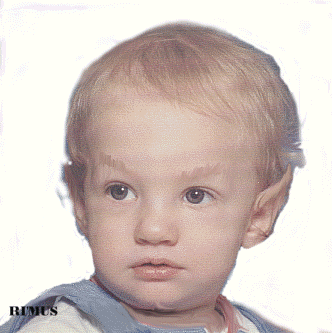
In Rihannsu society, male and female children are equally prized. There is no one person responsible for the care of the children. Rather, the entire household considers themselves to be responsible for each child. Indeed, except for the obvious role of child bearing, the Rihannsu have no seperate, specific male or female societal roles as do some other similar species. All household members (including the servants) are responsible to see that the children are cared for, educated, and protected. While raising Rihannsu children is truly a community effort, the formal eduction of the children is usually done under the strict auspices of a highly learned tutor in a nursery or schoolroom setting. The position of tutor to the children of the House is considered an extremely important post and good tutors are held in exceptionally high esteem by the Rihannsu. All children receive basic education in the sciences, the arts, literature, and mandatory military service. They are tutored in the proper forms of address for adults, equals, superiors, and servants. The important Rihannsuconcepts of honor, respect, duty, strength, service to the Empire, and self sacrifice are engrained within our children at a very early age. Prior to the age of testability, all children are extensively trained and prepared to their maximum potential. Children who have successfully completed the d'sora ceremony* are the joy of every Rihannsu household.
**Editor's note (d'sora ceremony): In the face of the ever present shortages of food and supplies, the ancient Rihannsu had to make certain difficult decisions. Succinctly put, preferential treatment was given to those individuals with the best chance for survival in the harsh environment. That is, only the smartest, healthiest, and the strongest could survive. It was customary for the ill and the infirm to simply walk away from the settlements, to elect to die with honor rather than strain the meager resources of the people to care for individuals who could not contribute to the greater good. In this time period also were the beginnings of the d'sora ceremony... the testing of the young child for intelligence, strength, and adaptability. This test traditionally occurs at age five for both male and female children. Those children who pass the test are feted to a glorious ceremony of feasting, dressed in magnificent ceremonial robes, and honored at a special religious service at which time they are given their family name and officially entered into the historical records of the family. Those who do not pass (who are genetically or intellectually inferior, who are ill or infirm in any way) are quietly, painlessly put to death and never spoken of again.
THE ARTS
Artistic abilities show the gentle side of the Rihannsu personality,balancing the fierce warrior ethic with the sensitivity of an artist. Sculpting, pottery, and carving are the most popular media, as Rihannsu prefer to work in three-dimensional forms, although painting is a reasonably common artistic activity. In addition to the visual arts, the Rihannsu enjoy writing, literature, poetry, and drama. The current popular mode of expression is formal, honorific, and somewhat melancholy.
Rh'vaurek is a well-known, world-class sculptor, whose biomorphic, surrealist style is anything but formal. Forgoing literal interpretation, his evocative figures seem to emerge out of their materials, harmonizing with natural textures and streaks, whether it be wood, stone, or bronze. "Truth to the material" is a cornerstone of his work.
Theatre
In theatre, D'Roush's newest play "Ael" is quite provocative; his method of breaking the fourth wall is masterful, and his words have an interpretive depth that some find intriguing.
MUSIC
Traditional ceremonial folk music and song feature the traditional Teelisa aHavrannsu [Songs of the Exodus, the tradition Romulan epic song-saga], and the traditional folk ballad "Au'lagga Jhu" ("A Flower for an Angel") is a particular favorite. Much of the current trend tends toward more modern forms in a celebratory mode. Many of the younger artists are breaking free of the more traditional forms finding new avenues of expression, including the emerging Teel'liam [jazz], which features the use of the dhaolasendt [a sliding brass instrument] and the d'pairhein Teel'liam [a keyboard instrument specifically designed for jazz]. Of course, always popular are the soothing harmonies of the classical sonata de' Renaissance works for the Rihannsu lute, in both the traditional harp (harder to play) and the modern, newer harps (though more precisely tuned, their composite metals do not produce the same timbre as wood).
LEISURE ACTIVITIES
Most Rihannsu play games such as d'elo, which is a game of stones and sticks that can be traced back to an ancient Vulcan, and lhi, a game of wits and riddles. There are arena games, where athletes, both men and women, show their prowess with various Rihannsu weapons and fighting techniques. Rihannsu also relish nature and enjoy the beauty of it, and most are avid hikers and enjoy the typical outdoor activities.
DRESS
Military duty uniforms are the standard dress while on active duty. On ceremonial occasions, hfihar cloaks can be worn to display family affiliation. These long, sweeping cloaks bear the insignia and colors of the hfihar whose name you bear. Those that do not belong to a Great or Minor House may not wear a cloak. Civilian clothing may be worn when off duty.Traditional Rihannsu clothing is primarily designed to be functional. While little attention is paid to clothing beyond what it may describe officially about the wearer, unusual or overly ornate clothing may lower others' opinions of the citizen wearing them. It is best to dress conservatively for more formal situations and to be cautious in your fashion selection so as not to cause embarrassment.
FOOD AND DRINK
There are certain traditions that must be adhered to when hosting a meeting with another Rihannsu. One is the serving of a beverage to guests when they first enter the house or quarters. This beverage may be one of four: ale, water, wine or citrus (juice). Ale is cheap, and is seldom served unless a social gathering requires cheap spirits. Water is the most common and not terribly expensive, but still showing courtesy to your guest. Wine is more expensive and is used when entertaining special guests. Citrus juice is the most expensive, and is reserved for very special occasions. It is the guest's privilege to take the first drink, out of respect to the host for serving the beverage. After the guest finishes his or her first drink, the host may follow. When dining, the guest is always first. Viinerine [traditional dishes] are always preferred; however, the latest food trend is the import of Terran recipes, including the popular "ice cream"-- although these foreign tastes are not for everyone.

Please keep in mind that Rihannsu culture and society is actually extremely complex with specific rules according to one's inherited social position, military status, age, etc. It is practically impossible to present even a cursory overview of the society as a whole in such a limited space. If you would like additional information related to Rihannsu culture or history, please see the links page or email grendelsbayne@hotmail.com
NOBLE HOUSES
HISTORY
Main