 I walked yet more
And thought of days
I spent upon the shore,
Of chasing waves
And skipping rocks,
Of carving driftwood
Left by tides.
Inlet Outlet: Poetry of Ninilchik, Alaska
Sometimes I write poems about Ninilchik, Alaska, where I grew up. Or about Cook Inlet whose waters wash the beaches of Ninilchik. Here are some poems from my chapbook, Inlet Outlet: Poetry of Ninilchik, Alaska, copyright 1994, by Wayne Leman:
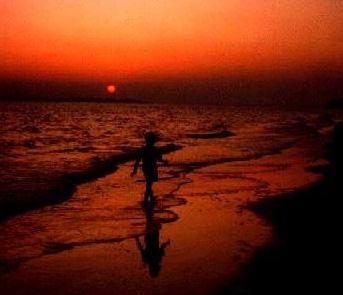
Along the Sand
I walked upon the sands of time.
They told me tales I chose to hear,
Of storms now past
And restful calm,
Of passing ships
And sailors' dreams,
Of fishers' work from morn till dusk,
Then rest when toil was done.
I walked yet more
And thought of days
I spent upon the shore,
Of chasing waves
And skipping rocks,
Of carving driftwood
Left by tides.
I think of storms, within, without,
And restful calm,
Of waves that beat upon the sand,
Yet made it firm,
So footing could come easier,
Of tides that left their water marks
With motley mix of flotsam scars,
Mixed memories, left upon the shore,
Yet washed by waves,
Like life,
To be renewed,
And onward trod.
Come walk with me upon the sand,
And tell me what you hear.
As I walk upon the sand
I hear the silence of our God
And then amidst the raging storm
I ponder whence this song has come
And yes, the sand doth bear the mark
Here is what a friend heard:
As I Walk Upon the Sand
Copyright © 2000 by George A. Goolde
I hear the roar of tempests past
Of crashing waves
Of tearing winds
Of ships in trouble sore.
No answer in the storm.
I hear the groans of failing ships
Whose crews do nought but mourn.
I hear a softer, gentler, song,
A song not driven by the wind
Nor tossed upon the shore.
A song that floats above the sand
A song that sings forevermore.
It speaks not of the tempest strong
It echoes not the crashing waves
But some sweet peaceful song
Of love, of quiet joy,
A comfort born beyond the sound
Of raging storm and crashing waves.
Of tempest, wind, and trouble sure.
But o’er it all the peaceful vest
Of cleansing water, quiet rest.
Some crash upon the shore
Leaving a frothy foam.
Others only tiptoe in
And smile upon the beach.
But each no matter how it comes
Goes back out again,
And what's been written on the sand
Will always be erased.
Sea Gull
Mr. Sea gull,
You're maligned,
You're called a scavenger.
It doesn't sound too noble.
I've always thought you
Rather grand,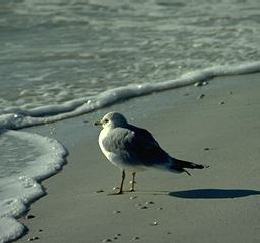
Bright white and gray
With sleek, trim lines.
And some say you and yours
Raise a raucous sound.
But why can surf
Mixed with your cries
Sound like a symphony?
Sure,
It's melancholy key
You're singing,
Lone or massed.
But melancholy key's
Like life,
Honest beauty
All its own.
So soar along,
Keep singing, too.
I like your style,
My friend.
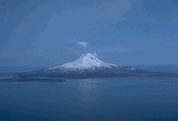
Sunset On Redoubt Summer's
Sun beams gather heaven's light
At twenty 'til seven the players enter the stage, Stretch out the single bass strings The conductors move each truck with its boat On the water the outboards are started The first notes are ties--to a buoy The musicians swing into action, Staccato percussion's persistent, There's a short rest before the next movement. Yes, it's partly a game, yet it's music
(Note: commercial fishing in Cook Inlet is usually
Maternally servicing Humpy soup is sure good, The winter is long, cold, and dark, Someone would get it, We salted our silvers, Kings always taste good, 'Cuz it tells us that Spring's here?
I'm a net, stretched across the water, I walk upon the sand I'd like to get you, Mr. Clam, Sometimes I barely grab your neck O.K.,
PaletteShimmering,
Fluorescent
purple
pink
green
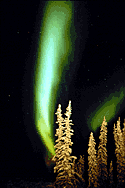 white
Waltzing
the northern sky,
Aurora Borealis.
Western sky on fire
Settling down for sleep
Upon the mountains,
Inlet sunset.
Magenta
Fields ablaze,
white
Waltzing
the northern sky,
Aurora Borealis.
Western sky on fire
Settling down for sleep
Upon the mountains,
Inlet sunset.
Magenta
Fields ablaze,
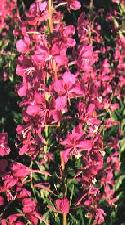 Fireweed.
White kites
Sailing along
The shore,
Sea gulls.
Silky
Soft
White heads,
Alaska cotton.
Fragile
Tiny
Timid
blue
Fireweed.
White kites
Sailing along
The shore,
Sea gulls.
Silky
Soft
White heads,
Alaska cotton.
Fragile
Tiny
Timid
blue
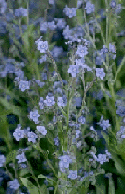 forget-me-nots.
Gray
Shadowy haze
Spooky silhouettes,
Winter twilight.
Sunny turquoise,
Sullen gray,
Moody changes,
Inlet waters.
Palette free,
to enjoy and remember.
forget-me-nots.
Gray
Shadowy haze
Spooky silhouettes,
Winter twilight.
Sunny turquoise,
Sullen gray,
Moody changes,
Inlet waters.
Palette free,
to enjoy and remember.
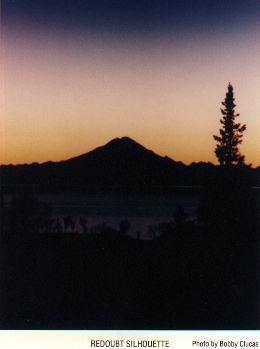
(The
following poem is a cinquain.
Mt. Redoubt is one of two volcanic
mountains, each 10,000+ feet in
height, which dominate the mountain
chain on the west side of Cook Inlet.)
setting sun slides
swiftly down the slippery
sleepy silhouette of midnight Mount
Redoubt
Angels Play
and pull our gaze toward Augustine.
Rays have baked a golden afternoon.
Angels, after morning's work, meet
to slide a slanted slippery beam
and laugh the joy of cherubs, soon
cavorting at the sun beam's feet.
Each conductor and each hired hand,
As the rumble of boom truck engines
Says it's time to start up the band.
>From the winch lifts to each waiting boat.
Get in tune as those boom strings are tightened
We'll soon hear the music's first note.
Toward the Inlet where the main movements play.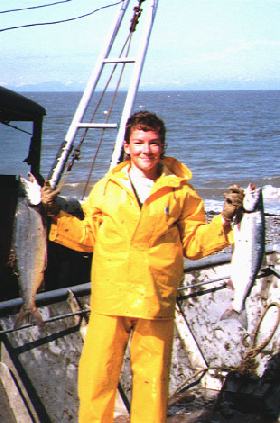
Each team is playing the same piece
That is played each fishing day.
And conductors' hands start to steer
Each player to his place for fishing music--
The Symphony at Seven, we're about to hear.
Then next comes the first rest of the show
As the final seconds are counted
And the conductor says, "Let's go!"
All intent on playing their parts
To have a successful performance
As this water music starts.
As the lead weights beat out the pace--
What's become of the symphony's tempo?
To be honest, it's really a race.
It's repeated, as the last movement, the same,
Each net in its turn, each note in its place,
Until the last tie of the net-setting game.
If you look around on the sea
And watch each fisherman playing in concert
At Seven, the Symphony.
from 7 a.m. to 7 p.m. on Mondays and Fridays.)
Company Boat
__ boats lined up
__ behind her
__ like ducklings
Hungrily gobbling
__ Inlet salmon
__ to her briny belly
Tenderly.
The Best Tasting Fish of the Year
And reds are wonderful smoked.
But the best tasting fish of the year
Is the first king shared around the town.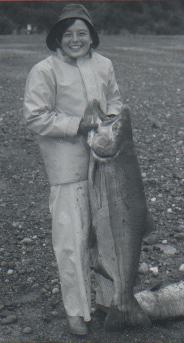
We wonder if Spring's gonna come.
But we know that it's here
When we share around the town,
That best tasting fish of the year.
That first king of the year.
Then family to family would share.
No matter how small
The pieces would be,
It would be the best fish of the year.
And dried some dogs,
And pickled fish sure tasted good,
But nothing could beat
That best taste of all,
The first king shared around the town.
Any time of the year,
But why, tell me, why,
Does it taste best of all,
That first one that's shared around the town?
'Cuz it's eaten so fresh?
Maybe so--
But you know what it could be,
Why it tastes best?
'Cuz it's shared all around the town.
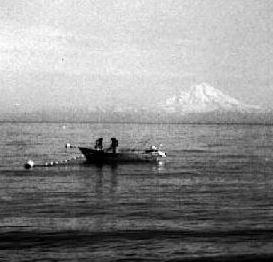 I'm a Gillnet
not the kind that drifts along with the tide,
or the limp kind that fishes in a river eddy,
but the kind I know best,
firmly tied by ropes anchored years ago,
stretched tight by forces beyond my control,
six hours of flood, then six of ebb,
flood, ebb, flood, ebb,
always the same,
waiting to gill the unsuspecting swimmer,
which is like a good thought
caught while its meat is still firm.
(Note: the following poem is about
digging for razor clams which are abundant on Ninilchik beaches. Here's
a picture of some of my relatives, good Ninilchik clam diggers.)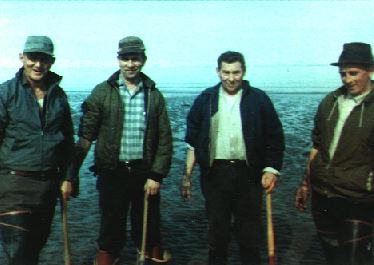
The Clam and I
Looking for your sign.
Your telltale dimple
Gives you away.
But you don't want me to.
I plunge my shovel in the ground--
You hurry right away.
And then it's tug-o-war.
You really stick your neck out
Trying to get away.
I'm not sure I'd stick my neck out either
If I were in your shoes.
No shoes, you say,
But you've got a big foot
Which I'd like to put in my mouth.
        Stale Mate

At the end of a long fishing day
it's sure good to call it quits.
Your muscles are sore,
there's fish scales on your arms,
and your face is sunburned some more.

Your honey has cooked a good supper,
now the sleepy feeling's coming on fast.
So by the end of the bed
you pull off your boots,
and park them far away from your head,

for the boots have the odor of fishing,
gurry, salt water, and sweat.
You crawl into bed and reach for your wife,
but there's something she hasn't said yet.

And it won't be easy to learn it
since she doesn't want to tell;
She appreciates your work for the family,
but the secret is you smell.

You try to hug your honey,
but she moves away from your grasp.
You wonder what's wrong--
Have you lost wooing power?
No, but what she hasn't yet said
as you lie on the bed
is that you clearly need a shower.

Finally you ask, "What's the matter?"
She hesitates a little then sighs,
"I do love you, honey,
But, yes, there is something:
Right now there's a fishy aroma
and you smell just like a king
  (salmon, of course)."

"So sorry," you mutter as you're drifting
off to sleep, not on the sea,
"I couldn't smell my own fishing odor--
I guess it's a part of me.

Just be glad I'm a man of the ocean
when you're contemplating my smell,
fish scales on my arm,
my boots by the bed,
I could be employed on a farm."
The
notes
throb
with
in
your
leath
ered
case,
beg
ging to be re
leased by calloused
fingers, and closed
eyes,.................. and a
face...............contor
ted in............ the ec
stasy of music in
the bones of centu
ries, churches, and
cowboys, and ripple
to our ears from the
strings of your
guitar.
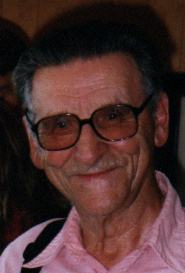
[Note: Anyone who has ever watched my father,
Nick Leman, play the guitar is struck by the
intensity with which he involves himself in
his music, an intensity especially shown in
his facial expressions. Let no one ever say
that music is only music. It can move the soul
(and, often the sole), the face, and more.]
There's something warm
        and safe
        and comfortable
About family,
The way our Heavenly Father
        intended it to be.

He loves His children,
        cares for them,
        and shelters everyone.
They each belong,
He throws none out,
Nor tells them,
        "Out! Be gone!"

We fathers, mothers,
Here on earth,
Do fail at times, we know.
Not always do we give the best soil
For family to grow.

Sometimes there's even children
Who are cast away to cry,
Not knowing who their family is,
They feel just like they die.

Or others know who family is,
Yet still rejected are,
Because of shame,
        or pride,
        or power--
It leaves an awful scar.

Oh, would that we
Like God could be,
A loving Father, yes,
Accepting each who comes to Him,
Even if in a mess.
He asks not our pedigree,
        our color,
        talents,
        worth.
He simply puts His arms around
Each who fits by birth.

It may be hard,
But may we try,
A family to be,
To tell each one
That does belong,
"Welcome, sit with me!"
Love,
was it bad?
It might have been,
it was not to be spoken.
And those who showed
their love
were laughed at.
Culture broken!
Broken,
unspoken
love.
Broken?
Break out!
It need not stay the same
forever.
I'll risk the word,
though heard,
and act
the fact,
I love.
Protected by water moat
Accessible by boat
Isolated from the mainland,
  alone.


If large enough for habitation
Island attracts a population
  which chooses
  isolation.

Separate from mainland humanity
With its ritual profanity
  and other human foibles
Island provides escape,
  and loneliness.
Easter Bread
Every Easter Grandma made
Easter bread
She called it Kulich
In her Russian language
And Kulich is
What we still call it.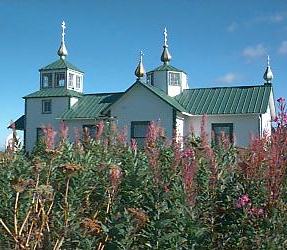
Easter was a special time
And Grandma shared her Kulich
Special bread
Recipe handed down for
Hundreds of years.
Grandma's Kulich had
Different shapes and sizes
Baked in coffee cans
Or other kinds of cans.
Some Kulich had raisins
Some did not
But it was always so good,
Heavy bread,
Special Easter taste,
Good frosting,
Candies on top.
Why do we eat Kulich?
For 1000 years of
Russian history
We have known of One
Who called Himself
The Living Bread.
For 1000 years we have said
At Easter,
Xristos vo skres!
Christ has risen!
For 1000 years we have responded,
Vayestinu vo skres!
Indeed, He has risen!
The Living Bread died
At Easter time
But He came alive again
And for 1000 years
We have said those words
Shared by millions
Around the world,
Christ has risen!
Indeed, He has risen!
Our Easter bread has risen, too,
And we eat it joyfully
As we celebrate
The Living Bread.
Copyright © 1993 by Wayne Leman
(Visit Bobbie Oskolkoff's site for
a
pretty
version of this Easter Bread poem,
with background music.)
Kulich recipes